
Beauty Unlocked
Use This Free App to Clean up Your Mac’s Menu Bar Instead of Paying for Bartender
Jun
Note: This article synthesizes current information from official app pages, Apple documentation, GitHub repositories, Mac app directories, and trusted Mac-focused publications. Source links are intentionally omitted for clean web publishing.
Your Mac’s menu bar starts innocently enough. A Wi-Fi icon here. A battery indicator there. Maybe the clock, Spotlight, Control Center, and one polite little app icon. Then one day you look up and the right side of your screen resembles a tiny airport departure board: VPN, cloud backup, clipboard manager, password manager, meeting app, screen recorder, keyboard tool, weather widget, caffeine app, note app, and three icons you swear you did not invite.
For years, Bartender has been the best-known solution for Mac menu bar clutter. It hides, rearranges, and reveals menu bar items so your desktop looks calm instead of caffeinated. But Bartender is paid software, and after ownership changes raised concerns among some long-time users, many Mac owners began looking for a free Bartender alternative that still feels polished, modern, and safe to use.
The answer for many people is Ice, a free, open-source Mac menu bar manager that lets you hide and reveal menu bar icons without pulling out your credit card. It is simple enough for casual users, powerful enough for productivity nerds, and exactly the kind of utility Apple should probably have built into macOS by now. Until that happens, Ice is the little frozen miracle your crowded menu bar deserves.
Why Your Mac Menu Bar Gets So Messy
The macOS menu bar is one of the most useful parts of the Mac interface. It gives you quick access to system controls, app menus, status icons, and background utilities. The problem is that nearly every productivity app wants to live there. Your VPN wants a spot. Your calendar helper wants a spot. Your cloud storage app wants a spot. Even apps you open once a month sometimes decide they deserve oceanfront property at the top of your screen.
On desktop monitors, this may not feel urgent. On a MacBook, especially a newer MacBook Pro with a notch, space is much tighter. Once the icons stretch too far, some of them can disappear behind the notch or get pushed off-screen by app menus on the left. That turns the menu bar from a productivity shortcut into a tiny scavenger hunt.
macOS does give you some built-in controls. You can adjust certain Apple system icons in System Settings, decide whether items like Wi-Fi or Bluetooth appear in the menu bar, and automatically hide the entire menu bar. That helps, but only up to a point. Apple’s settings do not give you complete control over third-party menu bar icons. If you want to hide specific app icons and reveal them only when needed, you still need a dedicated menu bar management app.
What Is Ice?
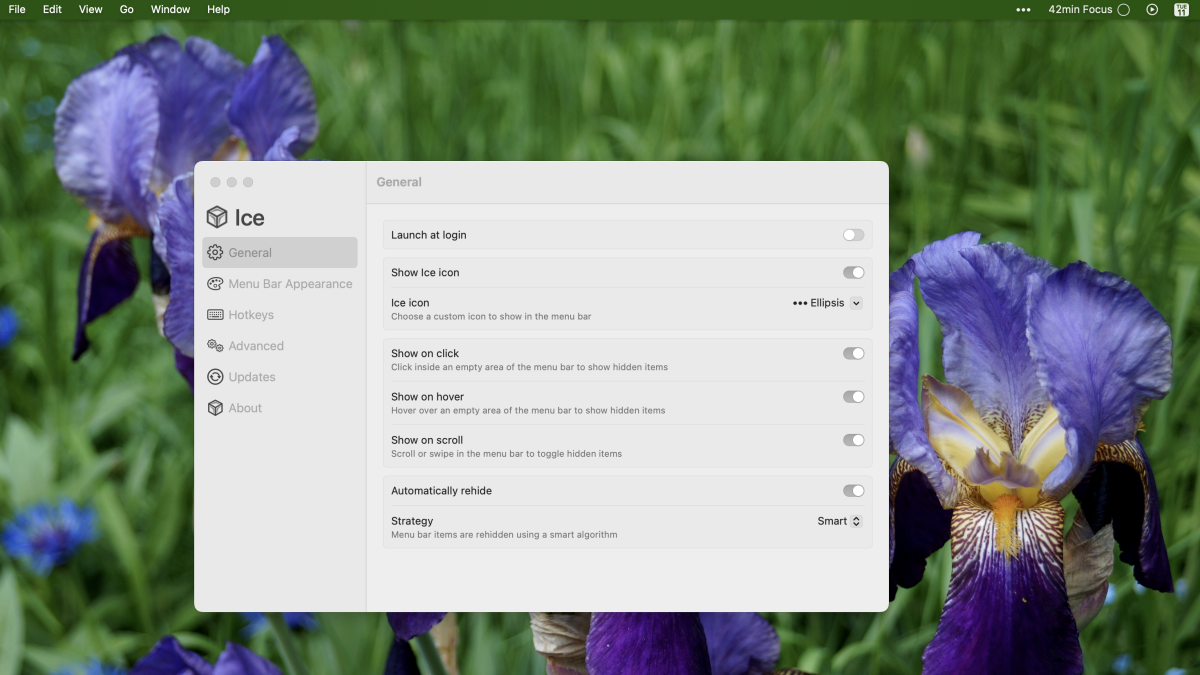
Ice is a free, open-source menu bar manager for macOS. Its main job is straightforward: it lets you hide menu bar items and bring them back on demand. Instead of letting every background app scream for attention at once, Ice creates a cleaner layout where only your most important icons remain visible.
The appeal is not just that Ice is free. Free Mac utilities are everywhere, and some of them feel like they were assembled in a digital garage during a thunderstorm. Ice feels more thoughtful. It includes a drag-and-drop layout interface, support for showing hidden items below the menu bar, appearance customization, and convenient reveal options. It is also actively developed, which matters because macOS changes can break small utilities faster than you can say “major update available.”
Because Ice is open source, users can inspect its code, follow development, and see what is changing over time. That transparency is a major reason it has become popular among people looking for a Bartender replacement. For a tool that sits in the background and interacts with your desktop constantly, trust is not a luxury feature. It is the whole sandwich.
Ice vs. Bartender: Do You Really Need to Pay?
Bartender is still a powerful Mac utility. It has been around for years, offers deep customization, supports triggers, search, hotkeys, and advanced workflows, and has a mature feature set. If you already own Bartender and it works perfectly for you, there is no urgent need to panic-delete it from your Mac while wearing a tinfoil hat.
But for many users, Bartender may be more app than they actually need. The average Mac owner does not require complex automation for every menu bar icon. Most people simply want to hide the clutter and reveal it when needed. Ice handles that core job beautifully, and it does so without a paid license.
Choose Ice if:
- You want a free Bartender alternative for Mac.
- You mainly need to hide and show menu bar icons.
- You prefer open-source software.
- You use a MacBook and want a cleaner screen.
- You do not need advanced trigger-based workflows.
Stick with Bartender if:
- You already paid for it and rely on its advanced features.
- You need complex rules, triggers, or menu bar item search.
- You prefer a long-established commercial app with premium support.
- You do not mind paying for a highly polished utility.
The practical takeaway is simple: Ice is the better first choice for most people today because it solves the main problem for free. Bartender remains the premium option for users who truly need its deeper feature set.
How Ice Cleans Up Your Menu Bar
Ice works by dividing your menu bar into visible and hidden sections. You decide which icons deserve permanent visibility and which ones should politely retreat into the background. For example, you might keep the clock, battery, Wi-Fi, and calendar visible while hiding Dropbox, VPN, keyboard tools, update helpers, and meeting apps until you need them.
Once configured, Ice gives your menu bar breathing room. The result is subtle but satisfying. Your Mac looks less crowded. Screenshots look cleaner. Screen sharing feels less embarrassing. You no longer have to explain why there are 22 tiny symbols next to your clock, including one that may or may not be from an app you uninstalled in 2021.
Key Features Worth Using
Hide and show menu bar items: This is the main event. Ice lets you hide less important icons and reveal them when necessary.
Show hidden items below the menu bar: This is especially useful on smaller screens and notched MacBooks. Instead of cramming every icon into the same narrow strip, Ice can display hidden items in a separate area.
Drag-and-drop organization: You can arrange items visually, which is much easier than digging through settings menus like a raccoon in a filing cabinet.
Appearance customization: Ice lets you adjust the look of the menu bar, helping it blend with your desktop style.
Open-source transparency: Since Ice is hosted publicly, users can review development activity and updates. That is comforting for anyone cautious about background utilities.
How to Install Ice on Your Mac
Installing Ice is straightforward. You can download it from the official Ice website or from its GitHub release page. Since it is a Mac utility that manages menu bar behavior, macOS may ask you to grant permissions during setup. Read the prompts carefully and approve only what is required for the features you plan to use.
Basic Setup Steps
- Download the latest Ice release from the official source.
- Open the downloaded file and move Ice to your Applications folder.
- Launch Ice.
- Follow macOS permission prompts if they appear.
- Drag menu bar icons into your preferred visible and hidden positions.
- Test the reveal behavior and adjust until it feels natural.
- Enable launch at login if you want Ice to start automatically.
Spend five minutes organizing your icons the first time. That small setup investment pays off every day. A good rule is to keep only the icons you check constantly. Everything else can go into the hidden section. If an icon is only useful when something goes wrong, it does not need front-row seats.
The Best Menu Bar Setup for Most Mac Users
The perfect menu bar setup depends on how you use your Mac, but most people benefit from a simple three-tier system.
Always Visible
Keep essentials visible: clock, battery, Wi-Fi, Control Center, Focus, calendar, or any app you truly check several times a day. If you use a password manager constantly, that might stay visible too.
Hidden but Easy to Reach
Hide apps that matter but do not need constant attention: cloud storage, VPN, clipboard manager, backup utilities, audio tools, screen recording apps, and update helpers. They are still available, just not waving at you all day.
Remove Completely
Some icons do not need to exist at all. Many apps have settings that let you disable their menu bar icon. Before hiding everything with Ice, open each app’s preferences and turn off icons you never use. A clean menu bar starts with fewer squatters.
What About Hidden Bar, Vanilla, and Other Free Alternatives?
Ice is not the only free Mac menu bar cleaner. Hidden Bar is another popular open-source option that lets you hide icons behind a simple divider. It is lightweight, available through the Mac App Store and GitHub, and works well for people who want the simplest possible tool.
Vanilla is another long-running menu bar utility. It offers a simple way to hide icons and has been recommended by Mac users for years. However, some users may find its free version more limited compared with newer alternatives.
So why choose Ice? Because it strikes the best balance between simplicity, modern features, and cost. Hidden Bar is great if you want basic hiding. Bartender is great if you want maximum power. Ice sits in the sweet spot: free, capable, modern, and friendly enough that you do not need a three-hour onboarding seminar.
Is Ice Safe to Use?
No app should be trusted blindly, especially one that runs in the background. That said, Ice has several trust signals working in its favor. It is open source, which means its code is available for public review. It is distributed through official project channels, and it has an active development presence. Those are good signs.
Still, basic Mac safety rules apply. Download Ice only from official sources. Avoid random mirror sites unless you know exactly what you are doing. Keep the app updated. Review macOS permission prompts instead of clicking through them like you are speed-running a cookie banner. If you ever stop using Ice, uninstall it properly and remove any permissions you granted.
Why a Clean Menu Bar Actually Matters
It is easy to dismiss menu bar clutter as cosmetic, but visual noise affects how your workspace feels. A crowded menu bar makes your Mac look busier than it is. It pulls attention upward. It makes important icons harder to find. During video calls or screen sharing, it can also reveal more about your workflow than you intended.
A clean menu bar creates a calmer desktop. You do not have to be a minimalist monk who owns one chair and drinks water from a ceramic bowl to appreciate that. You just need a screen that is not constantly shouting small symbolic nonsense at you.
For writers, developers, designers, students, and remote workers, the benefit is immediate. The fewer distractions competing for attention, the easier it is to focus on the actual work. Ice does not make your Mac faster in the benchmark sense, but it can make your workspace feel faster because you spend less time scanning clutter.
Common Mistakes When Using Menu Bar Managers
Hiding Too Much
Do not hide icons you genuinely need to monitor, such as a VPN connection if your work depends on it. A clean menu bar should not make important information harder to see.
Never Customizing the Defaults
Installing Ice is only step one. The real benefit comes from deciding what belongs where. If you never organize the icons, you have simply added one more icon to the chaos parade.
Ignoring App Settings
Some apps let you disable their menu bar icon entirely. Do that first. Ice is best used for icons you occasionally need, not for icons from apps you forgot existed.
Downloading from Unofficial Sources
Utilities that interact with macOS should come from trustworthy places. Stick with the developer’s official website or GitHub repository.
Real-World Experience: Living With Ice Instead of Bartender
After setting up Ice on a daily-use MacBook, the first thing you notice is how boring the menu bar becomes. That sounds like an insult, but it is actually the highest compliment. A good menu bar should be boring. It should show the essentials, stay out of the way, and stop looking like a drawer full of spare cables.
The best setup I found was to keep only the icons I use several times a day: battery, Wi-Fi, Control Center, date and time, and one calendar utility. Everything else went into Ice’s hidden section. That included cloud backup, VPN, clipboard history, screen capture tools, audio utilities, and a few background apps that are useful but not exactly VIP guests.
The difference during screen sharing was immediate. Before using Ice, sharing my screen in meetings always came with a tiny moment of menu bar self-consciousness. Why is that icon there? Is that app still running? Will someone ask what that weird little symbol means? After cleaning things up, the top of the screen looked intentional. Not empty. Not sterile. Just tidy.
Ice also helped with screenshots. Anyone who writes tutorials, bug reports, documentation, or social posts knows the pain of taking a screenshot and realizing the menu bar is full of distracting icons. Yes, you can crop screenshots, but cropping every image because your menu bar looks like a software flea market gets old quickly. With Ice, screenshots come out cleaner by default.
On a notched MacBook, the hidden-item behavior is especially valuable. The notch makes menu bar space feel weirdly precious. Without a manager, icons can vanish or become awkward to access when the active app has many menus. Ice reduces that friction by letting less important icons stay hidden until summoned. It feels less like wrestling macOS and more like quietly correcting it.
The open-source angle also changes the emotional math. With a paid app, especially one that has gone through ownership changes, users naturally wonder who controls it, what changed, and whether the software still aligns with their expectations. With Ice, the project is more transparent. That does not mean every user will read the code. Most people will not, because most people have hobbies. But the fact that the code can be inspected gives the app a trust advantage.
Performance was pleasantly uneventful. Ice did not feel heavy, did not interrupt normal work, and did not turn the Mac into a tiny space heater. Once configured, it faded into the background, which is exactly what a utility like this should do. The highest praise for a menu bar manager is that you forget it exists until you need it.
The only real adjustment is building a habit around hidden icons. For the first day, you may instinctively look for an icon that is no longer visible. That is normal. After a short while, the new layout becomes muscle memory. You know where the hidden section is, you reveal it when needed, and the rest of the time your Mac looks cleaner.
Would power users still prefer Bartender? Some will. Bartender has advanced features that Ice may not fully replace for every workflow. But for the average Mac user who simply wants to clean up the menu bar without paying, Ice is more than good enough. It is the rare free app that does not feel like a compromise. It feels like the obvious first thing to try.
Final Verdict: Ice Is the Free Bartender Alternative Most Mac Users Should Try First
If your Mac menu bar is overflowing, do not assume you need to pay for Bartender right away. Bartender is powerful, but Ice covers the most important use case for free: hiding menu bar clutter and bringing it back when needed. It is open source, modern, actively developed, and easy to set up.
For most people, that makes Ice the best free app to clean up a Mac menu bar. It will not write your emails, fix your sleep schedule, or stop you from opening 47 browser tabs. But it will make the top of your screen calmer, cleaner, and less chaotic. Sometimes that is enough to make your Mac feel new again.
SEO Tags

