
Makeup
How to Reset the Time and Resynchronize the Chimes on an Antique Mantel Clock
Jun
An antique mantel clock is not just a timekeeper. It is a tiny mechanical orchestra in a wooden case, and when everything is working properly, it ticks, strikes, and chimes with the confidence of a well-dressed butler. But when the time is wrong and the chimes are out of sync, that same charming heirloom can suddenly act like it has been drinking espresso in a thunderstorm.
The good news is that many antique and mechanical mantel clock problems can be corrected at home with patience, a steady hand, and a healthy respect for old gears. The bad news? If you rush the process, twist the wrong hand, or force a stubborn movement, you can turn a simple reset into an expensive trip to the clock repair shop. Nobody wants a repair bill that chimes louder than the clock.
This guide explains how to reset the time on an antique mantel clock, how to resynchronize the chimes, what to do when the clock strikes the wrong hour, and when to stop fiddling and call a professional. Whether your clock plays Westminster chimes, strikes on the hour and half-hour, or simply dings with antique dignity, the basic principles are similar: move slowly, listen carefully, and let the mechanism finish what it started.
Before You Touch the Hands: Know What Kind of Mantel Clock You Have
Most antique mantel clocks are mechanical clocks, meaning they run on wound springs instead of batteries. Some have a pendulum. Others use a balance wheel. Some strike only the hour. Some strike the hour and half-hour. More elaborate models play quarter-hour chimes, such as Westminster, Whittington, or St. Michael melodies. The more musical the clock, the more patient you need to be.
Look at the dial. If your clock has two winding holes, one usually powers the timekeeping train and the other powers the strike. If it has three winding holes, the center often powers timekeeping, one side powers the hour strike, and the other powers the quarter-hour chime. The exact arrangement can vary by maker, so do not assume your clock is identical to your neighbor’s clock, even if both clocks look equally serious and Victorian.
Also check for a chime selector or silent lever. Some mantel clocks have a small lever near the dial or inside the case that lets you choose a melody or silence the chimes. Make sure this lever is not stuck between settings. A chime lever halfway between “silent” and “melody” can make a clock behave like a confused church bell.
Tools and Setup for a Safe Clock Reset
You do not need a full watchmaker’s bench to reset a mantel clock. In most cases, you need only the clock key, a soft cloth, good lighting, and enough quiet to hear the chime sequence. If you need to remove or adjust a hand, a small pair of needle-nose pliers may help, but use them carefully and only on the hand bushing or nut, never on delicate painted surfaces.
Place the mantel clock on a stable, level surface. If it has a pendulum, make sure the pendulum is properly hung and swinging freely. The tick-tock should sound even: tick…tock…tick…tock. If it sounds like tick-tock…tick-tock with a limp, the clock may be out of beat. A clock that is out of beat may stop, run poorly, or lose time even after you reset it.
Before you begin, fully wind the clock using smooth, controlled turns. Stop when the spring resists and will not wind further. Never let the key snap backward in your hand. That little kickback is not the clock being playful; it can damage the winding arbor or hurt your fingers.
Step-by-Step: How to Reset the Time on an Antique Mantel Clock
Step 1: Use a Reliable Time Source
Start with the correct time. A phone, computer, or official time website works well. If you are setting a display piece that is mostly decorative, exact seconds do not matter. But if you want your mantel clock to keep honest time, compare it to a reliable source and write down whether it gains or loses time over several days.
Step 2: Move the Minute Hand, Not the Hour Hand
For ordinary time setting, use the long minute hand. On most mechanical mantel clocks, the hour hand moves automatically as the minute hand advances. Do not grab the hour hand and spin it around to set the time unless you are specifically correcting the hour strike count. The hour hand is often friction-fit, and while it can sometimes be repositioned, it is not meant to be used casually like a volume knob.
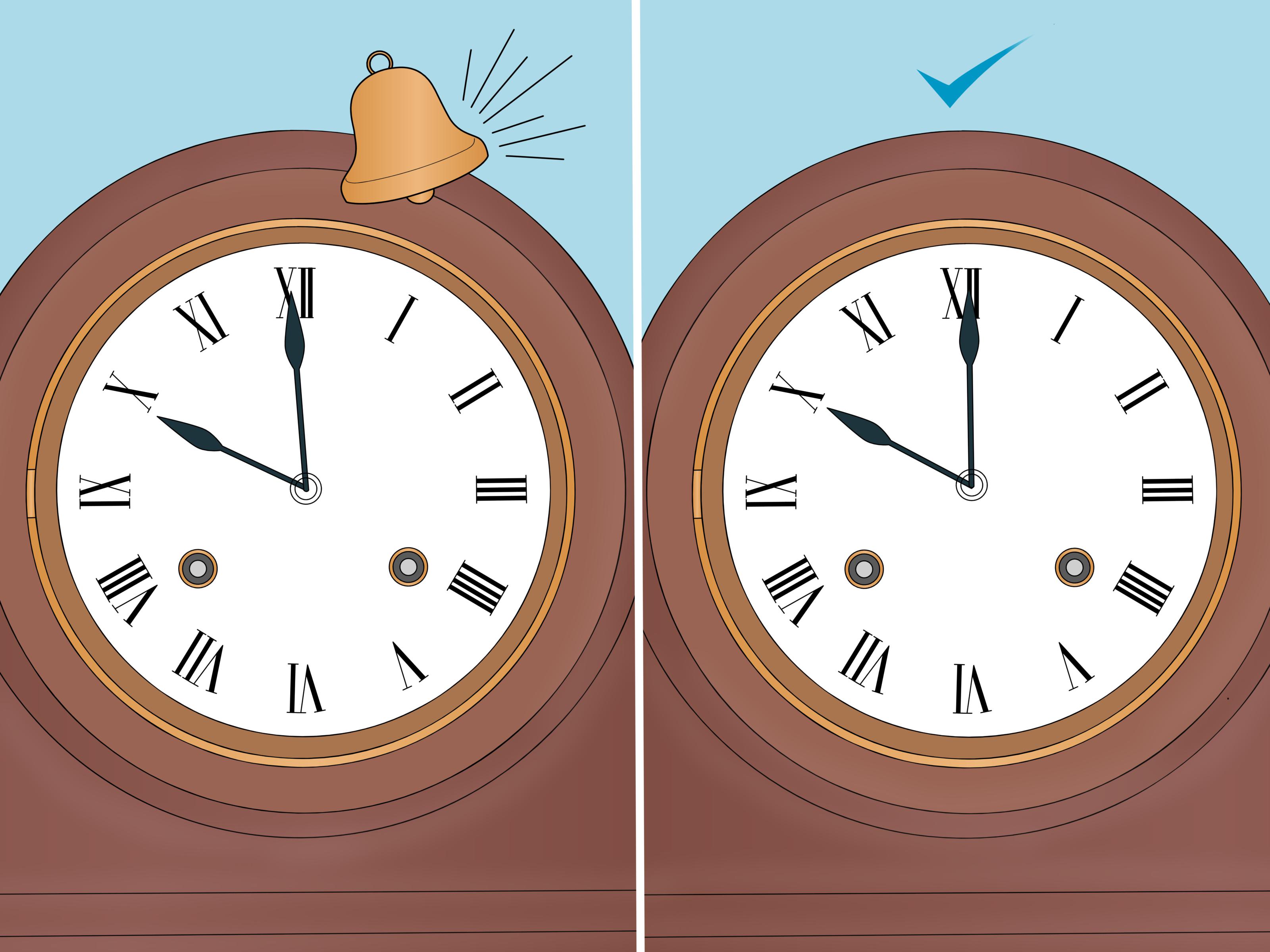
For many antique clocks, the safest method is to move the minute hand clockwise. Move it slowly. When you reach a chime or strike point, stop and let the clock finish. If your clock strikes at the half-hour, stop at 6. If it strikes the hour, stop at 12. If it plays quarter-hour chimes, stop at 3, 6, 9, and 12. Let the entire sequence play before moving again.
Step 3: Do Not Rush Through the Chimes
This is where many owners get into trouble. They move the minute hand from 2:10 to 8:45 in one dramatic swoop, then wonder why the chimes sound like they are announcing lunchtime in a haunted hotel. Mechanical chime and strike trains need time to complete their cycles. If you push the hands while the clock is chiming, you may interrupt the sequence and create more confusion.
Move the minute hand gently to the next chime point. Pause. Listen. Wait until everything stops. Then continue. It may take several minutes to set a clock forward by several hours, but antique clocks reward patience. They were made in an age when people still waited for bread to rise and letters to arrive by horse. Your clock is not impressed by your Wi-Fi speed.
Step 4: Avoid Moving the Hands Backward Unless the Clock Allows It
Some modern mechanical clocks can safely be set by moving the minute hand counterclockwise. However, many antique mantel clocks should not be moved backward past the hour or half-hour points. If you feel resistance, stop immediately. Never force the hand. Resistance is the clock’s polite way of saying, “Please do not break my 100-year-old insides.”
If the clock needs to be set backward for daylight saving time or a time correction, the safest antique-clock method is often to stop the clock and restart it when the real time catches up. For example, if the clock reads 3:00 but it should read 2:00, stop the pendulum or let the clock run down briefly, then restart it at the correct time. This is slower, but safer.
How to Resynchronize Mantel Clock Chimes
Chime synchronization depends on what is wrong. The clock may be playing the right melody at the wrong quarter. It may be striking five times when the hands show 8:00. It may chime a few minutes early or late. Each problem has a different fix, so diagnose before adjusting.
Problem 1: The Clock Chimes the Wrong Quarter
If a Westminster-style mantel clock plays the wrong quarter-hour sequence, let it run for one to two hours before you adjust anything. Many mechanical chime movements are designed to self-correct after running through a full cycle. In plain English: the clock may know it is confused and may fix itself if you stop interrupting it.
Set the time with the minute hand, stop at every quarter, and allow every chime to finish. Then let the clock run. If the chime sequence corrects itself within an hour or two, congratulationsyou have repaired the clock using the advanced technical method known as “leaving it alone.”
Problem 2: The Clock Strikes the Wrong Hour
If the clock face shows 7:00 but the clock strikes four times, the strike train and the hour hand are not in agreement. On many mantel clocks, this is corrected by moving the hour hand to match the number of strikes.
Here is the common method: slowly move the minute hand clockwise until the clock reaches the hour and begins striking. Count the strikes. If it strikes four times, gently move the short hour hand to 4. Hold the hand close to the center while moving it so you do not bend it. Once the hour hand matches the strike count, use the minute hand to advance the clock to the correct time, pausing at each strike or chime point.
This adjustment changes what the dial shows; it does not change the internal strike sequence. Think of it like straightening a picture frame. The wall did not move. The frame was just crooked.
Problem 3: The Chime Plays a Few Minutes Early or Late
If your clock chimes at 12:57 instead of 1:00, or at 3:17 instead of 3:15, the minute hand may be misaligned on its shaft. If the difference is only a minute, many owners choose to live with it. Antique clocks are allowed a little personality. If the chime is more than a minute or two off, the minute hand may need to be removed and adjusted on its bushing.
This is a more delicate repair. You usually remove the small hand nut, lift off the minute hand, adjust the bushing slightly, reinstall the hand, and test again. Make very small changes. A tiny adjustment at the center can shift the hand several minutes at the dial. If the hand is fragile, painted, rusted, or very tight, stop and call a clock repair professional.
A Simple Strike Synchronization Method
For many hour-and-half-hour antique mantel clocks, this basic synchronization process works well:
- Wind the clock fully, especially the strike side.
- Move the minute hand clockwise to 12 and let the clock strike.
- Count the number of strikes.
- Move the hour hand gently to the number the clock just struck.
- Advance the minute hand clockwise to the correct time.
- Pause at 6 and 12, or at every quarter-hour if the clock has quarter chimes.
- Let the clock run for at least one full hour before making further changes.
If the clock has a strike-release wire beneath the dial or inside the case, you may be able to advance the strike sequence manually without moving the hands through several hours. However, this varies by movement. Do not pull random wires inside an antique clock unless you know what they do. That is not troubleshooting; that is mechanical roulette.
How to Reset a Westminster Chime Mantel Clock
Westminster chime clocks are more complex because they play different portions of the melody at each quarter-hour. Typically, the clock plays a short phrase at quarter past, a longer phrase at half past, more at quarter to, and the full melody followed by the hour strike at the hour.
To reset a Westminster mantel clock, move the minute hand clockwise to the next quarter-hour and stop. Let the chime finish completely. Continue to the next quarter, stop again, and listen. Repeat this until you reach the correct time. If the quarter sequence sounds wrong, let the clock run for at least an hour. Many Westminster movements will correct themselves after cycling through the quarters.
If the clock strikes the wrong hour after the full Westminster melody, correct the hour hand to match the strike count. Then advance the minute hand to the real time, pausing at every quarter. It feels slow, but this is the proper rhythm. The clock is doing choreography; you are not supposed to shove it across the dance floor.
Common Mistakes That Make Chime Problems Worse
Forcing the Minute Hand
If the hand resists, stop. Forcing the minute hand can damage gears, levers, or the hand itself. Resistance often means the chime or strike mechanism is preparing to activate.
Moving the Hour Hand for Regular Time Setting
The hour hand should only be moved when correcting an hour-strike mismatch. For normal time setting, use the minute hand.
Changing the Chime Selector While the Clock Is Chiming
If your clock has multiple melodies, change the selector only when the clock is quiet. Moving the selector during a chime can jam or confuse the mechanism.
Expecting Atomic Clock Accuracy
An antique mantel clock may gain or lose a few minutes per week. That does not mean it is broken. It means it is mechanical, old, and still trying its bestfrankly, relatable.
How to Regulate the Time After Resetting
Once the chimes are synchronized, check timekeeping over several days. Do not regulate the clock after only ten minutes of observation. Mechanical clocks need time to settle into their normal rhythm.
If the clock has a pendulum, the nut beneath the pendulum bob usually controls speed. Move the bob up to make the clock run faster and down to make it run slower. Use tiny adjustments. A partial turn can make a noticeable difference. If your mantel clock uses a balance wheel, look for a regulator marked “F” and “S” or “Fast” and “Slow.” Again, small adjustments are the secret. This is not a jar of pickles; do not crank it aggressively.
When to Call a Professional Clock Repairer
Call a professional if the clock will not run after winding, the hands are stuck, the chime sounds weak or uneven, the movement grinds, the springs feel unsafe, or the clock repeatedly falls out of sync after being corrected. Also seek help if the clock is a valuable family heirloom, a rare maker, or a museum-quality piece.
Old clock oils dry into sticky residue over time. Dust and worn pivots can create drag. A clock that has not been serviced in decades may need cleaning, oiling, bushings, or deeper repair. Spraying household oil into the movement is not a shortcut. It is how good clocks go to the emergency room.
Real-World Experiences: What Antique Mantel Clocks Teach You
The first experience most people have with an antique mantel clock is surprise. You think you are buying or inheriting a decorative object, then suddenly you are negotiating with a brass machine that has opinions. One owner sets the clock after moving it across the living room, only to discover that it now strikes nine at six o’clock. Another winds all three arbors proudly, then panics when the Westminster chime starts halfway through its melody. These moments are common, and they usually do not mean disaster. They mean the clock needs calm handling.
A useful lesson is to listen before adjusting. Many people immediately move the hands when the chime sounds wrong. Better practice is to let the clock finish, count what it does, and write it down. For example: “At 12, it struck 8.” That note tells you the hour hand probably needs to be moved to 8 before the clock is advanced to the correct time. Without listening, you are guessing. With listening, you are diagnosing.
Another experience is learning that old clocks dislike being relocated. A mantel clock that ran beautifully on one shelf may stop on another because the new surface is not level or because the pendulum is slightly out of beat. The owner may blame the winding key, the moon, or the cat. The actual problem may be a wobbly table. A thin shim under one side of the case can sometimes restore an even tick. It is humbling when a century-old clock is fixed by a piece of cardboard.
Many owners also discover that “silent” levers are sneaky. A clock may refuse to chime because the selector is not fully engaged, not because the chime train is broken. Before assuming the worst, check the lever position, make sure the clock is wound, and confirm the hands are not touching each other. Simple checks save money and embarrassment, both of which are worth preserving.
The biggest personal lesson from resetting antique mantel clocks is that patience is not optional. You cannot bully a mechanical clock into cooperation. You advance the minute hand, wait for the chime, let the strike finish, and continue. The process feels slow at first, but it becomes part of the charm. In a world where everything updates instantly, an antique mantel clock makes you stand still and listen. That is annoying for the first five minutes and oddly peaceful after that.
Finally, owners learn when to stop. If a hand will not move, a spring feels dangerous, or the clock keeps losing synchronization, the best repair is restraint. Antique clocks survive because someone cared enough not to force them. Treat the clock like a respected elder: guide it gently, listen when it complains, and do not make it do gymnastics after midnight.
Conclusion
Resetting the time and resynchronizing the chimes on an antique mantel clock is mostly a matter of patience, observation, and gentle handling. Move the minute hand slowly, pause at each chime or strike point, let the mechanism finish, and correct the hour hand only when the strike count does not match the dial. If the clock has quarter-hour chimes, give it time to self-correct before reaching for tools.
An antique mantel clock is a mechanical heirloom, not a disposable gadget. When you treat it carefully, it rewards you with warm ticking, elegant chimes, and the small daily pleasure of hearing time announced by something with actual gears. And if it occasionally acts dramatic? Well, after a hundred years, it has earned a little flair.
SEO Tags

