
Hair Care
When to Aerate the Lawn: Your Questions, Answered
Jul
A lawn can look perfectly respectable on top while the soil underneath is packed tighter than a suitcase five minutes before checkout. Grass may still be green, but compacted soil can restrict root development, slow water infiltration, increase runoff, and make it harder for oxygen and nutrients to reach the root zone.
Core aeration helps correct those problems by removing small plugs of turf and soil. However, timing matters. Aerating during the wrong season, when the ground is saturated, or while the grass is already fighting heat and drought can create more stress than improvement.
The best time to aerate a lawn depends primarily on whether the yard contains cool-season or warm-season grass. Soil moisture, grass health, local climate, weed-control treatments, and plans for overseeding also affect the decision. Here is how to choose the right aeration window without turning a simple lawn project into a weekend-long soil excavation festival.
What Does Lawn Aeration Actually Do?
Lawn aeration is a cultivation practice that creates openings through the turf and into the soil. The most effective method for compacted residential lawns is usually core aeration, also called plug aeration. A core aerator uses hollow tines to remove cylinders of soil, grass, and thatch.
Those openings can improve the movement of water and air into the root zone while giving roots more room to expand. Core aeration also brings soil and its microorganisms to the surface, where they can help break down accumulated organic material in the thatch layer. University extension guidance generally favors machines that remove plugs rather than tools that simply punch narrow holes.
Aeration does not magically repair every brown patch, eliminate every weed, or persuade the neighbor’s dog to respect property lines. It is most useful when compaction, poor infiltration, heavy traffic, or thatch buildup is contributing to weak turf.
When Is the Best Time to Aerate the Lawn?
The simple rule is to aerate while the grass is actively growing and has enough favorable weather ahead to recover. That means fall for most cool-season lawns and late spring through early summer for most warm-season lawns.
Best Time for Cool-Season Grass
Cool-season grasses include Kentucky bluegrass, tall fescue, fine fescue, and perennial ryegrass. They grow most vigorously during the cooler conditions of spring and fall and often slow down during hot summer weather.
For these lawns, late summer through early fall is usually the best aeration period. In many northern and transition-zone locations, that means approximately late August through September, although local weather and elevation can shift the schedule.
Fall aeration gives cool-season grass time to recover under milder temperatures. It also pairs conveniently with overseeding because seeds can fall into the openings and make better contact with the soil. Several extension programs identify late summer or early fall as the preferred window for aeration, renovation, and recovery of cool-season turf.
Early spring can serve as a secondary window when compaction is severe. However, routine spring aeration may encourage weed germination and can disrupt pre-emergent herbicide barriers. When the lawn can reasonably wait, fall is normally the safer choice for cool-season grass.
Best Time for Warm-Season Grass
Warm-season grasses include bermudagrass, zoysiagrass, St. Augustinegrass, centipedegrass, bahiagrass, and carpetgrass. These grasses green up as temperatures rise and produce their strongest growth during late spring and summer.
Aerate warm-season lawns after they have fully emerged from dormancy and are growing vigorously. Late spring through early summer is commonly ideal. Depending on location and grass species, the practical window may extend from May into August.
Avoid aerating warm-season grass in winter, during early spring dormancy, or close to the beginning of fall dormancy. Grass that is barely growing cannot quickly fill the openings or repair mechanical injury. Guidance from southeastern extension programs consistently recommends aerating warm-season turf during active growth.
How Can You Tell Whether Your Lawn Needs Aeration?
Not every lawn needs annual aeration. A lightly used yard growing in loose, well-drained soil may go several years without it. A clay lawn that hosts children, pets, cookouts, delivery traffic, and an annual family football game may need considerably more attention.
Look for several common warning signs:
- Water puddles or runs off instead of soaking into the soil.
- The ground feels unusually hard when dry.
- Grass grows thin in frequently traveled areas.
- Roots remain shallow even with appropriate watering.
- The lawn dries quickly or struggles during moderate heat.
- Thatch has accumulated between the green blades and soil.
- The property was recently built and heavy equipment crossed the yard.
A simple screwdriver test can provide a quick clue. Push a long screwdriver into moderately moist soil. If it enters several inches with reasonable pressure, severe compaction may not be present. If it barely penetrates, or requires the dramatic determination normally reserved for opening a stubborn pickle jar, the area may benefit from core aeration. Clemson Extension recommends this type of probing as a practical way to evaluate soil resistance.
What Soil Conditions Are Best for Aerating?
The soil should be moist but not waterlogged. Slightly moist ground allows hollow tines to penetrate deeply and remove clean plugs. Bone-dry soil can be too hard for effective penetration, while saturated soil smears, clumps, and compacts under the weight of equipment.
If rainfall has been scarce, water the lawn thoroughly one or two days before aerating. Test the soil on the scheduled day. It should hold together enough to form a plug but should not stick heavily to shoes or machinery.
Avoid aerating immediately after a downpour. Operating a heavy machine on saturated soil can create ruts and additional compactionthe landscaping equivalent of cleaning a window with a muddy sponge. Extension specialists emphasize adequate moisture while cautioning against working wet soil.
How Often Should a Lawn Be Aerated?
Frequency should be based on lawn conditions rather than a rigid calendar.
Aerate Once a Year When:
- The lawn grows in heavy clay soil.
- Children or pets use the yard frequently.
- Vehicles or equipment occasionally cross the turf.
- The grass struggles with recurring compaction.
- The lawn has a moderate thatch problem.
Aerate Twice a Year When:
Severely compacted clay soil may initially benefit from both spring and fall treatment for cool-season turf, provided the grass is healthy and weather conditions support recovery. High-use recreational areas may also require more frequent cultivation. Missouri and Michigan State extension guidance notes that heavily compacted lawns may need more than one treatment before conditions improve.
Aerate Every Two or Three Years When:
A lawn in loamy or sandy soil with limited foot traffic may need aeration only occasionally. If water infiltrates normally, roots are developing well, and a soil probe enters easily, annual machine rental may be unnecessary.
Should You Use a Core Aerator or Spike Aerator?
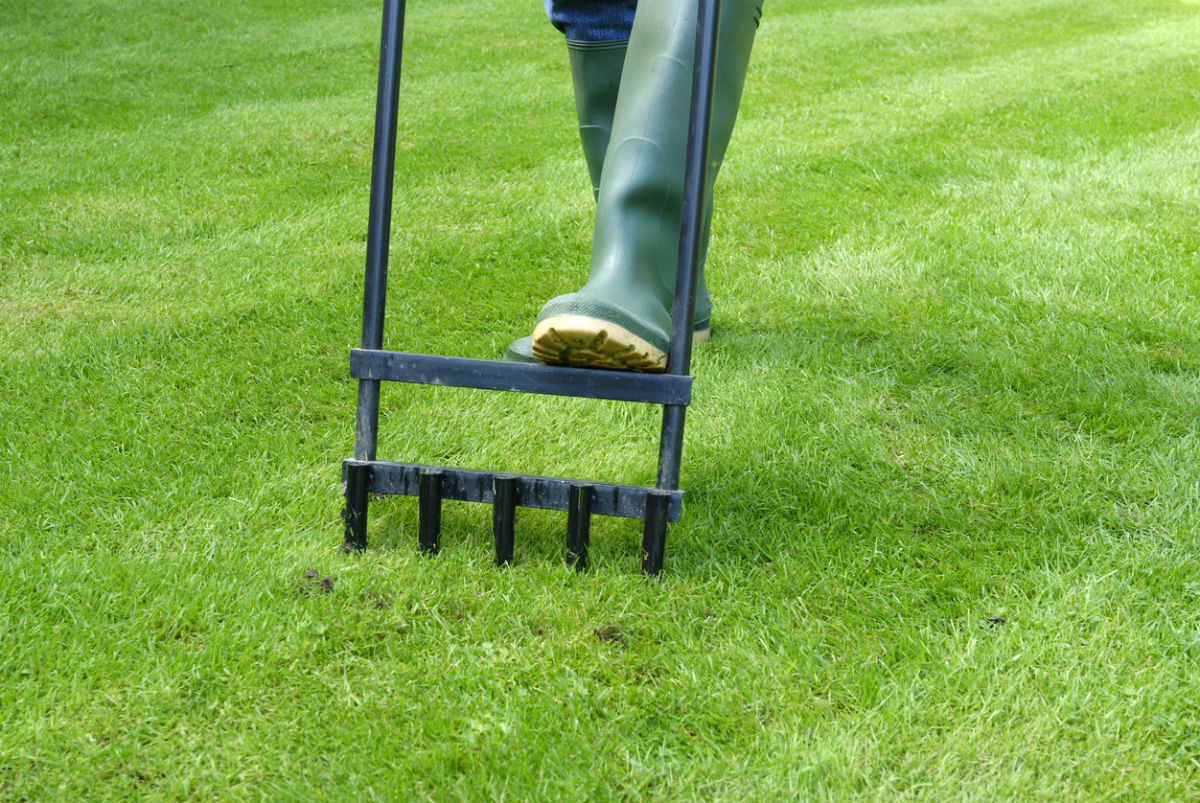
Choose a core aerator when the goal is to relieve meaningful compaction. Hollow tines remove soil rather than merely pushing it sideways. Multiple passes can create a useful concentration of openings and reduce soil density near the surface.
Spike aerators, aerator sandals, and solid-tine tools make holes but do not remove soil. They may provide temporary surface openings in mildly firm ground, but they can compress soil around each hole. NC State guidance specifically discourages spike aeration as a substitute for proper coring on compacted lawns.
For a small problem area, a manual core aerator may be adequate. For an entire lawn, a powered machine is far more efficient. Aerator sandals sound delightfully simple until the wearer discovers that lawn improvement has unexpectedly become leg day.
How Should You Prepare Before Aerating?
Preparation improves both safety and results.
- Mow normally. Do not scalp the lawn, but trimming excessive growth can make the area easier to cover.
- Water if necessary. Moistening dry soil beforehand helps the tines penetrate.
- Mark sprinkler heads. Also identify shallow irrigation pipes, landscape lighting wires, septic components, cable lines, and invisible pet fencing.
- Remove debris. Pick up branches, toys, hoses, and stones that could interfere with the machine.
- Plan several passes. One quick trip may leave the holes too widely spaced to provide much benefit.
For compacted areas, travel in two or more directions. Research-based extension recommendations often call for enough passes to create holes approximately two to three inches apart. The exact number of passes depends on tine spacing and machine design.
What Should You Do With the Soil Plugs?
Leave them on the lawn. The plugs may look as though a committee of tiny moles held a convention, but they are useful. As they dry and break apart, the soil filters back into the turf and can contribute microorganisms that help decompose thatch.
Rain, irrigation, mowing, and ordinary foot traffic usually break the cores down within a few days to several weeks. You can mow after the plugs have dried or lightly drag a mat over the lawn to distribute them. Removing every plug is unnecessary and discards part of the benefit of core aeration.
Can You Aerate and Overseed at the Same Time?
Yes. Aeration and overseeding are often performed together, especially on cool-season lawns in fall. The openings expose soil, improve seed-to-soil contact, and create protected spaces where some seeds can germinate.
A practical order is:
- Mow the existing turf.
- Core aerate in multiple directions.
- Spread an appropriate grass seed.
- Apply fertilizer only when recommended by a soil test and local lawn calendar.
- Water lightly and consistently until seedlings become established.
Aeration is helpful, but it does not guarantee uniform seeding by itself. Seed still needs direct soil contact, moisture, suitable temperatures, and enough time to mature before extreme weather. Late-summer overseeding is widely recommended for northern cool-season lawns because warm soil supports germination while cooler air reduces stress.
Can You Aerate After Applying Pre-Emergent Herbicide?
Be cautious. Pre-emergent herbicides form a treatment zone near the soil surface that suppresses germinating weeds. Cultivation may disturb that zone and create openings where weeds can emerge.
If crabgrass prevention is a priority, coordinate aeration with the herbicide schedule. Cool-season lawns are commonly aerated in fall, reducing conflict with spring pre-emergent treatments. For warm-season turf, consult the product label and local extension calendar before combining cultivation and weed control. Clemson notes that soil-disturbing practices may need to be postponed after a pre-emergent application.
When Should You Not Aerate a Lawn?
Delay aeration under the following conditions:
- The grass is dormant.
- The lawn is experiencing severe drought or heat stress.
- The soil is saturated or muddy.
- The ground is frozen.
- The lawn was recently treated with a product whose label restricts cultivation.
- The grass is diseased, newly installed, or too weak to recover.
- Extreme heat or frost is expected before recovery can occur.
Cool-season grass should generally not be core aerated during midsummer heat. Warm-season grass should not be aerated during winter dormancy. The correct moment is not simply when the rental store has a machine available; it is when the grass is actively growing and soil conditions are workable.
Does Aeration Replace Dethatching?
No. Aeration and dethatching solve related but different problems.
Aeration primarily relieves soil compaction and creates channels into the root zone. It can gradually help manage moderate thatch by mixing soil with organic material.
Dethatching mechanically removes a substantial layer of undecomposed stems, roots, and plant material. It is more disruptive and may be needed when the thatch layer becomes excessive. A layer greater than about one-half inch is commonly used as a signal to investigate corrective treatment, although grass species and lawn conditions matter.
Grass clippings are not normally the main cause of thatch. Properly sized clippings break down quickly. Excessive nitrogen, overwatering, compacted soil, and vigorous spreading grass species are more likely contributors.
Practical Lawn-Aeration Experiences and Lessons
Homeowners commonly discover that the difference between a successful aeration project and an exhausting one is not the machineit is the preparation. Consider a typical cool-season lawn with compacted clay soil, thin grass near the patio, and water that runs toward the driveway after irrigation.
The first instinct may be to rent an aerator on the first pleasant Saturday in spring. The grass is green, the hardware store is offering a weekend special, and motivation has appeared without warning. Yet spring may not be the best choice. If crabgrass pre-emergent was recently applied, aggressive cultivation can interfere with that treatment. Waiting until early fall often allows the homeowner to aerate, overseed, and repair summer damage in one coordinated project.
Another common lesson concerns soil moisture. On very dry ground, a machine may bounce across the surface and remove short, unimpressive plugs. The operator makes repeated passes, becomes increasingly suspicious of the equipment, and eventually develops strong opinions about rental-store maintenance. Watering deeply a day or two beforehand can completely change the outcome. The same machine may then remove longer, cleaner cores with less effort.
The opposite mistake is working immediately after heavy rain. Saturated soil sticks inside hollow tines, tires create ruts, and turning the machine can peel back sections of turf. A lawn that was supposed to receive better drainage instead receives decorative wheel tracks. Waiting until the soil is moist rather than muddy prevents much of this damage.
Coverage also matters. A single pass often looks productive because plugs are visible, but the holes may be too far apart to significantly improve a compacted area. Crossing the lawn in a second direction creates denser coverage. High-traffic spots near gates, playsets, sidewalks, and patios may deserve additional passes.
Marking underground objects is another lesson people tend to remember foreverusually after learning it once. Sprinkler heads, shallow irrigation tubing, low-voltage lighting wire, and invisible dog-fence cable should be clearly flagged. A core aerator is remarkably impartial about what it punctures.
After aeration, the lawn can look temporarily untidy. Soil plugs scatter across the surface, holes are visible, and family members may ask whether the yard has developed a mysterious rodent problem. Leaving the cores in place is usually the right move. As they dry, mowing and rainfall gradually break them apart. Within a couple of weeks, they become far less noticeable.
The most satisfying results are often gradual rather than theatrical. Aeration does not typically produce an overnight transformation. Over time, however, water may soak in more evenly, compacted paths may support thicker turf, and overseeded areas may establish more successfully. Repeating the process during the proper growing season can steadily improve difficult soil.
The broad practical lesson is simple: aerate because the lawn shows a need, not because aeration appeared on a generic seasonal checklist. Match the timing to the grass type, work with moderately moist soil, use a core aerator, make enough passes, and give the turf favorable conditions for recovery. That approach produces better results with fewer surprisesand considerably less shouting at machinery.
Final Answer: When Should You Aerate?
Aerate cool-season lawns in late summer or early fall, when cooler conditions encourage vigorous recovery. Aerate warm-season lawns in late spring or early summer, after the grass is fully green and actively growing. In either case, choose a mild day when the soil is moist but not saturated.
Lawns with clay soil, heavy traffic, poor water infiltration, or recurring compaction may need annual aeration. Less compacted lawns may require it only every few years. Use hollow-tine core equipment, leave the plugs on the surface, and coordinate the job with overseeding, fertilization, and weed-control schedules.
Note: This article provides general lawn-care guidance based on U.S. university extension recommendations. Grass species, climate, soil conditions, and product restrictions vary, so consult your local cooperative extension service when developing a regional maintenance schedule.

