
Makeup
I Found My Happy Place And It’s Made Of Clay
Jun
Some people find peace in yoga studios, mountain cabins, perfectly organized pantries, or that one grocery store aisle where nobody asks them for anything. I found mine in a lump of clay. Not a glamorous lump, either. A slightly sticky, stubborn, dust-producing blob that looked like it had been dug up by a very confused mole. Yet somehow, the moment I pressed my thumbs into it, the world got quieter.
Clay has a funny way of doing that. It does not care about unread emails. It has no opinion about your career timeline. It will not ask whether you have “optimized your personal brand.” Clay simply sits there, earthy and patient, waiting for your hands to begin. Then, before you know it, a pinch becomes a paw, a roll becomes a tail, and a tiny creature with suspiciously dramatic eyebrows is staring back at you like it pays rent.
The idea behind “I Found My Happy Place And It’s Made Of Clay” is more than a cute caption for handmade ceramics. It is a love letter to creativity, small joys, tactile art, and the kind of happiness that does not arrive loudly. It shows up under your fingernails. It settles on your apron. It hides in the curve of a handmade mug, the smile of a clay fox, or the wobbly bowl that somehow becomes your favorite thing in the kitchen.
Why Clay Feels Like Therapy, Even When You’re Just Making a Tiny Bear
Working with clay is one of the rare activities that pulls your attention into the present without demanding that you become a monk, buy incense, or pretend you enjoy sitting perfectly still. Your hands are busy. Your mind has something real to follow. You notice texture, pressure, shape, balance, moisture, and movement. The process becomes a quiet conversation between intention and accident.
Art therapy professionals have long recognized that making art can support emotional expression, stress relief, coping skills, and a sense of control. Clay is especially powerful because it is physical. You can squeeze it, roll it, flatten it, stretch it, carve it, repair it, and start over. That flexibility makes it forgiving in a way life often is not. If a clay rabbit’s ear falls off, nobody calls a meeting. You score it, slip it, attach it again, and maybe decide the rabbit now has “character.”
There is also something deeply satisfying about turning raw material into a finished object. A small clay sculpture begins as nothing more than potential. With time and patience, it becomes a fox in a scarf, a sleepy owl, a mushroom house, a teacup, a charm, or a little dragon who looks like he forgot why he entered the room. That transformation is soothing because it reminds us that progress can be slow, messy, and still completely real.
The Magic of Handmade Clay Art
Handmade clay art has a personality that mass-produced objects rarely capture. A machine can make a perfect cup, but it cannot make a cup that looks like it has a secret. Handmade ceramics carry fingerprints, tiny asymmetries, tool marks, and creative decisions that reveal the maker’s hand. Those details are not flaws; they are the heartbeat of the object.
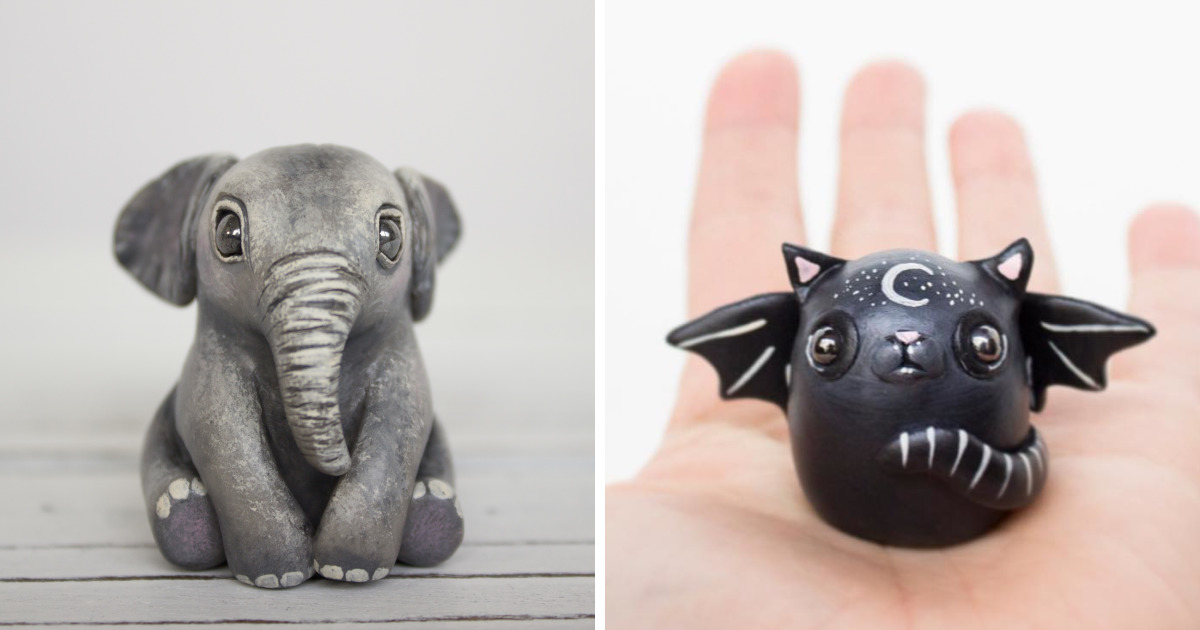
This is why miniature clay animals, polymer clay sculptures, ceramic mugs, and whimsical figurines attract such devoted audiences online. People are not only looking at an object. They are responding to a story. A black bear cub in a winter sweater is not just “decor.” It is a little emotional ambush. A clay elephant with soft eyes can make a tired person smile at 2 a.m. while scrolling through the internet in pajamas they absolutely did not plan to wear all day.
The charm comes from contrast. Clay is earth, dust, and minerals. Yet in skilled hands, it becomes softness, humor, fantasy, and feeling. It can become a creature that looks shy, brave, grumpy, sleepy, royal, confused, or all of the above. That emotional range is what makes clay sculpture so addictive for both artists and collectors.
From Hobby Table to Happy Place
Many artists begin with clay as a hobby. They buy a small block of polymer clay, a few tools, maybe a pasta machine if they are feeling dangerously ambitious, and tell themselves they are “just experimenting.” This is adorable. Clay has heard that before. Soon the dining table is a studio, the kitchen oven has a schedule, and every household object is being evaluated for texture potential. Toothbrush? Tool. Lace? Texture stamp. Bottle cap? Circle cutter. Cat? Supervisor, unfortunately unpaid and unhelpful.
What begins as casual crafting can become a source of identity. For some makers, clay offers a way out of burnout. For others, it becomes a bridge between imagination and income. Online shops, local craft fairs, art markets, and social media have helped clay artists reach people who love objects with personality. A tiny handmade creature can travel farther than its maker ever expected, landing on a desk, bookshelf, windowsill, or bedside table across the country.
The beauty of this creative path is that it does not require permission. You do not need a gallery invitation to begin. You do not need a perfect studio, an expensive kiln, or a dramatic artist statement involving moonlight and existential soup. You need curiosity, patience, materials, and the willingness to make something imperfect enough to teach you something.
Why Polymer Clay Became a Playground for Imagination
Polymer clay has become especially popular among miniature artists because it is accessible, colorful, and wonderfully versatile. Unlike traditional ceramic clay, polymer clay cures in a home oven, making it easier for beginners and home-based artists to experiment. It can be sculpted into jewelry, charms, ornaments, dolls, tiny foods, fantasy creatures, animal figurines, and decorative objects.
It also invites precision. Artists can build tiny noses, feather textures, scales, claws, flowers, buttons, and expressions that are barely larger than a pea. This small scale creates a special kind of intimacy. When someone looks at a miniature clay animal, they lean in. They slow down. They notice. In a world designed to make us scroll faster, that tiny pause feels almost rebellious.
Polymer clay is also friendly to color. Artists can blend shades, layer details, paint surfaces, add gloss, create faux stone, imitate fabric, and build entire miniature worlds. The result is a medium that feels playful but can become astonishingly sophisticated. One artist may use it to make a frog wearing a hat. Another may create museum-worthy jewelry. Both are valid. Honestly, the frog may also deserve a museum.
The Emotional Pull of Tiny Clay Creatures
There is a reason people melt over tiny clay animals. Miniatures invite affection. They make the viewer feel protective, amused, and curious. A small fox curled under a mushroom does not solve world problems, but it does solve one very specific problem: the day was dull, and now it is less dull.
Whimsical clay creatures often combine innocence with humor. Their proportions are slightly exaggerated. Their eyes are expressive. Their poses suggest stories. A hedgehog carrying a teacup looks like it has somewhere important to be. A dragon wrapped in a blanket looks like Monday won. A clay cat with a suspicious stare feels less like a figurine and more like a roommate.
These little sculptures work because they create emotional recognition. We see ourselves in them: sleepy, brave, awkward, dramatic, cozy, hopeful. Handmade clay art gives those feelings a body. It turns moods into objects we can hold.
Clay, Mindfulness, and the Joy of Getting Your Hands Dirty
One of the strongest reasons clay feels like a happy place is that it demands presence. You cannot successfully sculpt while mentally sprinting through tomorrow’s worries. Clay notices. Press too hard and it collapses. Ignore moisture and it cracks. Rush the details and your tiny raccoon suddenly looks like a haunted potato.
That gentle demand for attention creates a natural mindfulness practice. The maker focuses on the next small action: smoothing a seam, shaping a paw, balancing a head, adding texture, softening an edge. The brain gets a break from abstract stress because the hands are solving concrete problems.
There is also relief in the mess. Modern life often rewards polished appearances, clean screens, and instant results. Clay says, “Absolutely not.” Clay is dust, fingerprints, scraps, mistakes, fingerprints again, and one mysterious hair that appears from nowhere. The mess is part of the process. It reminds us that making something meaningful often looks chaotic before it looks beautiful.
How Clay Builds Confidence One Wobbly Object at a Time
Beginners often worry that they are “not artistic.” Clay is a good teacher because it laughs gently at that fear. The first few pieces may be lumpy. The proportions may be strange. A handmade mug may lean as though it has heard shocking news. But every object teaches proportion, patience, and problem-solving.
As skills grow, confidence grows with them. The maker learns how much pressure to use, how long to condition polymer clay, how to avoid fingerprints, how to support delicate parts, how to bake correctly, how to sand, paint, glaze, or seal. Each lesson is practical, but it also carries an emotional message: you can learn difficult things by staying with them.
That is why clay can become more than a hobby. It becomes proof. Proof that hands can learn. Proof that mistakes can be repaired. Proof that imagination can become visible. Proof that joy does not always arrive as a life-changing thunderbolt; sometimes it arrives as a two-inch bear in a sweater.
The Community Around Clay Art
Clay may begin as a solitary activity, but it often leads to community. Pottery studios, ceramics classes, craft markets, online forums, Instagram pages, Etsy shops, and local art groups allow makers to share techniques, encourage one another, and celebrate finished work. A person who once worked quietly at a kitchen table can suddenly find themselves surrounded by other people who understand the emotional importance of the perfect shade of mushroom cap.
This community matters. Creative hobbies become more sustainable when people feel seen. A simple comment like “I love this little owl” can keep an artist going through a week of failed experiments. Artists trade tips about baking temperatures, clay brands, armatures, sealants, photography, packaging, pricing, and the eternal question: why did that white clay pick up every speck of dust in the known universe?
In the handmade world, support is often personal. Buyers are not just purchasing an item; they are encouraging a practice. A small sale can feel like applause. A repeat customer can feel like a tiny miracle wearing sensible shoes. For independent artists, those moments help turn the happy place into a livelihood.
Why Handmade Objects Feel Different in the Home
Handmade clay objects bring warmth into a room because they interrupt perfection. A shelf full of identical decor may look tidy, but one handmade ceramic creature can make the whole space feel alive. It invites conversation. It creates memory. It says someone made this, someone chose this, and someone smiled at this.
That emotional presence is especially strong with functional ceramics. Drinking coffee from a handmade mug feels different from drinking it from a standard office cup that says “Team Synergy 2019.” A handmade mug has weight, texture, and irregularity. It asks to be noticed. It turns a routine into a ritual.
Even decorative clay pieces can become personal anchors. A tiny sculpture on a desk can remind someone to stay playful. A handmade ornament can mark a holiday. A clay animal can become a gift that says, “I saw this and thought of you,” which is one of the nicest sentences an object can translate.
Tips for Finding Your Own Clay Happy Place
Start small and stay curious
You do not need to begin with a full dinnerware set or a dragon the size of a houseplant. Start with simple shapes: beads, charms, tiny animals, small bowls, ornaments, or magnets. Small projects reduce pressure and help you learn the material without declaring war on your own patience.
Choose the right clay for your goals
Polymer clay is great for home sculpting, jewelry, miniatures, and colorful figurines. Air-dry clay works for decorative pieces and beginner experiments, though it is generally less durable. Ceramic clay is ideal for wheel throwing, hand-building, and functional pottery, but it usually requires studio access and firing. Each type has its own personality. Polymer clay is the flexible friend. Ceramic clay is the ancient philosopher. Air-dry clay is the casual weekend guest who may or may not crack if ignored.
Let mistakes become design choices
Clay teaches improvisation. A broken antler can become a flower crown. A crooked bowl can become rustic. A smudged expression can become suspicious charm. Many beloved handmade pieces exist because something went wrong and the artist refused to panic.
Make room for repetition
Skill improves through repetition, not through one magical afternoon. Make ten tiny birds. Make twenty leaves. Make five mugs. Repeat a shape until your hands understand it better than your anxious brain does. Repetition is not boring when it leads to freedom.
What Clay Teaches About Happiness
Clay teaches that happiness can be practical. It can live in routines, tools, shelves, and quiet hours. It can smell faintly of dust and sealant. It can require cleanup. It can ask you to slow down, pay attention, and accept that beauty often needs drying time.
It also teaches that joy does not need to be efficient. Nobody technically needs a tiny handmade raccoon holding a strawberry. And yet, the world is better because it exists. Art does not always have to justify itself with usefulness. Sometimes its usefulness is delight.
That may be the secret of a clay happy place. It is not about escaping life completely. It is about creating a corner of life where imagination is allowed to be serious, play is allowed to be meaningful, and a small handmade object can carry more comfort than anyone expected.
500 More Words of Clay-Covered Experience: Finding Peace in the Process
The first time you sit down with clay, it may not feel magical right away. It may feel awkward. The clay might be too cold, too hard, too soft, or somehow all three, because art materials enjoy comedy. Your fingers may leave dents where you wanted smoothness. The little animal you planned may look less like a fox and more like a potato with trust issues. But after a while, something shifts. You stop trying to force perfection and begin listening to the material.
That is when the experience becomes personal. You learn that clay responds to patience. If you warm it slowly, it softens. If you support delicate parts, they hold. If you rush, the piece remembers. There is a lesson in that. Many of us move through life expecting ourselves to perform instantly, heal instantly, decide instantly, and become instantly impressive. Clay refuses that nonsense. It says, “Slow down. Try again. Use both hands.”
A clay workspace also becomes its own little universe. There are tools arranged in cups, half-finished creatures waiting like a tiny jury, scraps sorted by color, and reference photos of animals making expressions no animal should legally be allowed to make. Time behaves differently there. Fifteen minutes can disappear while shaping ears. An hour can pass while mixing the perfect shade of warm brown. The outside world still exists, but it loses some of its volume.
One of the most satisfying experiences is watching a piece gain personality. At first, it is only a shape. Then the head tilts slightly. The eyes go in. A nose appears. Suddenly, the sculpture has an attitude. It looks nervous, cheerful, sleepy, proud, or mildly offended. That moment feels like a tiny sunrise. You did not just make an object; you invited a character into the room.
Clay also changes the way you notice the world. A walk becomes research. You study the curve of a leaf, the posture of a squirrel, the pattern on a mushroom, the way a dog’s ears fold when it is pretending not to hear the word “bath.” Everyday details become useful. Life becomes a reference library.
There is comfort in finishing, too. Sanding a rough edge, adding a final blush of paint, sealing a surface, or placing a completed sculpture on a shelf creates a small but real sense of accomplishment. The finished piece may be tiny, but the emotional weight is not. It represents attention, care, decisions, corrections, and persistence.
And if the final result is imperfect? Good. Imperfection is where handmade art breathes. A perfectly identical object can be bought anywhere. A slightly lopsided handmade creature can only come from one set of hands on one particular day in one particular mood. That is not a defect. That is evidence of life.
So yes, a happy place can be made of clay. It can be a table, a tray, a studio, a corner of a bedroom, or a few stolen minutes after work. It can be quiet, messy, funny, grounding, and full of creatures that look like they know your secrets. In a noisy world, clay offers a simple invitation: come back to your hands, make something small, and let joy take shape.
Conclusion
“I Found My Happy Place And It’s Made Of Clay” is not just a charming title; it is a reminder that creativity can become a refuge. Clay gives people a way to slow down, express emotion, practice patience, and turn imagination into something visible. Whether it becomes a professional art practice, a weekend hobby, or a private ritual after a long day, working with clay offers a rare combination of play, focus, and emotional release.
The best part is that clay does not ask for perfection. It welcomes beginners, dreamers, overthinkers, collectors, and artists who still occasionally make a creature that looks like a pancake with eyes. It rewards curiosity. It teaches resilience. It turns small moments into keepsakes. And sometimes, when the world feels too loud, a lump of clay becomes exactly what we need: a quiet place to begin again.
Note: This article was written in original American English and synthesized from reputable information about art therapy, craft-based creativity, ceramics, polymer clay, handmade art communities, and the wellness benefits of creative practice.

