
Skincare
How to Understand Logarithms: 5 Steps
Jun
Logarithms have a reputation problem. The word looks like it wandered out of a math textbook wearing a tiny bow tie and asking everyone to “solve for x” before breakfast. But once you understand what a logarithm is really asking, it becomes much friendlier. A logarithm is not a mysterious spell. It is simply a way to answer this question: what exponent do I need?
That is the heart of it. If exponents are the math version of stacking multiplication on top of itself, logarithms are the detective who walks in afterward and asks, “Who did this?” For example, because 23 = 8, we can say log2(8) = 3. Translation: “What power do I raise 2 to in order to get 8?” The answer is 3.
This guide breaks down how to understand logarithms in five practical steps. You will learn the definition of logarithms, how they connect to exponents, how to read log notation, how to use basic logarithm rules, and how logarithms show up in real life. No panic, no math fog machine, and no unnecessary jargon parade.
What Is a Logarithm?
A logarithm is the inverse operation of exponentiation. That means logarithms undo exponents in the same way subtraction undoes addition and division undoes multiplication.
Here is the basic relationship:
If by = x, then logb(x) = y.
In plain English: the logarithm tells you the exponent.
For example:
- 103 = 1000, so log10(1000) = 3.
- 52 = 25, so log5(25) = 2.
- 34 = 81, so log3(81) = 4.
The base is the number being raised to a power. The argument is the number inside the logarithm. The answer is the exponent. Once you keep those three roles straight, logarithms stop looking like a villain and start acting like a calculator with better manners.
Step 1: Translate Every Logarithm Into an Exponent
The fastest way to understand logarithms is to translate them into exponential form. This is the “secret decoder ring” of logs.
The Translation Formula
logb(x) = y means by = x.
Let’s decode a few examples:
- log2(32) = 5 means 25 = 32.
- log4(64) = 3 means 43 = 64.
- log10(100) = 2 means 102 = 100.
Whenever you see a logarithm and feel your brain reaching for the emergency exit, rewrite it as an exponent. Ask: “The base raised to what power gives me the number inside the log?”
For log2(16), ask: “2 raised to what power equals 16?” Since 24 = 16, the answer is 4.
Step 2: Learn the Three Main Parts of Log Notation
Logarithm notation can look strange at first, mostly because it packs several ideas into one compact expression. Take this example:
log3(27) = 3
It has three major parts:
- Base: The small number below the word log. Here, the base is 3.
- Argument: The number inside the parentheses. Here, the argument is 27.
- Value: The answer to the logarithm. Here, the value is 3.
So log3(27) = 3 means “3 raised to the third power gives 27.”
Common Logarithms and Natural Logarithms
Two types of logarithms appear so often that they get special treatment:
- Common logarithm: Written as log(x), usually meaning base 10.
- Natural logarithm: Written as ln(x), meaning base e, where e is approximately 2.718.
Common logs are useful when working with powers of 10, scientific notation, and measurements that span huge ranges. Natural logs are especially important in higher math, calculus, finance, biology, and anything involving continuous growth or decay. In other words, log is the friendly neighborhood base-10 log, while ln is the elegant cousin who shows up in calculus wearing a scarf.
Step 3: Understand Logarithms as “Counting Multiplications”
Another helpful way to think about logarithms is this: a logarithm counts how many times you multiply by the base to reach a number.
Suppose you want to understand log2(8). Start with 1 and multiply by 2 until you get 8:
- 1 × 2 = 2
- 2 × 2 = 4
- 4 × 2 = 8
You multiplied by 2 three times, so log2(8) = 3.
This idea becomes even more useful when the answer is not a whole number. For example, log10(1000) = 3, because 10 × 10 × 10 = 1000. But log10(500) is between 2 and 3, because 500 is between 100 and 1000. You do not need to know the exact decimal immediately to understand the scale. The logarithm tells you where a number lives between powers of the base.
Why This Matters
Logarithms are excellent at handling big ranges. Instead of comparing 10, 100, 1,000, 10,000, and 100,000 as giant jumps, logs let you compare them as 1, 2, 3, 4, and 5. That is much easier on the eyes, the brain, and any poor spreadsheet trying to make a readable chart.
Step 4: Use the Basic Logarithm Rules
Logarithm rules are not random tricks. They come from exponent rules. Since logs undo exponents, their rules mirror how exponents behave.
Product Rule
logb(MN) = logb(M) + logb(N)
A logarithm of a product becomes a sum of logarithms. For example:
log2(8 × 4) = log2(8) + log2(4)
Since log2(8) = 3 and log2(4) = 2, the answer is 5. That matches log2(32) = 5.
Quotient Rule
logb(M/N) = logb(M) – logb(N)
A logarithm of a quotient becomes a difference. For example:
log10(1000/10) = log10(1000) – log10(10)
That gives 3 – 1 = 2, which matches log10(100) = 2.
Power Rule
logb(Mp) = p logb(M)
This rule lets you move an exponent down in front of the log. It is especially useful when solving equations where the variable is trapped in the exponent, banging on the glass like it wants to escape.
For example:
log2(82) = 2 log2(8) = 2 × 3 = 6
And since 82 = 64, this agrees with log2(64) = 6.
Change-of-Base Formula
Most calculators have buttons for log and ln, but not always for every base. That is where the change-of-base formula saves the day:
logb(x) = log(x) / log(b)
You can also use natural logs:
logb(x) = ln(x) / ln(b)
For example, to estimate log3(20), calculate:
log(20) / log(3)
This gives about 2.727, meaning 3 must be raised to a little more than 2.7 to reach 20.
Step 5: Connect Logarithms to Real Life
Logarithms are not just classroom decorations. They appear anywhere numbers grow, shrink, or vary across huge ranges.
Earthquake Magnitude
Earthquake magnitude uses a logarithmic idea. A one-unit increase in magnitude represents a tenfold increase in measured wave amplitude. That means a magnitude 6 earthquake is not just “a little bigger” than a magnitude 5. It is much larger in measured amplitude. Logarithms help compress enormous differences into manageable numbers.
pH Scale
The pH scale is also logarithmic. A difference of one pH unit corresponds to a tenfold difference in hydrogen ion concentration. That is why a liquid with pH 3 is much more acidic than one with pH 4. The numbers look close, but chemically speaking, they are not casual neighbors waving across the fence.
Sound and Decibels
Sound intensity is commonly measured using decibels, a logarithmic unit. This helps represent huge differences in sound power without writing enormous ratios. A whisper, a conversation, a lawn mower, and a jet engine cover a wide range of intensity, and logarithms make that range easier to compare.
Money, Growth, and Time
Logarithms are useful in finance because they help answer questions involving compound growth. For example: “How long will it take an investment to double?” That is a logarithm question hiding in a money jacket. If something grows by a fixed percentage each year, logs can help solve for time.
How to Solve a Basic Logarithm Problem
Let’s solve this problem:
log2(x) = 6
Step one: rewrite it as an exponent.
26 = x
Step two: calculate.
64 = x
So the answer is x = 64.
Now try a slightly different one:
log5(125) = x
Ask: “5 raised to what power equals 125?” Since 53 = 125, the answer is x = 3.
Common Mistakes When Learning Logarithms
Mistake 1: Forgetting That Logs Ask for Exponents
The biggest mistake is treating a logarithm like ordinary multiplication or division. Remember, log2(8) does not mean 2 × 8 or 8 ÷ 2. It means “what exponent turns 2 into 8?”
Mistake 2: Ignoring the Base
The base changes the question. log2(8) equals 3, but log4(8) is not 3. Since 41 = 4 and 42 = 16, log4(8) is between 1 and 2.
Mistake 3: Taking Logs of Zero or Negative Numbers
In standard real-number algebra, the argument of a logarithm must be positive. You can take log(10) or log(0.5), but not log(0) or log(-3) in ordinary real-number settings. This is because positive bases raised to real powers produce positive outputs, not zero or negative numbers.
Mistake 4: Misusing Log Rules
Be careful: log(M + N) is not the same as log(M) + log(N). The product rule works for multiplication, not addition. Logs are powerful, but they are not magical coupons you can apply to every expression in the store.
A Simple Practice Plan for Mastering Logarithms
To get comfortable with logarithms, practice in this order:
- Convert logarithmic form to exponential form.
- Convert exponential form to logarithmic form.
- Evaluate simple logs with whole-number answers.
- Use product, quotient, and power rules.
- Solve basic exponential and logarithmic equations.
For example, practice converting 34 = 81 into log3(81) = 4. Then go backward. This back-and-forth movement builds real understanding because it trains your brain to see logarithms and exponents as two sides of the same coin.
of Experience: What Actually Helps When Learning Logarithms
From experience, the biggest breakthrough with logarithms happens when students stop trying to memorize them as a brand-new creature and start seeing them as exponents in reverse. Many learners meet logarithms after already feeling shaky about exponents, so the first reaction is often, “Wonderful, the math has grown another head.” But the problem is usually not the logarithm itself. The problem is that the connection between exponent form and log form has not become automatic yet.
A practical trick is to say the logarithm out loud. For log2(32), say: “Two to what power is thirty-two?” That sentence does half the work for you. It turns a symbol into a question. Once it becomes a question, your brain can search for an answer instead of staring at the notation like it is written in ancient calculator runes.
Another helpful experience is building a small power table. Write powers of 2, 3, 5, and 10. For example, list 2, 4, 8, 16, 32, 64 and then write the matching logarithms beside them. This gives you a visual map. You begin to see that log2(64) is not random; it is simply asking where 64 appears in the powers of 2. It appears at the sixth step, so the answer is 6.
Graphing also helps. A logarithmic graph rises quickly at first and then slows down. That shape tells a story: logs grow, but they grow slowly. This is why logarithms are so useful for large numbers. They compress giant differences into smaller, more readable values. When students connect this to real examples like pH, earthquakes, or sound, the topic becomes less abstract. Suddenly logarithms are not just homework; they are how scientists talk about things that are too large, too tiny, or too wildly spread out for ordinary scales.
One common experience is confusion over log rules. Students often ask, “Why does multiplication turn into addition?” The answer is that exponents already work that way. When you multiply powers with the same base, you add exponents: 102 × 103 = 105. Since logarithms reveal exponents, multiplying inside a log becomes adding outside the log. It is not a trick; it is exponent behavior wearing a logarithm costume.
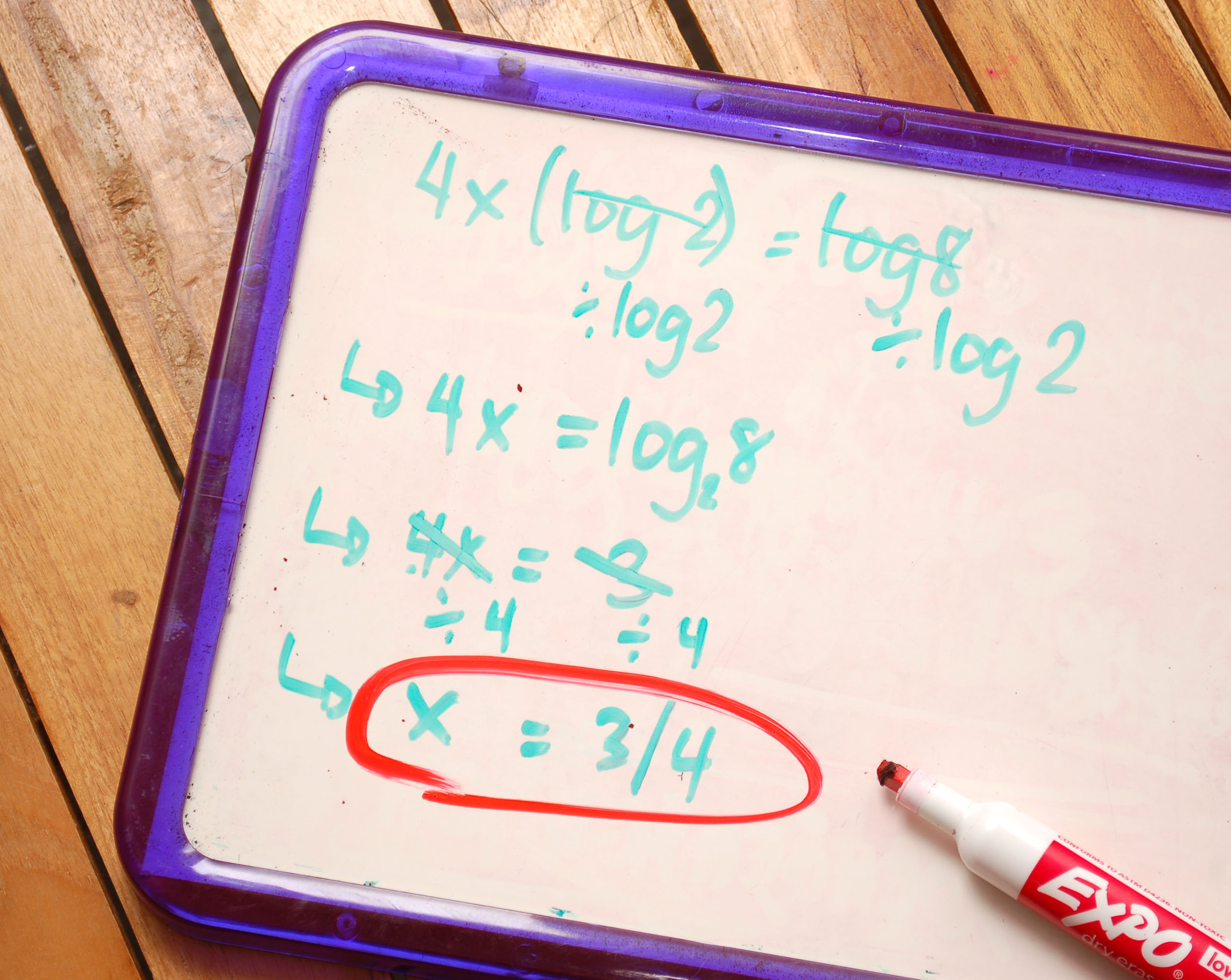
The best way to improve is to mix small wins with real problems. Start with clean examples like log10(1000), then move to equations like 2x = 20. Use logs to solve for x. This gives logarithms a job: they rescue variables stuck in exponents. And honestly, any math tool that rescues trapped variables deserves at least a little respect.
Conclusion
Logarithms are easier to understand when you remember their main purpose: they tell you the exponent. If by = x, then logb(x) = y. That single idea powers everything else: log notation, log rules, change-of-base, logarithmic graphs, and real-world applications in science, finance, sound, chemistry, and earthquakes.
To master logarithms, translate them into exponent form, identify the base and argument, practice the main rules, and connect the concept to real-life scales. With enough practice, logarithms stop feeling like a math ambush and start feeling like a useful shortcut for understanding growth, scale, and change. Not bad for something that used to look like a typo with ambition.
Note: This article is written for educational publishing and synthesizes established logarithm concepts from reputable math-learning and science references. It does not include unnecessary source-code artifacts or placeholder citation tags.

