
Beauty Unlocked
Early English Delft Wall & Floor Tiles
Jun
Early English Delft wall and floor tiles are the kind of historic design detail that can make a room feel instantly older, wiser, and just a little bit more interesting than everyone else’s kitchen. These blue-and-white ceramic squares were never meant to be shy. They decorated fireplaces, chimney breasts, kitchens, dairies, passageways, and occasionally floors or hearth areas, bringing hand-painted charm into homes long before “statement tile” became a Pinterest category.
Although the word “Delft” points to the Dutch city famous for blue-and-white pottery, English delftware developed its own personality. It borrowed the tin-glazed technique, nodded politely to Dutch imports, flirted with Chinese porcelain designs, and then went home to London, Bristol, Liverpool, and other English pottery centers to make something proudly local. The result was a tile tradition full of ships, flowers, animals, biblical scenes, landscapes, corner ornaments, and delightful imperfections. In other words: history, but with better backsplash energy.
What Are Early English Delft Tiles?
Early English Delft tiles are typically tin-glazed earthenware tiles produced in England from the late 17th century through the 18th century, with the strongest period of tile production and popularity falling in the 1700s. They were made from fired clay covered with an opaque white tin glaze. Artisans then painted decoration onto the surface, most famously in cobalt blue, though manganese purple, green, yellow, and polychrome designs also appeared.
The white glaze was the magic trick. English clay was not porcelain; it was porous earthenware. Tin glaze gave it a bright, porcelain-like surface that could hold painted decoration. This allowed English potters to imitate the fashionable blue-and-white ceramics arriving from the Netherlands and Asia, without needing the same raw materials or firing technology used for true porcelain.
Unlike modern machine-printed tiles, early English Delft tiles often show brush variation, uneven glaze, softened edges, and slight differences in size. A row of them may not line up with military discipline, but that is part of the appeal. These tiles have the relaxed confidence of objects made by human hands, not a factory robot named Gary.
A Short History of English Delftware
Delftware belongs to a larger European tradition of tin-glazed earthenware, sometimes called faience. The technique moved through the Middle East, Spain, Italy, the Low Countries, and eventually England. Dutch potters helped popularize the blue-and-white style in the 17th century, especially after Chinese porcelain became a luxury obsession in Europe.
In England, delftware production grew in places such as London, particularly Southwark and Lambeth, as well as Bristol and Liverpool. These centers produced dishes, chargers, apothecary jars, punch bowls, tiles, and other decorative or practical ceramics. By the 18th century, Dutch tile imports were so popular in Britain that English potteries began producing their own versions for domestic interiors.
London, Bristol, and Liverpool: The Big Names
London delftware, especially from Southwark and Lambeth, was among the earliest and most influential English production. London workshops made a wide range of tin-glazed wares, including tiles for fireplaces and wall panels. Their decoration could be bold, lively, and sometimes wonderfully quirky.
Bristol delftware became known for quality production and distinctive decoration. Bristol’s position as a major port helped connect it with imported goods, trade patterns, and fashionable design ideas. Tiles from Bristol often show confident brushwork and designs suited to middle- and upper-class interiors.
Liverpool delftware flourished especially in the 18th century. Liverpool potters produced tiles and other ceramics for both local use and export. Maritime subjects, ships, and trade-related imagery were especially appropriate in a port city that knew a thing or two about boats, cargo, and the occasional sailor with dramatic stories.
Why Delft Tiles Became Popular in English Homes
Early English Delft tiles were attractive, practical, and fashionable. That combination has always been dangerous for homeowners. Give people something beautiful that is also easy to wipe clean, and suddenly every fireplace starts looking underdressed.
Fireplaces were one of the most common places to use Delft tiles. In the age of open fires, soot and smoke were part of daily life. Tin-glazed tiles helped protect fireplace surrounds and made cleaning easier. They also brightened dark interiors, reflecting light and adding decorative detail around the hearth, which was often the emotional and practical center of the home.
Tiles were also used in kitchens, dairies, wash areas, and other working spaces. Their glazed surfaces made them more resistant to splashes than bare plaster or wood. However, early delftware was not as hard or durable as modern porcelain tile. It was beautiful, but it was not built for today’s muddy boots, rolling office chairs, or enthusiastic golden retrievers.
Wall Tiles vs. Floor Tiles: An Important Difference
The title “Early English Delft Wall & Floor Tiles” sounds broad, but there is an important historical distinction. Most surviving early English Delft tiles were designed primarily for walls, fireplace surrounds, chimney pieces, and decorative panels. Their soft earthenware bodies and tin-glazed surfaces could chip, craze, and wear under heavy foot traffic.
That does not mean Delft-inspired tiles never appeared near floors. They could be used around hearths, in low-traffic decorative areas, or in later restoration schemes. But if you are planning a modern floor, antique Delft tiles should be treated with caution. Original tiles are better suited for vertical display, protected surrounds, framed panels, or carefully designed installations where they will not be punished by daily footsteps.
For actual flooring, high-quality reproduction Delft tiles made with floor-rated ceramic or porcelain bodies are usually the smarter choice. You get the look without forcing a 250-year-old tile to survive modern life. Antique tiles deserve admiration, not a stress test.
Common Designs and Motifs
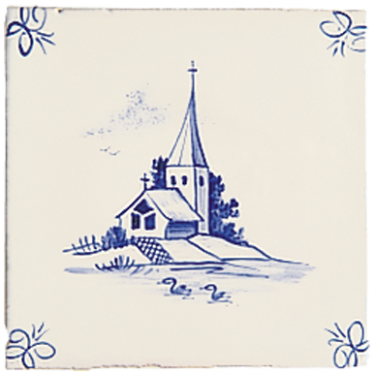
One of the pleasures of early English Delft tiles is their range of imagery. Many tiles feature a central scene surrounded by small corner motifs. These corner decorations helped connect tiles visually when installed in groups. Popular corner motifs included ox-head patterns, spider-like flourishes, fleur-de-lis shapes, and stylized leaves.
Blue-and-White Scenes
The most iconic Delft look is cobalt blue painted on a white ground. English tiles often show small figures in landscapes, shepherds, houses, boats, birds, animals, and flowers. Some scenes are charmingly simple: a tiny cottage, a tree, a person walking, perhaps a dog that looks like it has heard gossip.
Biblical and Mythological Subjects
Religious and mythological scenes were common across European ceramic design. Tiles might show episodes from the Bible, classical stories, or moralizing themes. These images served as decoration, conversation starters, and visual storytelling in homes where printed images were less common than they are today.
Ships and Maritime Imagery
Because England was a maritime nation, ships became popular tile subjects. A single blue ship on a white tile could suggest trade, travel, empire, risk, and adventure. It could also suggest that someone in the household really liked boats. Both interpretations are allowed.
Floral and Geometric Patterns
Not all Delft tiles were pictorial. Floral sprays, carnations, tulips, leaves, geometric borders, and repeating patterns also appeared. These designs worked especially well in larger wall arrangements where the goal was not to tell a story tile by tile, but to create rhythm, brightness, and elegance.
How Early English Delft Tiles Were Made
The making of early English Delft tiles involved several stages. First, clay was prepared and shaped into flat square tiles. The tiles were dried and fired once to create a biscuit body. After that, they were coated with a tin glaze, which created the opaque white surface. Decoration was painted onto the unfired glaze, often with cobalt oxide for blue designs. The tile was then fired again, fixing the decoration into the glaze.
This process required speed and confidence. Painting onto raw tin glaze was not like doodling on notebook paper. The glaze surface absorbed pigment quickly, so corrections were difficult. That is one reason antique Delft tiles often feel spontaneous. The brush marks have movement. Lines may wobble slightly. A tree may lean as though it has opinions about the weather.
How to Identify Authentic Early English Delft Tiles
Authentic early English Delft tiles usually reveal their age through materials, surface, and craftsmanship. The glaze may be slightly uneven, with tiny pits, crazing, or areas where the color pools. Chips may expose a buff, reddish, or yellowish earthenware body underneath. Edges may be irregular from hand cutting, wear, or old installation.
Hand-painted decoration is another clue. Look for brush variation rather than identical printed repetition. Two similar tiles may share the same design but differ in line weight, spacing, or expression. In a group of antique tiles, the charm often comes from the fact that each one seems to have woken up in a slightly different mood.
Collectors also examine thickness, back texture, glaze coverage, corner motifs, subject matter, and provenance. Because reproductions can be convincing, high-value purchases should be reviewed by a reputable dealer, ceramics specialist, or appraiser. A beautiful tile is always nice; a beautiful tile with a trustworthy history is better.
Decorating With Early English Delft Tiles Today
Early English Delft tiles work beautifully in traditional, cottage, farmhouse, coastal, and English-country interiors. They also look surprisingly fresh in modern spaces when used with restraint. A few antique tiles above a stove, around a fireplace, or set into a small framed panel can add depth without turning the room into a museum exhibit with better lighting.
Fireplace Surrounds
A fireplace surround is the classic location. Delft tiles bring historical character and a soft blue-and-white palette that pairs well with wood mantels, stone hearths, painted paneling, and brass accessories. If original antique tiles are used, they should be installed carefully and protected from impact.
Kitchen Backsplashes
In kitchens, Delft tiles can create a backsplash with personality. Reproduction tiles are often best for active cooking zones because they are easier to replace and may be more durable. A mix of plain field tiles and hand-painted Delft-style accent tiles can keep the design from becoming too busy.
Bathrooms and Powder Rooms
Delft-style tiles also suit bathrooms, especially powder rooms where decorative impact matters more than heavy-duty performance. Original antique tiles should be kept away from constant moisture unless properly assessed and installed by professionals. Reproductions are safer for showers and wet areas.
Framed Tile Panels
If you own a few antique Delft tiles but do not want to permanently install them, frame them. A set of four, six, or twelve tiles can become wall art. This approach protects the tiles, makes them movable, and allows you to enjoy historic ceramics without involving grout, dust, and mild renovation regret.
Care and Conservation Tips
Early English Delft tiles should be cleaned gently. Avoid acidic cleaners, bleach, abrasive pads, and aggressive scrubbing. A soft cloth, mild soap, and minimal moisture are usually enough. Antique tiles with flaking glaze, cracks, or old repairs should be handled with special care.
If tiles are already installed, inspect grout and surrounding materials. Moisture can worsen existing damage, especially if tiles are mounted in bathrooms, kitchens, or exterior walls. For valuable tiles, consult a ceramics conservator before attempting repairs. Superglue and optimism are not a conservation strategy.
Buying Early English Delft Tiles
When buying early English Delft tiles, focus on authenticity, condition, subject matter, and suitability for your project. A tile with minor chips may still be desirable, especially if the image is strong and the surface has character. In fact, some wear can support the feeling of age. However, severe cracks, heavy overpainting, or unstable glaze should affect value and installation decisions.
Ask sellers for provenance when possible. Reputable antique dealers should be able to describe approximate date, origin, condition, and any restoration. For larger installations, buy more tiles than the exact square footage requires. Antique tiles vary in size and condition, and replacements can be difficult to match later.
Why Designers Still Love Delft Tiles
Designers love Delft tiles because they offer history without feeling heavy. Their blue-and-white palette is crisp, but their hand-painted scenes are warm and human. They can be elegant, rustic, playful, or scholarly depending on the setting. Few materials can sit comfortably beside a farmhouse table, a marble counter, a Georgian mantel, and a modern brass faucet without looking confused.
They also bring narrative into a room. A plain tile says, “I cover a wall.” A Delft tile says, “Here is a tiny ship, a tree, a shepherd, and perhaps a moral lesson if you stare long enough.” That storytelling quality gives interiors a collected-over-time feeling, even when the renovation finished last Tuesday.
Experience Notes: Living With the Look of Early English Delft Tiles
Working with Early English Delft wall and floor tiles, or even good reproductions, teaches one lesson quickly: these tiles do not behave like ordinary background material. They want to be noticed. A plain subway tile politely stands in line; a Delft tile introduces itself, tells you where it came from, and points out that your fireplace looked lonely before it arrived.
The best experience comes from treating Delft tiles as individual artworks within a larger surface. When planning a backsplash or fireplace surround, lay the tiles out before installation. This sounds obvious, but it is the step that separates a graceful arrangement from a ceramic traffic jam. Because many Delft tiles feature tiny scenes, the eye naturally jumps from image to image. Too many dramatic tiles packed together can feel busy. Mixing decorated tiles with plain white, cream, or soft blue field tiles gives the design room to breathe.
Another practical experience: embrace variation. Antique tiles may not be perfectly square. Their edges may be worn. Their glaze may show crazing, chips, or small firing flaws. These are not always defects; often they are the entire reason the tile is interesting. Trying to make antique Delft tiles look brand-new misses the point. The charm is in the evidence of age, handwork, and survival.
Lighting matters more than many people expect. Delft tiles can look quiet in dim corners but come alive in natural light. A fireplace wall with morning light will show brushwork, glaze texture, and subtle blue variations that flat photographs never fully capture. Under warm evening light, the tiles can feel softer and more atmospheric. In a kitchen, under-cabinet lighting can highlight the painted details, but extremely bright light may make old glaze imperfections more visible. That is not bad, but it is worth knowing before you install them at eye level and then become personally acquainted with every tiny crackle line.
For floors, experience suggests caution. Delft-style flooring can be beautiful, especially in entryways, hearth zones, or powder rooms, but original early English Delft tiles are usually too delicate for heavy traffic. Reproduction tiles made for floors are more practical. If you love the antique look, use originals on the wall and let modern materials handle the shoes, chair legs, dropped keys, and daily chaos of human existence.
Color pairing is another enjoyable part of the process. Early English Delft tiles love natural wood, aged brass, honed stone, limewash, warm white paint, and deep blue cabinetry. They can also soften modern kitchens that might otherwise feel too sleek. A few hand-painted tiles behind a range can make stainless steel appliances seem less like machinery and more like guests at a historic dinner party.
Finally, Delft tiles reward patience. They are not the cheapest, fastest, or most invisible design choice. But they bring character that cannot be faked by a flat printed pattern. Whether used as a fireplace surround, a framed panel, or a carefully planned backsplash, Early English Delft tiles add texture, history, wit, and a sense of place. They remind us that useful surfaces can still tell stories. And really, if a wall has to exist anyway, it may as well have a tiny blue ship sailing across it.
Conclusion
Early English Delft wall and floor tiles remain beloved because they combine beauty, craft, history, and practicality. Born from the wider tradition of tin-glazed earthenware, shaped by Dutch influence, Chinese porcelain fashion, and English regional production, these tiles became a defining decorative feature of 17th- and 18th-century interiors. Their hand-painted scenes, blue-and-white palette, and charming irregularities continue to inspire designers, collectors, and homeowners today.
Whether used around a fireplace, displayed as framed art, or reimagined through durable reproductions for modern floors and backsplashes, Delft tiles offer something rare: a surface with a soul. They are not just decoration. They are tiny ceramic windows into trade, taste, domestic life, and craftsmanship. Also, they look fantastic next to a kettle. History approves.
Note: This article is original web-ready content synthesized from historical, museum, antiques, conservation, and interior design knowledge about Early English Delft wall and floor tiles.

