
Skincare
“Awkward”: Winner Asks Teammate To Share Olympic Podium To “Listen To The National Anthem Together”
Jun
At the Olympics, four one-hundredths of a second can separate a gold medal from a silver medal, a lifelong dream from a lifelong what-if, and apparently, a beautiful team gesture from a worldwide internet debate. That is exactly what happened after Team USA swimmer Torri Huske won the women’s 100-meter butterfly at the Paris 2024 Olympics and invited her teammate Gretchen Walsh, the silver medalist, to stand with her on the top step of the podium while the national anthem played.
The moment was sweet, spontaneous, and deeply human. It was also, depending on which corner of social media you happened to fall into, a little awkward. Some viewers saw a moving display of friendship between two American swimmers who had just finished one-two in one of the most thrilling races of the Games. Others wondered whether China’s bronze medalist Zhang Yufei had been unintentionally left out of the emotional spotlight.
Like many viral Olympic moments, the truth is more layered than the comment section. This was not just a podium pose. It was a story about rivalry, respect, national pride, sportsmanship, and the strange modern habit of analyzing every public gesture as if it were a courtroom exhibit. So let’s dive in, goggles optional.
The Race That Created The Viral Olympic Podium Moment
The women’s 100-meter butterfly final at Paris 2024 already had all the ingredients of a sports movie: two American teammates, one world-record holder, one Olympic redemption arc, and a finish so close that the scoreboard had to do the emotional heavy lifting.
Gretchen Walsh entered the final as one of the biggest names in the event. She had set a world record at the U.S. Olympic Trials and then broke the Olympic record in the Paris semifinals with a blazing 55.38 seconds. In plain English: she was not just fast; she was “blink and check the replay” fast.
Torri Huske, however, had her own unfinished business. At the Tokyo Olympics, she missed an individual medal in the same event by just 0.01 seconds. That is less time than it takes most of us to decide whether to hit the snooze button. In Paris, she was determined not to let another Olympic podium slip away.
When the final began, Walsh looked strong early. She led at the turn and seemed to be in control. But in the final meters, Huske surged. She touched the wall in 55.59 seconds, with Walsh right behind in 55.63. Zhang Yufei of China took bronze in 56.21. The difference between gold and silver was 0.04 seconds, a margin so tiny it feels rude to call it a margin at all.
Why Torri Huske Invited Gretchen Walsh Onto The Top Step
After the race, Huske and Walsh embraced in the pool. It was not the hug of two athletes pretending to be polite for the cameras. It looked like the kind of hug that says, “We just survived something enormous, and our hearts are still somewhere around lane five.”
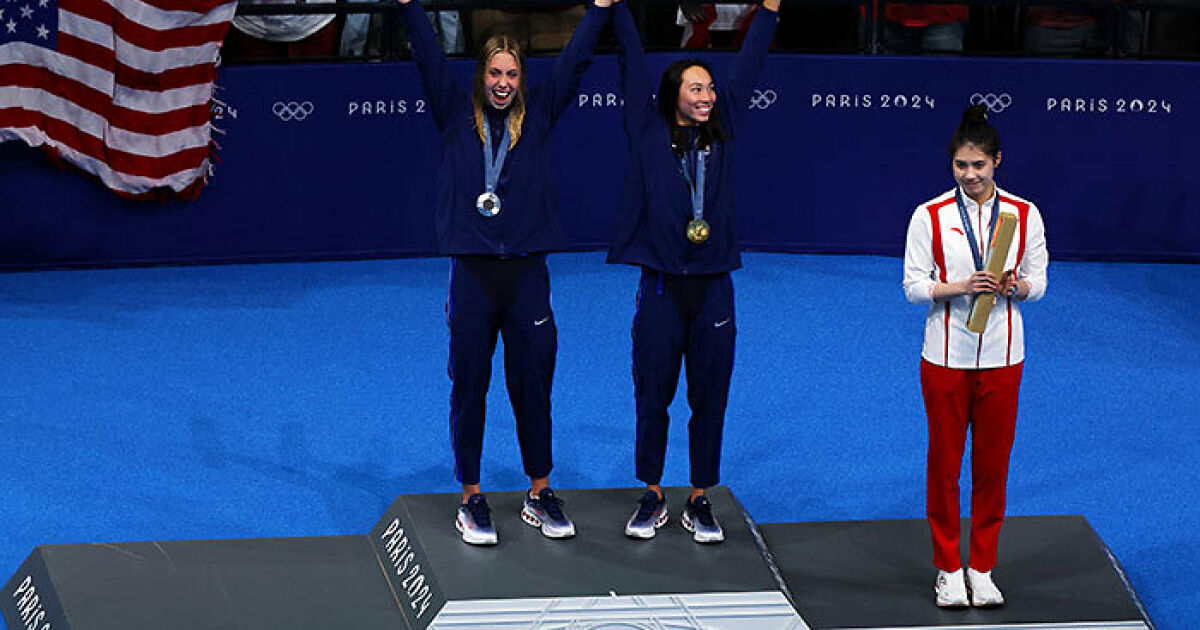
Then came the medal ceremony. Huske, as the gold medalist, stood on the highest podium step. Walsh stood on the silver step. Zhang stood on bronze. Before the national anthem played, Huske gestured for Walsh to join her on the top step. Walsh accepted, and the two American swimmers stood side by side while “The Star-Spangled Banner” played.
Huske later explained the gesture simply: when there is another American on the podium with you, you listen to the national anthem together. For her, it was not a grand political statement, a breach of protocol, or a carefully rehearsed viral moment. It was an instinctive act of team unity. She had won gold, but Team USA had won gold and silver. In that emotional second, she wanted the anthem to feel shared.
Why Some Viewers Called The Moment “Awkward”
The internet, as always, brought snacks and opinions. Many fans praised Huske for being generous, humble, and thoughtful. They saw the gesture as a reminder that Olympic athletes compete fiercely but often share years of training, travel, pressure, and sacrifice. Huske and Walsh were rivals in the water, but they were also teammates.
Other viewers felt uncomfortable because Zhang Yufei remained on the bronze step while the two Americans shared the gold step. To them, the visual created an accidental imbalance: two athletes together above, one athlete alone below. Some comments described the scene as heartwarming but awkward, while others suggested Zhang should have been included from the beginning.
That reaction is understandable, especially in a global event where symbolism matters. Olympic medal ceremonies are carefully staged rituals. Every position, flag, anthem, and camera angle carries meaning. When someone changes the expected arrangement, even with good intentions, viewers notice.
But the full picture matters. Zhang was later invited up for photos with Huske and Walsh, and she reportedly described the gesture as warm. That detail changes the tone of the story. What looked to some viewers like exclusion may have been a brief anthem-specific moment followed by a broader shared celebration.
The Cultural Layer: Olympic Podiums Are Never Just Podiums
An Olympic podium is a very small platform carrying a very large amount of meaning. It represents individual achievement, national identity, years of training, family sacrifice, coaching systems, and sometimes international tension. No pressure, right?
When athletes stand on those steps, they are not just receiving medals. They are participating in a ceremony that millions of people interpret through their own cultural expectations. In the United States, inviting a teammate to share an anthem can feel like a classic team-first gesture. In another context, it may look like the gold and silver medalists are visually separating themselves from the bronze medalist.
That is why this moment traveled so quickly online. It was not scandalous in the traditional sense. Nobody threw a medal, stormed off, or gave the Olympic mascot a side-eye. Instead, it was a tiny social puzzle. Was it sweet? Was it awkward? Was it both? The answer may be yes, yes, and please stop yelling in the comments.
Sportsmanship, Rivalry, And Friendship In One Frame
The most interesting part of the Huske-Walsh podium moment is that it captured two truths at once. First, elite sports are brutally competitive. Huske beat Walsh by 0.04 seconds. Walsh had entered the race as the world-record holder and Olympic-record setter. Silver is a magnificent achievement, but after leading for much of the race, it can also sting.
Second, elite sports are deeply relational. Teammates push each other, train beside each other, study each other, and often become part of each other’s greatest moments. Walsh’s excellence helped raise the level of the event. Huske’s finish created an unforgettable Olympic result. Their one-two finish was both a personal battle and a national triumph.
That is why Huske’s invitation resonated. It acknowledged that the race was not a lonely achievement. It was a shared climb, even if only one swimmer could touch the wall first. In a world that often treats success like a solo trophy cabinet, the moment suggested something more generous: sometimes victory feels bigger when you make room for the person who pushed you there.
What About Zhang Yufei?
Zhang Yufei’s role in this story deserves more than a footnote. She is an accomplished Chinese swimmer and Olympic medalist who finished third in a loaded field. Her bronze medal was not a consolation prize; it was proof of world-class performance in one of the toughest races of the Games.
For some fans, the concern was not that Huske meant any disrespect. It was that Zhang, visually, appeared isolated during a moment of American celebration. That is a fair observation. Public ceremonies are partly about optics, and optics can be messy even when intentions are kind.
Still, the later inclusion of Zhang in photos and her positive response suggest that the athletes themselves experienced the moment differently from many viewers online. That is a useful reminder: spectators often judge from a distance, while athletes live the moment in real time, with adrenaline, exhaustion, and emotion all arriving at once like an uninvited group chat.
Why The Internet Loves Debating Olympic Etiquette
Olympic etiquette is a surprisingly powerful content engine. People love discussing what athletes should wear, how they should celebrate, whether they should cry, whether they should not cry, whether they hugged too soon, whether they hugged too late, and whether a podium step has been used according to the invisible constitution of sports manners.
The Huske-Walsh moment became viral because it sat in the perfect gray area. It was not obviously wrong. It was not universally understood. It was emotional, visual, and short enough to be clipped, captioned, and debated by people who had never watched a butterfly race before but suddenly became experts in medal ceremony diplomacy.
That does not mean the debate was useless. In fact, it opened a thoughtful conversation about inclusion, national pride, and how athletes balance personal joy with respect for competitors. The best version of that conversation does not need villains. It simply asks: how can athletes celebrate shared success while making sure every medalist feels honored?
The Bigger Lesson Behind The Podium Moment
The headline may say “awkward,” but the deeper story is about emotional intelligence under pressure. Huske had just won the biggest individual race of her life. Walsh had just experienced the complicated heartbreak of winning silver after being favored for gold. Zhang had earned bronze against a historically fast field. All three athletes were processing the moment in public, under cameras, with the world ready to pause, zoom, and judge.
In that context, the podium moment feels less like a controversy and more like a snapshot of human imperfection. Huske’s gesture was generous. Walsh’s acceptance was gracious. Zhang’s later participation showed warmth. Could the choreography have been smoother? Sure. But Olympic emotions do not come with a rehearsal dinner.
The most generous reading is also the most reasonable one: Huske wanted to share the anthem with a teammate, not diminish anyone else. The mixed reaction says more about how carefully viewers read symbolic moments than it does about any deliberate slight.
Why This Olympic Moment Still Matters
Small moments often outlive statistics because they give people something to feel. Many viewers will remember that Huske won gold in 55.59 seconds. Swimming fans will remember Walsh’s Olympic record and world-record status. But casual fans may remember the podium: the gold medalist reaching down, the silver medalist stepping up, the anthem playing, and the bronze medalist later joining the celebration.
That is the magic and danger of the Olympics. Every gesture becomes part of the story. Sometimes the story is clean and heroic. Sometimes it is complicated and slightly awkward. Often, it is both.
In the end, the moment worked because it felt real. It was not polished into bland perfection. It revealed the tension between individual medals and team identity, between national celebration and global sportsmanship, between what athletes intend and what audiences perceive. That is why people talked about it. That is why the headline traveled. And that is why, long after the medal ceremony ended, the conversation kept swimming.
Experience Notes: What This Moment Teaches Beyond The Pool
Anyone who has ever worked on a team knows the strange emotional math behind shared success. Maybe you have won a school competition with a friend who almost beat you. Maybe you received a promotion while a colleague you respect came close. Maybe your sibling, coworker, or teammate pushed you every day, and when your big moment arrived, it did not feel right to stand there alone. That is the everyday version of what happened on the Olympic podium.
The Huske-Walsh moment reminds us that achievement is rarely as individual as it looks. Behind one person’s victory are training partners, coaches, families, rivals, and teammates who helped raise the standard. In the workplace, the person giving the presentation may get the applause, but the spreadsheet wizard, the editor, the designer, and the calm person who fixed the printer during a crisis all helped build the win. In sports, the swimmer on the top step gets the anthem, but the teammate one lane over may have helped create the speed required to get there.
There is also a lesson about timing. Good intentions can still create complicated optics. Inviting Walsh up was meaningful, but because Zhang was also on the podium, viewers naturally asked whether the gesture accidentally created distance. That does not make Huske wrong. It makes the situation human. In real life, we face similar moments all the time. We thank one person and forget another. We celebrate with our closest circle and realize later someone else may have felt outside it. The solution is not to stop showing emotion. The solution is to widen the circle when we can.
For leaders, coaches, parents, and teammates, this story is a helpful reminder that recognition matters. People want to be seen. Walsh was seen by Huske. Zhang was later seen when she joined the photos. The best celebrations make room for excellence in all its forms: the winner, the runner-up, the bronze medalist, the comeback story, the record-setter, and the person who gave everything even when the result was not golden.
Finally, the moment teaches us to be careful spectators. Online reactions move fast, but real life is slower and messier. A few seconds of video rarely contain the entire emotional truth. Before declaring something rude, awkward, perfect, or problematic, it helps to ask what the people actually involved said and did next. In this case, the athletes appeared to treat the moment with warmth. Maybe that is the best takeaway: celebrate boldly, include thoughtfully, and when the anthem plays, remember that even the highest podium step is stronger when it carries gratitude.
Conclusion
Torri Huske inviting Gretchen Walsh to share the Olympic podium was one of those rare sports moments that could be described as heartwarming, awkward, generous, and complicated without contradiction. It came after an unforgettable women’s 100-meter butterfly final at Paris 2024, where Huske edged Walsh by 0.04 seconds and Zhang Yufei claimed bronze. The gesture sparked debate because Olympic ceremonies are full of symbolism, and viewers noticed every detail.
But at its core, the moment was about teammates, respect, and the emotional overflow that follows a life-changing race. Huske wanted to share the anthem with another American who had pushed her to greatness. Walsh accepted with grace. Zhang was later included and responded warmly. The internet may keep debating the etiquette, but the athletes gave us something better than a perfect ceremony: they gave us a real one.
SEO Tags

