
Makeup
Solving A Retrocomputing Mystery With An Album Cover: Greengate DS:3
Jun
Every great retrocomputing story needs three things: a rare machine, a stubborn mystery, and at least one person willing to stare at a circuit board until the board blinks first. The Greengate DS:3 story has all three, plus a bonus plot twist worthy of a record-store detective novel: an album cover helped revive an obscure Apple II sampler from the early 1980s.
The headline sounds like a joke someone would tell at a vintage computer festival after too much coffee: “A musician, a hacker, and a vinyl sleeve walk into KiCad.” Yet that is essentially what happened. The Greengate DS:3, an early digital sampling system built around the Apple II, was rare, under-documented, and partly protected by intentionally obscured chip markings. For years, it sat in that foggy corner of music technology history where collectors whisper, forum threads trail off, and manuals become as precious as pirate treasure maps.
Then came the album. Specifically, Into Trouble With The Noise Of Art, a 1984 record connected to Mainframe, the synth-pop duo involved with Greengate. Its cover art was not merely “inspired by” the DS:3 printed circuit board. It showed the board’s top layer in enough detail to help reconstruct the hardware. In other words, the clue was hiding in plain sight, shrink-wrapped in pop culture.
What Was the Greengate DS:3?
The Greengate DS:3 was a sound-sampling expansion system for the Apple II family, especially the Apple IIe and compatible machines. In an era when professional samplers such as the Fairlight CMI and E-mu Emulator cost serious studio money, Greengate aimed to bring digital sampling closer to home musicians. It turned an Apple II into a surprisingly capable sampling workstation with a plug-in card, software, audio interface, and optional music keyboard.
The DS:3 could capture sound through a microphone or line input, store it digitally, and play it back at different pitches. That may sound ordinary now, when a phone can record a dog sneeze and transform it into a dance track before lunch. In the mid-1980s, however, this was wizardry. Affordable sampling meant musicians could build songs from breaking glass, drum hits, vocal fragments, tape loops, and whatever else the room had the courage to produce.
Contemporary reviews described the DS:3 as offering four-note polyphony, waveform editing, sequencing, looping software, and a sampling rate around 30,000 samples per second. One review noted a maximum sample time of roughly 1.3 seconds at full bandwidth, extendable with lower bandwidth or added memory. Those numbers may look tiny beside modern audio workstations, but the creative leap was enormous. The DS:3 did not simply play notes; it let users turn the world into an instrument.
Why the Apple II Was the Perfect Host
The Apple II was not designed as a music production powerhouse. Its built-in sound was famously modest: a speaker that could click. But the machine’s real superpower was expansion. With multiple internal slots, the Apple II invited third-party developers to build hardware that Apple never imagined. Disk controllers, memory boards, communications cards, graphics boards, and musical devices all found homes inside that beige box.
This openness made the Apple II fertile ground for creative hacks. The Greengate DS:3 took advantage of that architecture by placing specialized audio hardware on a card and letting software handle the user interface. Instead of buying an expensive dedicated sampler, musicians who already had an Apple could add sampling capability. The result was not cheap in pocket-money terms, but it was dramatically more accessible than a high-end Fairlight system.
That matters because retrocomputing is not only about old chips; it is about old possibilities. The Apple II’s expansion slots turned a general-purpose computer into whatever an inventive developer could persuade it to become. In this case, it became a sampler, sequencer, waveform editor, and slightly temperamental musical companion.
The Mainframe Connection
The DS:3 was closely tied to Mainframe, the British electronic duo of Murray Munro and John Molloy. Mainframe embraced computers not as backstage tools but as part of their identity. Their work combined pop instincts, home-studio resourcefulness, and the kind of technological curiosity that leads musicians to ask dangerous questions such as, “What if the computer could play the broken bottle?”
Mainframe’s practical needs helped push the DS:3 forward. Like many musicians of the era, they wanted convincing drum and percussion sounds without relying on expensive studio gear. The earliest Greengate ideas grew from the need to sample, sequence, and control sounds in a musician-friendly way. The goal was not to make a computer that happened to squeak musically. The goal was to make a musical instrument that happened to live inside a computer.
Into Trouble With The Noise Of Art became both a creative record and a demonstration of what the DS:3 could do. It also had a mischievous edge, playfully nodding toward the era’s glamorous Fairlight-driven productions. The record’s cover, showing the DS:3 board artwork, later became the unlikely Rosetta Stone for a hardware resurrection.
The Mystery: A Rare Board With Missing Clues
Recreating vintage hardware is not like assembling a modern kit. The documentation is often incomplete, components may be obsolete, and surviving units are scarce. With the Greengate DS:3, the difficulty level was turned up by a particularly cheeky obstacle: some chip markings had been removed. That meant even if someone had a board photo, identifying every part was not straightforward.
One mystery chip was especially troublesome. If it had been a custom ASIC, cloning the card might have stalled. A custom chip can be the locked door in a restoration project: you can understand the hallway, admire the wallpaper, and still not get into the room. But the surrounding circuit behavior suggested something more hopeful. The chip appeared to control address lines and move sample data toward multiple digital-to-analog converters. That pointed toward a direct memory access controller.
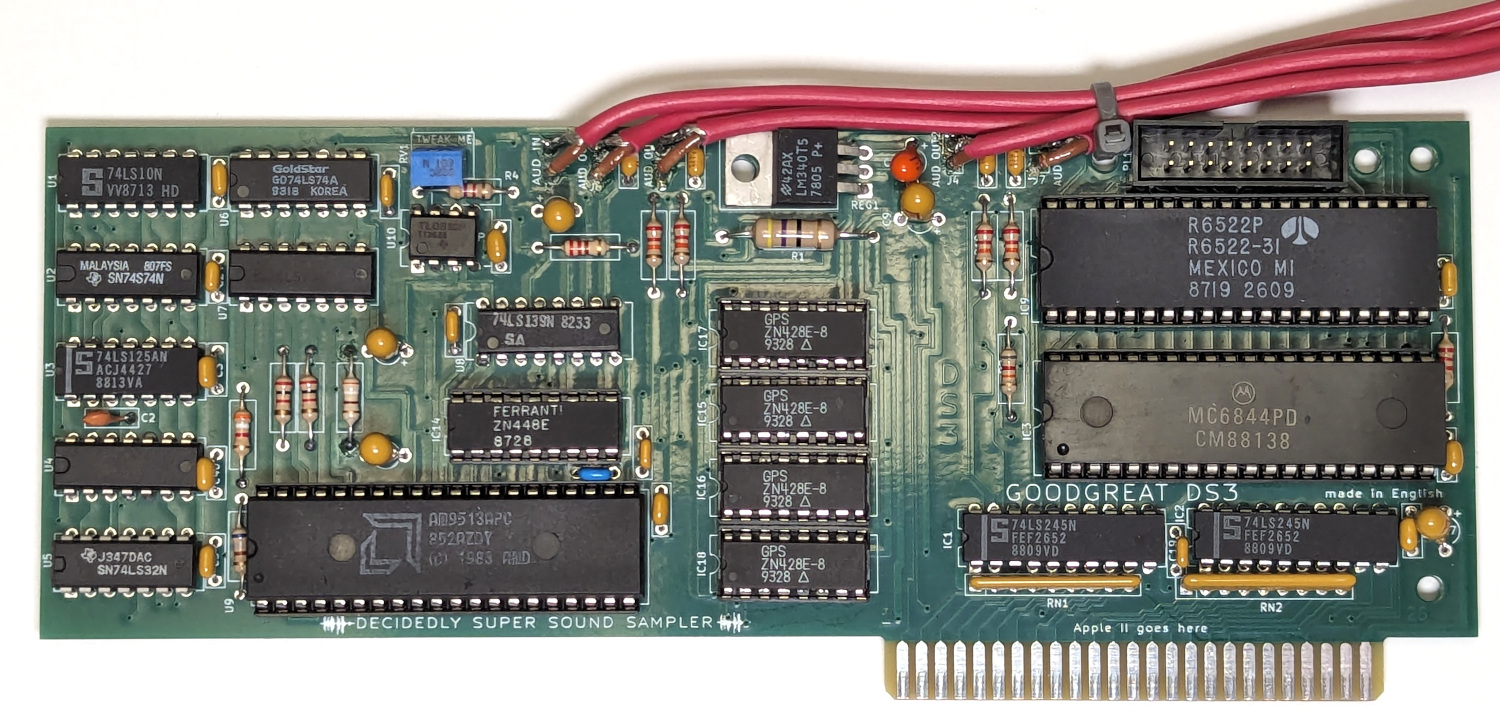
By comparing pinouts and circuit context, Eric Schlaepfer, known online as TubeTime, identified the part as a Motorola MC6844 DMA controller. That was the “aha” moment. The gremlin under the heatsink was not a mythical beast. It was an off-the-shelf component wearing a fake mustache.
How an Album Cover Became a Circuit Diagram
The most charming part of the story is not merely that a board was reverse engineered. It is the source material: album art. The cover of Into Trouble With The Noise Of Art displayed the top layer of the DS:3 PCB clearly enough to trace many of its connections. That was valuable because components on a real board often hide traces. A clean board-art image can reveal routes that a normal photo cannot.
Schlaepfer used the album artwork along with available photos of the board’s reverse side to recreate the PCB in KiCad. The process required matching footprints, tracing routes, resolving ambiguities, and using logic when the visual evidence became fuzzy. Reverse engineering is part electronics, part archaeology, and part “I swear this trace goes somewhere useful.”
The project eventually became the Goodgreat DS3, an open recreation of the Greengate card. The name is both a nod and a wink, because retrocomputing people are physically incapable of resisting wordplay when naming clone hardware. Once the design files were ready, boards could be fabricated and populated with period-correct or surplus components.
What Made the DS:3 Technically Interesting?
Several things make the Greengate DS:3 more than a historical footnote. First, it treated the Apple II as a serious musical platform. The card handled audio conversion, while software provided sampling, editing, sequencing, and performance features. That division of labor feels familiar today because modern music production also blends specialized hardware with flexible software.
Second, the DS:3 offered a workflow that anticipated later digital audio habits. Users could view waveforms, trim samples, loop sounds, and sequence musical patterns. The interface was primitive compared with a modern DAW, but the conceptual DNA is recognizable. You record a sound, inspect its shape, clean it up, assign it to notes, and build music from it. The pixels were chunkier, the disks were floppier, and saving your work probably required more patience, but the creative logic still feels modern.
Third, the DS:3 gave musicians a way to personalize sound. A preset synthesizer says, “Here are the sounds we made for you.” A sampler says, “Go outside and make your own.” That shift helped define 1980s production and later genres built around sampling. The DS:3 belonged to that broader cultural movement, even if it never became a household name.
Fairlight Dreams on an Apple II Budget
The Fairlight CMI looms over any discussion of early sampling. Introduced in 1979, it became famous for letting musicians sample real-world sounds, draw waveforms, sequence parts, and build textures that seemed futuristic at the time. It was also expensive enough to make most musicians check their wallet, laugh nervously, and return to their cassette four-track.
The Greengate DS:3 did not beat the Fairlight at being a Fairlight. That was not the point. Its importance lies in the way it translated high-end ideas into a smaller, scrappier, more personal system. It gave Apple II owners a taste of sampling culture without requiring a mansion, a major-label advance, or a producer named Trevor.
This is why the DS:3 feels so compelling today. It represents the democratization of a technology before that word became a conference cliché. It gave creative people access to tools that had previously belonged mostly to elite studios. It said, in effect, “You may not own the spaceship, but here is a very interesting bicycle with blinking lights.”
Why Retrocomputing Mysteries Matter
Some people may ask why anyone should care about reconstructing a rare Apple II sampler. After all, modern music software can emulate samplers, synths, tape machines, and probably a haunted toaster if a developer sees market demand. But retrocomputing is not about proving that old hardware is more convenient. It usually is not. Sometimes it is actively inconvenient in ways that feel personally targeted.
The value is preservation. Hardware like the Greengate DS:3 captures a moment when artists, engineers, and small companies were experimenting with the future before the future had settled into standards. These devices show how ideas evolved: sampling, sequencing, waveform editing, computer-assisted performance, and the home studio revolution.
When a rare board disappears, we do not just lose a gadget. We lose design decisions, user workflows, manufacturing clues, software assumptions, and cultural context. Recreating the DS:3 helps preserve that knowledge. It also gives modern enthusiasts a working way to experience the machine rather than simply admire a blurry photo and sigh dramatically.
The Joy of Hardware Detective Work
The Greengate DS:3 mystery is delightful because it rewards careful looking. The album cover was not a schematic, but it contained enough truth to begin. The board photos were not perfect, but they revealed enough to continue. The mystery chip was not labeled, but the circuit around it gave away its role. This is the kind of detective work that makes retrocomputing addictive.
It also shows the power of community. One person had interest and context. Another had reverse-engineering skills. Others had photos, original hardware, memories, software, or documentation. Retrocomputing breakthroughs often happen when scattered fragments finally meet. A forum post, a GitHub repository, a festival demo, and a dusty record sleeve can become one shared act of preservation.
There is a lesson here for anyone with old gear in a closet: scan the manuals, photograph the boards, preserve the disks, and label the weird cables. Future historians may thank you. Future hackers may build something wonderful from your “junk box.” At minimum, they may stop muttering at a monitor at 2 a.m., which is a public service.
Specific Example: From Cassette Sample to Apple II Performance
A practical DS:3 workflow could begin with a sound source as simple as a cassette. The user feeds audio into the system, adjusts gain, captures a short sample, trims the beginning and end, and assigns the sound for playback. With the keyboard connected, that sound can be performed across pitches. With sequencing software, the user can build repeating patterns or layered arrangements.
This may seem basic now, but imagine the thrill in 1984. A sound that existed only on tape or in the room could suddenly become playable. A cough, a snare hit, a synth stab, a phrase from a radio, or a clank from the kitchen could be turned into a musical element. The DS:3 made the Apple II less like an office machine and more like a tiny studio goblin, ready to steal noises and arrange them rhythmically.
Experience Notes: What This Mystery Teaches Modern Creators
Working through the Greengate DS:3 story offers several practical experiences for modern creators, even for those who never plan to solder a 40-pin chip or negotiate with a floppy drive. The first experience is patience. Retro hardware rarely reveals itself politely. It makes you earn every fact. A missing manual, an erased part number, or a nonstandard connector can turn a weekend project into a slow excavation. But that slowness is also where understanding grows.
The second experience is the importance of multiple evidence types. A single photograph may be misleading. A magazine review may omit technical detail. A surviving unit may have been modified by an owner with confidence, wire cutters, and questionable handwriting. But when you combine photos, album art, software behavior, period reviews, and component pinouts, a fuller picture emerges. The DS:3 was solved not by one magic document but by layering imperfect clues until they formed a usable map.
The third experience is humility. Modern creators often assume progress is linear: new tools are smarter, faster, and therefore more creative. The DS:3 challenges that assumption. Its limits were severe, yet those limits pushed musicians to think carefully. Short sample times forced tight editing. Four-note polyphony encouraged deliberate arrangement. Disk storage demanded organization. The machine did not remove friction; it made friction musical.
The fourth experience is respect for design. The Greengate team built a sampling system around a consumer microcomputer at a time when digital audio was still exotic. That required clever hardware, efficient software, and a strong understanding of what musicians actually needed. The DS:3 was not merely a technical stunt. It was designed for people who wanted to make songs, not just watch numbers change.
The fifth experience is that culture can preserve technology in unexpected ways. A record sleeve saved information that conventional documentation did not. That is wonderfully strange, but it is also a reminder that artifacts are connected. Music history, graphic design, electronics, software, and fan communities overlap. The clue to a circuit board may be in a magazine ad, a stage photo, a demo record, or a video background. Preservation works best when people look beyond obvious archives.
Finally, the Greengate DS:3 story teaches that restoration is a creative act. Rebuilding old hardware is not only about nostalgia. It is about making lost possibilities audible again. When a recreated DS:3 plays a sample through an Apple II, the result is more than sound. It is proof that a fragile chain of knowledge survived: the engineers who designed it, the musicians who used it, the writers who reviewed it, the collectors who saved it, and the modern hackers who refused to let the trail go cold.
Conclusion
Solving the Greengate DS:3 mystery with an album cover is one of those stories that makes retrocomputing feel magical without requiring any actual magic. It is a story about a rare Apple II sampler, an intentionally obscured chip, a record sleeve hiding a circuit board clue, and a community determined to bring a forgotten instrument back to life.
The DS:3 deserves attention because it sits at the intersection of affordable home computing and early digital music production. It gave musicians a way to sample, edit, sequence, and perform real-world sounds on an Apple II at a time when professional sampling was still financially out of reach for many artists. The modern Goodgreat DS3 recreation does more than clone a board; it restores a small but meaningful piece of music technology history.
In the end, the lesson is simple: never underestimate old media. A vinyl sleeve might be a cover, a cultural artifact, a joke, a design statement, and a circuit diagram all at once. Somewhere, a dusty album in a crate may be quietly waiting to solve the next retrocomputing mystery. Please handle it carefully. It may contain traces.

