
Beauty Tools & Accessories
Top Ten Most Notorious Former Red Light Districts in America
Jul
Long before nightlife came with online reservations, craft cocktails, and a polite reminder to tip your bartender, many American cities maintained neighborhoods where gambling rooms, saloons, dance halls, brothels, and political corruption operated almost side by side. These former red-light districts were often tolerated, regulated, relocated, raided, reopened, and finally erasedsometimes in that exact order.
The word “notorious” is important here. These neighborhoods were famous, but they were not necessarily glamorous. Behind the theatrical names and colorful legends were poverty, exploitation, racial discrimination, public-health crises, organized crime, and limited economic choices for women. This ranking considers national fame, size, longevity, political influence, cultural impact, and the strength of each district’s surviving historical legacy. It is an editorial ranking rather than a scientific measurement of municipal misbehavior.
How America’s Red-Light Districts Developed
Most of these districts appeared in rapidly growing transportation and industrial centers. Ports supplied sailors. Railroads delivered transient workers. Mining towns attracted overwhelmingly male populations with money in their pockets and few local social ties. City leaders frequently responded by concentrating commercial sex in a designated area rather than eliminating it. Officials could then monitor the trade, collect fines, protect valuable commercial streets, or quietly profit from corruption.
That arrangement rarely remained stable. Reformers objected to the visible sex trade, while developers wanted centrally located land for offices, hotels, theaters, and transportation projects. Military officials also pushed for closures when they believed nearby districts threatened troop health or discipline. Consequently, yesterday’s vice district often became tomorrow’s redevelopment zonewith only a plaque, museum, alleyway, or unusually persistent ghost story left behind.
10. Creek Street Ketchikan, Alaska
A red-light district built above the water
Ketchikan’s Creek Street earns a place on this list because few former vice districts occupy a more memorable setting. Its wooden buildings stand on pilings beside Ketchikan Creek, giving the old neighborhood the appearance of a postcard designed by somebody with an unexpectedly scandalous sense of humor.
Mining, fishing, logging, and salmon canneries drew large numbers of working men to southeastern Alaska. In 1903, Ketchikan required its “bawdy houses” to move south of the creek, effectively turning Creek Street into the town’s designated red-light district. Establishments such as the Star and Dolly’s House served fishermen, miners, and loggers. The Star can be documented as a brothel from 1917 until the city closed the district in 1954.
Today, the boardwalk is better known for galleries, shops, restaurants, historic buildings, and spawning salmon. Dolly’s House operates as a museum, proving that urban reputations can change dramatically. The neighborhood went from selling forbidden entertainment to selling souvenirs, which may be the most American redevelopment story imaginable.
9. Omaha’s Sporting District Omaha, Nebraska
Where vice and political power became close neighbors
Omaha’s sporting district flourished around the city’s lower downtown streets, particularly near Ninth Street and Capitol Avenue. Saloons, gambling houses, theaters, brothels, and political machines created a district whose reputation traveled well beyond Nebraska.
When temperance campaigner Carry Nation toured Omaha in 1902, crowds followed her into the red-light district. Women appeared at windows, spectators packed the streets, and patrons cheered or cursed as Nation confronted the neighborhood’s saloon culture. Afterward, she reportedly concluded that Omaha fully deserved the bad stories she had heard about it.
Historical estimates cited by History Nebraska describe a city containing roughly 100 brothels and 2,500 women in prostitution during its peak vice era. Such estimates should be treated cautiously, but they reveal how deeply the underground economy had become connected to nightlife and local politics. Omaha’s district was not merely a row of questionable businesses; it was part of a broader system in which gambling operators, saloon owners, fixers, and politicians protected one another.
8. The Line Galveston, Texas
Postoffice Street during the Free State era
Galveston’s red-light district, commonly known as the Line, centered on Postoffice Street near the waterfront. Its location was no accident. A busy Gulf port meant sailors, railroad workers, soldiers, businessmen, and travelers were continually arriving with money and time to spend.
The district operated from the late 19th century into the mid-20th century. Its fortunes became closely associated with Galveston’s “Free State” era, when gambling, bootlegging, nightclub entertainment, and organized vice flourished under the influence of Sam and Rosario Maceo. The Line included establishments ranging from expensive houses to dangerous operations in which workers faced violence, disease, police raids, and economic exploitation.
Galveston’s history also complicates the traditional image of sex workers as people without agency. Surviving records suggest that some women viewed the trade as one of the few available routes toward financial independence, travel, or education. Others entered because poverty and limited employment left them with little practical choice. The district therefore resists both romantic nostalgia and simple moral condemnation. Parts of its Victorian streetscape remain, while Postoffice Street has become an arts, entertainment, dining, and residential destination.
7. Mercury Street Butte, Montana
A mining boomtown’s remarkably durable vice district
Butte became one of America’s great mining cities, and its red-light district grew alongside the copper industry. Located largely around Mercury Street, only a few blocks from respectable commercial areas, the district served miners while also attracting wealthy businessmen who preferred their entertainment with upholstered furniture and a discreet entrance.
The neighborhood contained cramped “cribs,” saloons, theaters, inexpensive houses, and elaborate parlor establishments. The Dumas, purpose-built as a brothel in 1890, offered both small basement rooms and more elegant upstairs spaces. Wealthy property owners benefited by renting buildings in the district even when they publicly supported conventional morality. Apparently, respectability and rental income have been negotiating with each other for a very long time.
Montana outlawed prostitution in 1917, but the Dumas continued operating until 1982. That extraordinary longevity made it one of the longest-running brothels in the United States. Its survival also demonstrates how enforcement could depend more on local tolerance, political convenience, and economics than on the wording of state law.
6. Seattle’s Tenderloin and Lava Bed
Gold-rush money meets “open town” politics
Seattle’s early vice district developed south of Mill Street, later Yesler Way, in an area sometimes called the Lava Bed or the Tenderloin. Loggers, sailors, railroad workers, and miners heading to or returning from Alaska supported brothels, gambling rooms, breweries, theaters, and lodging houses.
The Klondike gold rush produced an especially profitable period. Some buildings were divided into dozens of tiny rooms known as cribs, while more expensive parlor houses attempted to provide luxury and discretion. In 1902, the Tenderloin was pushed farther south as central land became more valuable and civic leaders sought greater separation between vice and respectable commerce.
Seattle’s history also exposes the racial inequality of vice enforcement. Indigenous and Asian women were frequently singled out by ordinances and raids, while white-owned establishments sometimes enjoyed greater protection. Political battles between reformers and “open town” advocates continued for years, turning the district into a test of who truly controlled the city: voters, reform organizations, publishers, business owners, or officials receiving conveniently unexplained benefits.
5. Market Street’s Row Denver, Colorado
From opulent parlor houses to two-bit rooms
Denver’s best-known red-light district developed along Market Street and became known simply as the Row. During the late 19th and early 20th centuries, the area contained dance halls, saloons, brothels, small cribs, and luxurious parlor houses serving customers from different economic classes.
The district’s architecture reflected that hierarchy. Wealthy clients could enter ornate establishments furnished like expensive private homes, while workers and travelers used cheaper houses offering little privacy or comfort. Race created another dividing line. Parts of the district were segregated, and Black women were frequently confined to lower-priced houses with fewer protections and greater exposure to violence.
Market Street was never separate from Denver’s legitimate economy. Property owners, suppliers, cab drivers, saloons, politicians, and police all benefited from the flow of money. Reform campaigns eventually weakened the Row, while redevelopment transformed its physical setting. Modern visitors walking through Lower Downtown would have difficulty imagining the density of vice businesses that once made Market Street nationally infamous.
4. The Tenderloin New York City
Brothels, Broadway, lobster palaces, and police graft
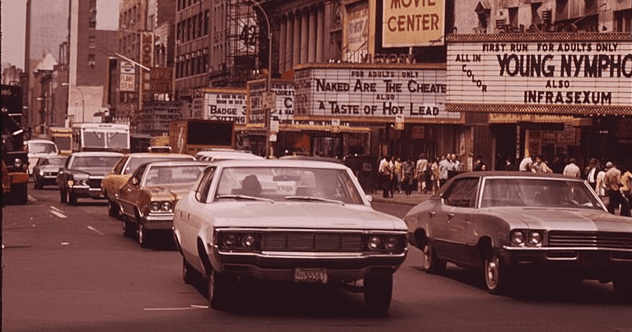
New York’s Tenderloin covered part of Midtown Manhattan during the late 19th and early 20th centuries. Its northern edge included Longacre Square, the area renamed Times Square in 1904. The neighborhood combined brothels, theaters, saloons, gambling establishments, restaurants, hotels, and nightlife venues in a crowded entertainment economy.
The name supposedly referred to the rich rewards available to police officers transferred into a district where collecting graft could provide a financial upgrade from ordinary living. Whether every colorful version of the nickname is true or not, corruption was central to the Tenderloin’s reputation. Businesses could survive when the right officials were paid, warned, or politically persuaded.
As Broadway theaters and fashionable restaurants moved north, commercial entertainment and illicit activity occupied the same streets. That mixture helped establish the nighttime identity later associated with Times Square. New York repeatedly attempted to “clean up” prostitution through investigations, raids, new laws, and redevelopment, yet the trade usually shifted into new buildings or neighborhoods rather than disappearing.
3. The Barbary Coast San Francisco, California
A waterfront district with an international reputation
San Francisco’s Barbary Coast emerged near the waterfront during and after the California Gold Rush. Sailors, miners, laborers, immigrants, gamblers, thieves, musicians, and fortune seekers crowded into saloons, dance halls, gambling rooms, lodging houses, and brothels.
A sensational 1871 account described the area’s dance cellars, opium dens, gambling rooms, thieves’ hangouts, and constant danger. Such Victorian descriptions were often exaggerated for dramatic effect, but they show how thoroughly the Barbary Coast had captured America’s imagination. The district’s reputation was not merely local; it became shorthand for a port neighborhood where pleasure, violence, fraud, and entertainment were sold under the same roof.
The 1906 earthquake and fire destroyed much of the area, but nightlife returned during reconstruction. Reformers and city officials later restricted dancing, closed establishments, and attempted to eliminate prostitution. By the 1910s, the original Barbary Coast was fading, although later clubs revived the name as a marketable piece of San Francisco folklore. Vice had become heritage brandingwith considerably better signage.
2. The Levee Chicago, Illinois
America’s industrial-age capital of organized vice
By 1900, Chicago’s Levee was among the most infamous sex districts in the United States. It occupied part of the Near South Side, roughly between 18th and 22nd Streets and between State Street and Armour Avenue, now Federal Street. Its “sporting clubs,” saloons, gambling rooms, dance halls, brothels, and street activity operated on an enormous scale.
The Levee’s power came from organization. Business owners depended on protection from police, ward politicians, and intermediaries who converted illegal activity into dependable revenue. Chicago’s rapid growth, railroad connections, stockyards, conventions, and transient workforce supplied customers. Meanwhile, the district’s visibility made it a favorite target of journalists, settlement workers, religious organizations, and anti-vice campaigners.
A municipal vice commission studied whether prostitution should remain concentrated or be outlawed and dispersed. Reformers ultimately prevailed, and the Levee was officially closed in 1912. Yet vice did not vanish; it moved into other Chicago neighborhoods and adopted less conspicuous forms. Closing a district proved easier than closing the market that had sustained it.
1. Storyville New Orleans, Louisiana
The most legendary red-light district in American history
Storyville ranks first because no former American red-light district has produced a more powerful combination of documented history, music, mythology, architecture, and popular culture. Established through municipal regulation in 1897, the district concentrated prostitution within a defined part of New Orleans and operated until 1917.
Storyville contained everything from inexpensive cribs to elaborately furnished mansions. Guidebooks advertised establishments and their workers, while saloons, dance halls, cabarets, restaurants, and gambling businesses drew customers into the surrounding entertainment economy. Music was an important part of that world. Some houses employed piano players, while bands performed in nearby clubs and dance halls.
Jazz was not born solely inside Storyville, despite a durable legend, but the neighborhood helped introduce the developing music to wider audiences. When military pressure contributed to the district’s closure in 1917, musicians found work elsewhere, helping spread New Orleans styles across the country.
Most Storyville buildings disappeared during the construction of the Iberville public-housing development in the 1940s. Only a small number of original structures and fragments survived. The physical district was largely erased, but its cultural afterlife remains enormous. Storyville is the rare neighborhood that became more famous after it ceased to exist.
What These Former Vice Districts Reveal About America
These neighborhoods were products of migration, industrialization, unequal gender opportunities, segregated housing, transient labor, and political corruption. City governments often treated commercial sex as both a moral problem and a useful source of unofficial revenue. Officials condemned it in speeches, collected money from it in practice, and relocated it whenever valuable real estate was required for something more respectable.
The stories of the women who worked in these districts are especially complicated. Some became property owners, business operators, or financially independent figures in eras when women had few legal and professional opportunities. Many others experienced coercion, trafficking, addiction, disease, poverty, racism, and violence. A responsible history must preserve both realities rather than replacing them with a cheerful fantasy of feathered costumes and nonstop piano music.
The districts also shaped American entertainment. Jazz, vaudeville, cabaret, dance music, restaurant culture, theater, and nightlife frequently developed near spaces officially labeled disreputable. Respectable society publicly rejected the vice district while quietly borrowing its music, fashion, slang, performers, and business ideas.
Experiencing America’s Former Red-Light Districts Today
A journey through preserved streets, erased blocks, and uncomfortable memories
Exploring a former red-light district today rarely feels like entering a preserved movie set. In some cities, the physical evidence is obvious. Ketchikan’s Creek Street still curves above the water on wooden pilings. Its bright storefronts and salmon-filled creek create a charming scene, yet museum displays and historic markers reveal that the boardwalk once represented geographic and social separation. Visitors can admire the architecture while recognizing that city officials deliberately moved stigmatized businessesand many marginalized residentsaway from the community’s respectable center.
Butte offers a heavier atmosphere. The surviving Dumas building preserves narrow rooms that communicate more than a colorful anecdote ever could. A small crib forces visitors to think about privacy, safety, heat, sanitation, and the daily economics of survival. Ornate rooms upstairs reveal the class system within the trade: comfort and decoration followed the customer’s wallet, while workers occupied dramatically different environments. The contrast turns an entertaining tour into a lesson about labor, gender, and inequality.
Other districts require imagination. In New York, crowds move through Times Square beneath giant digital advertisements without realizing they are crossing part of the old Tenderloin. Theatergoers, tourists, office workers, street performers, and police still share the neighborhood, although the businesses and technologies have changed. Knowing the history alters the view. The glowing signs seem less like a modern invention and more like the latest version of a century-old competition for nighttime attention.
New Orleans produces an even stranger experience because so little of Storyville survives. The visitor must rely on maps, photographs, archaeology, music history, and street patterns. Ordinary blocks acquire significance when one learns where a saloon, cabaret, crib house, or dance hall once stood. The absence itself becomes part of the story. Large redevelopment projects did not simply replace deteriorating buildings; they removed physical evidence of communities, businesses, racial boundaries, and musical networks.
Walking through these neighborhoods responsibly means resisting two temptations. The first is romanticization: turning difficult lives into a costume party populated entirely by witty madams and piano players. The second is moral simplification: treating every worker as identical and every district as nothing more than a collection of crimes. The historical truth sits between those extremes. These were workplaces, entertainment zones, political battlegrounds, homes, investment properties, and sites of exploitation at the same time.
A good visit therefore combines curiosity with humility. Look at surviving architecture, but also ask who owned it and who labored inside. Enjoy the music associated with a district, but consider why musicians found work there. Notice how close vice businesses stood to banks, churches, theaters, government offices, rail stations, and wealthy neighborhoods. That proximity is the final surprise. America’s red-light districts were never completely outside respectable society. They were built, supplied, protected, patronized, condemned, and eventually redeveloped by it.
Conclusion
The most notorious former red-light districts in America were more than collections of brothels. They were complicated urban ecosystems tied to transportation, labor, entertainment, real estate, policing, race, public health, and political power. Storyville influenced the spread of jazz. Chicago’s Levee demonstrated how vice could become an organized industry. The Barbary Coast turned waterfront disorder into international legend. Smaller districts from Butte to Ketchikan show how the same forces reached mining camps, fishing ports, and frontier towns.
Most of these districts eventually disappeared beneath highways, housing projects, office buildings, tourist shops, parking lots, and respectable entertainment venues. Their histories remain valuable because they expose a recurring American habit: condemning an underground economy while allowing powerful people to profit from it. The red lights may be gone, but the questions about labor, morality, corruption, redevelopment, and whose stories deserve preservation remain very much switched on.

