
Beauty Unlocked
How to Fix an Amana Dryer When It Won’t Heat
Jun
Your Amana dryer is tumbling like a champ, making its usual low rumble, and pretending everything is fine. Then you open the door and find a load of damp towels staring back at you like they just returned from a swamp vacation. If your Amana dryer won’t heat, do not panicand do not immediately assume the appliance has joined a secret rebellion against laundry day.
In many cases, the fix is surprisingly simple: a tripped breaker, closed gas valve, clogged lint screen, blocked dryer vent, or wrong cycle setting. In other cases, the problem may involve a failed thermal fuse, heating element, thermostat, igniter, flame sensor, or gas valve coil. The trick is to troubleshoot in the right order, starting with the easy and safe checks before diving into part replacement.
This guide explains how to fix an Amana dryer when it won’t heat, whether you own an electric Amana dryer or a gas Amana dryer. We will walk through symptoms, likely causes, DIY checks, part-testing tips, safety warnings, and real-world experience from common dryer repair scenarios.
First, Confirm the Dryer Is Really Not Heating
Before grabbing a screwdriver and giving your dryer the side-eye, confirm the heating problem. Sometimes a dryer does produce heat, but poor airflow, overloading, or the wrong cycle makes clothes stay wet. That is not exactly “no heat”; it is more like “heat trapped in traffic.”
Run a Quick Heat Test
Set the Amana dryer to a heated timed cycle, not air fluff, wrinkle prevent, or a delicate no-heat option. Let the empty dryer run for about five minutes. Open the door carefully and feel inside the drum. If the drum is warm, the dryer is heating, and your issue is more likely airflow, load size, or drying performance. If the drum is completely cold, move forward with the no-heat troubleshooting steps.
Check the Cycle Setting
It sounds almost too easy, but many dryer “repairs” begin and end with the cycle knob. Air Dry, Fluff Air, or some delicate settings may tumble clothes without heat. If the dryer was set to one of these, congratulations: your Amana dryer is not broken; it is simply following orders with annoying accuracy.
Safety First: Do This Before Any Dryer Repair
Dryers use high voltage, high heat, moving parts, and, in gas models, combustible fuel. That is a spicy combination. Before inspecting internal parts, always unplug the dryer. For gas dryers, shut off the gas supply valve before moving the appliance or opening panels.
If you smell gas, hear hissing, see burned wiring, find melted terminals, or notice repeated breaker trips, stop troubleshooting and call a qualified technician. A dryer repair is not worth turning your laundry room into a dramatic news segment.
Common Reasons an Amana Dryer Won’t Heat
The most common causes depend on whether your dryer is electric or gas. Electric Amana dryers rely on a 240-volt power supply and a heating element. Gas Amana dryers rely on proper gas flow, an igniter, flame sensor, and gas valve coils. Both types depend heavily on airflow. When airflow is restricted, the dryer can overheat and trigger safety parts that shut down heat.
Quick Cause Checklist
- Wrong cycle setting or no-heat option selected
- Tripped breaker or incomplete 240-volt supply on electric models
- Closed gas valve or interrupted gas supply on gas models
- Clogged lint screen or blocked exhaust vent
- Crushed, kinked, or incorrect dryer vent hose
- Blown thermal fuse or thermal cutoff
- Failed heating element on electric dryers
- Faulty high-limit thermostat or cycling thermostat
- Bad igniter, flame sensor, or gas valve solenoid coils on gas dryers
- Loose wiring, damaged terminal block, timer issue, or control board problem
Step 1: Check the Power Supply on Electric Amana Dryers
An electric Amana dryer can tumble without heating if it receives only part of its required power. Many electric dryers use two breaker legs: one can power the motor while the other powers the heating element. If one side trips, the drum may spin normally while the dryer produces no heat. Sneaky, yes. Rare? Not at all.
How to Check the Breaker
Go to your home electrical panel and find the double-pole breaker for the dryer. Flip it fully off, then fully back on. Do not just glance at it and say, “Looks fine.” Some breakers trip halfway and look innocent. After resetting, test the dryer on a heated timed cycle.
If the breaker trips again, do not keep resetting it. Repeated tripping can signal a short, damaged wiring, overloaded circuit, or internal dryer fault. Call an electrician or appliance technician.
Check the Power Cord and Terminal Block
If your dryer was recently installed, moved, or repaired, the power cord connection may be loose or wired incorrectly. Electric dryers require the correct 3-prong or 4-prong cord setup based on your outlet and local code. Loose terminal screws can also cause overheating, arcing, or no heat. Unplug the dryer before inspecting the terminal block. If you see burned marks, melted plastic, or damaged wiring, stop and schedule service.
Step 2: Check the Gas Supply on Gas Amana Dryers
If you have a gas Amana dryer, the machine needs gas flow before it can produce heat. The gas shutoff valve should be open, meaning the valve handle is usually parallel with the gas pipe. If the handle is perpendicular, the valve is closed.
Make sure the gas supply is on and that no one accidentally shut it off during cleaning, moving, remodeling, or enthusiastic garage organization. If other gas appliances are also not working, the problem may be with the home gas supply rather than the dryer.
Listen for Normal Gas Dryer Operation
Gas dryers often make clicking sounds as the gas valve opens and closes. That can be normal. What is not normal is an igniter that glows but never lights the burner, a burner that lights briefly then shuts off too soon, or no glow from the igniter at all. Those clues help narrow the problem to the igniter, flame sensor, gas valve coils, thermal fuse, or related wiring.
Step 3: Clean the Lint Screen
The lint screen is small, humble, and often ignored. Yet it is one of the most important parts of dryer performance. A clogged lint screen restricts airflow, slows drying, raises internal temperature, and may contribute to blown safety fuses.
Pull out the lint screen and remove lint by hand. If you use dryer sheets, wash the screen occasionally with warm water, mild soap, and a soft brush. Dryer sheet residue can create an invisible film that blocks airflow. To test for residue, run water over the screen. If water pools instead of flowing through, the screen needs washing.
Step 4: Inspect and Clean the Dryer Vent
If your Amana dryer heats a little but clothes still come out damp, or if the dryer overheats and then stops heating, suspect the vent system. Dryers need steady airflow to carry moisture outside. When lint blocks the vent, heat builds up inside the dryer instead of moving through the laundry and out of the house.
Signs of a Blocked Dryer Vent
- Clothes take two or three cycles to dry
- The dryer top feels unusually hot
- The laundry room feels humid
- There is a burning lint smell
- Lint collects behind or under the dryer
- The outside vent flap barely opens
- The dryer shuts off mid-cycle
How to Check Airflow
Run the dryer for five to ten minutes, then go outside to the exhaust hood. You should feel strong airflow. If the airflow is weak, clean the duct and outside hood. Disconnect the vent hose from the back of the dryer, vacuum lint from the dryer outlet and hose, and use a dryer vent brush to clear the duct. Make sure the vent is not crushed behind the dryer. A dryer shoved too close to the wall can flatten the duct and choke airflow like a garden hose under a car tire.
For best performance, use a 4-inch metal vent. Avoid plastic or thin foil ducts because they can trap lint, crush easily, and create fire risk. Keep the vent path as short and straight as possible.
Step 5: Check the Thermal Fuse or Thermal Cutoff
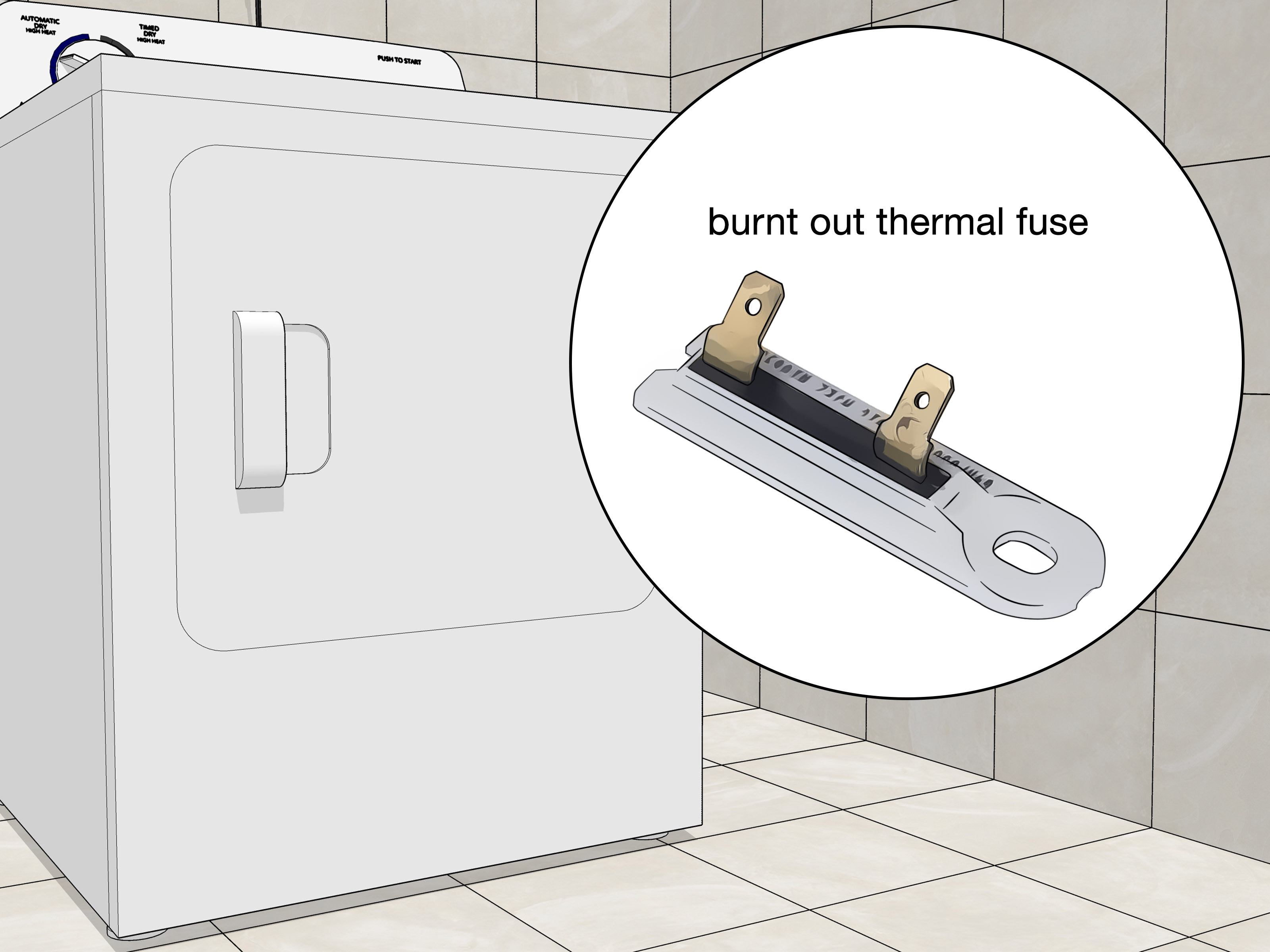
The thermal fuse is a safety device that protects the dryer from overheating. Depending on the model, a blown fuse or thermal cutoff may stop the dryer from heating or stop the dryer from running altogether. If the dryer runs but does not heat, the thermal fuse or cutoff is still worth checking, especially after a clogged vent problem.
How to Test It
Unplug the dryer. Locate the thermal fuse, often near the blower housing or heating assembly. Remove one wire from the fuse and test it with a multimeter set to continuity. A good fuse usually shows continuity. A blown fuse shows no continuity and must be replaced. It cannot be reset.
Important: do not replace a blown thermal fuse without fixing the airflow problem that caused it. Otherwise, the new fuse may fail again, and your dryer will continue its expensive little magic trick of turning new parts into dead parts.
Step 6: Test the Heating Element on Electric Amana Dryers
In electric Amana dryers, the heating element is the part that warms the air. Over time, the coil can break, burn out, or short against its housing. When that happens, the dryer may tumble normally but produce no heat.
Symptoms of a Bad Heating Element
- The dryer runs but the drum stays cold
- Drying performance declined gradually before heat stopped
- The element coil has a visible break
- A continuity test shows an open circuit
Unplug the dryer before accessing the heating element. Inspect the coil for breaks or burn marks. Use a multimeter to test continuity. If the element has no continuity, replace it with the correct part for your Amana model number. The model tag is usually inside the dryer door opening or on the frame.
Step 7: Check the High-Limit Thermostat and Cycling Thermostat
Thermostats regulate dryer temperature. The cycling thermostat controls normal temperature cycling, while the high-limit thermostat helps protect against overheating. If either part fails, the dryer may not heat correctly, may overheat, or may shut heat off too early.
Testing usually requires a multimeter and access to the heater housing or blower area. Many thermostats should show continuity at room temperature, but specifications vary by model. If you are replacing thermostats, use the exact replacement part. Dryer thermostats are not decorative accessories; close enough is not close enough.
Step 8: Troubleshoot Gas Dryer Ignition Parts
Gas Amana dryers have a few extra players in the heating system: igniter, flame sensor, and gas valve solenoid coils. When one of these fails, the dryer may run without heat, heat only briefly, or work once and then fail after the coils warm up.
Bad Igniter
The igniter glows hot enough to light the gas burner. If it is cracked, broken, or electrically open, the burner will not light. A bad igniter may show no glow at all. It can be tested for continuity, but handle it carefully because igniters are fragile.
Faulty Flame Sensor
The flame sensor detects heat from the burner flame. If it fails, the gas valve may not open correctly. In many diagnostic sequences, you check the igniter and thermal fuse first, then test the flame sensor for continuity at room temperature.
Weak Gas Valve Solenoid Coils
Gas valve coils open the valve ports so gas can flow to the burner. A classic symptom of bad coils is this: the igniter glows, then shuts off, but no flame appears. Another common pattern is heat at the beginning of the cycle, followed by no heat later. Coils can fail when hot, which makes the problem feel random and deeply annoying.
When replacing gas valve coils, many technicians replace them as a set. If you are not comfortable working around gas components, call a professional. Gas repairs require extra caution.
Step 9: Consider the Timer, Motor Switch, or Control Board
If the power supply, venting, fuse, thermostats, heating element, and gas ignition parts check out, the issue may involve the timer, electronic control board, wiring harness, or motor centrifugal switch. The motor switch can allow the drum to run while failing to complete the heat circuit. Timers and boards can also fail internally.
These problems are less common than clogged vents, blown fuses, bad elements, or gas coil failures, but they do happen. At this stage, diagnosis becomes more advanced. A wiring diagram, voltage testing, and model-specific service information may be needed.
When to Call a Professional
DIY troubleshooting is great for lint screens, breaker checks, vent cleaning, and simple continuity tests. But call a qualified appliance technician if you smell gas, see burned wiring, are unsure about electrical testing, need to move a gas dryer, or have replaced a part and the dryer still will not heat.
You should also consider professional service if your dryer repeatedly blows thermal fuses. That usually means the root cause has not been fixed. Common culprits include hidden vent restrictions, poor duct design, a failing thermostat, or improper cycling.
How to Prevent Amana Dryer Heating Problems
The best dryer repair is the one you never need to make. A little maintenance keeps your Amana dryer heating properly, drying efficiently, and operating safely.
Dryer Maintenance Checklist
- Clean the lint screen before every load
- Wash the lint screen occasionally to remove dryer sheet residue
- Clean the dryer vent at least once a year
- Check the outside exhaust hood for lint, nests, or stuck flaps
- Do not overload the dryer
- Use automatic cycles correctly and avoid no-heat settings for heavy laundry
- Keep the area behind and around the dryer clear
- Replace crushed foil or plastic ducts with proper metal venting
- Inspect the power cord and outlet if the dryer has been moved
Real-World Experience: What Usually Fixes an Amana Dryer That Won’t Heat
In real homes, Amana dryer no-heat problems tend to follow a familiar pattern. The owner first notices towels taking forever. Then jeans come out damp at the waistband. Then someone says, “Maybe it just needs one more cycle,” which is laundry-room code for “something is wrong, but I am emotionally unavailable to deal with it.” By the third extra cycle, the dryer has used more energy, the clothes are still damp, and everyone is annoyed.
One of the most common experiences is the half-tripped breaker on an electric Amana dryer. The dryer runs, the drum turns, the timer moves, and everything looks normalexcept there is no heat. Because the motor still works, people assume the power supply is fine. But an electric dryer needs the full 240 volts for heat. Resetting the double breaker solves the issue more often than many homeowners expect.
Another frequent real-world fix is vent cleaning. A dryer may still feel warm inside, but the clothes do not dry because moist air cannot escape. In this case, replacing the heating element will not help. The dryer already has heat; it cannot breathe. I have seen this situation compared to trying to dry your hair while wearing a motorcycle helmet. Technically, the heat exists. Practically, good luck.
For electric models, a failed heating element is also common, especially in older dryers. The repair is usually straightforward for a careful DIYer with a multimeter, the correct replacement part, and patience. The key is confirming the diagnosis before ordering parts. Guessing can get expensive fast. A heating element, thermal cutoff kit, thermostat, and fuse may all look suspicious when laundry is piling up, but only one may actually be bad.
For gas Amana dryers, many no-heat stories involve the igniter and gas valve coils. A useful clue is whether the igniter glows. If it never glows, the igniter, fuse, sensor, or wiring may be involved. If it glows and then goes dark without flame, weak gas valve coils become a strong suspect. Some gas coils work when cold and fail when hot, which creates an especially frustrating symptom: the dryer heats at first, then quits heating later in the cycle. That kind of intermittent failure can make a person question reality, socks, and the entire concept of appliance ownership.
Another experience worth noting: many people replace a blown thermal fuse and celebrate too early. The dryer heats again for a short time, then fails again. That usually means the fuse was not the original villain; it was the messenger. The actual cause may be a clogged vent, crushed duct, blocked outdoor hood, or overheating thermostat. Always treat a blown thermal fuse as evidence of a bigger airflow or temperature-control problem.
The most successful repair approach is boring but effective: verify the setting, test for heat, check power or gas, clean the lint screen, inspect the vent, then test parts with a multimeter. Do not start with the most complicated repair. Dryers are like mystery novels, except the culprit is often lint, and lint has absolutely no charisma.
Finally, remember that your Amana dryer model number matters. Two dryers may look similar from the outside but use different parts inside. Before buying a heating element, thermal fuse, igniter, or thermostat, find the model number and match the part exactly. This one step prevents returns, delays, and the unique sadness of holding a brand-new part that almost fits.
Conclusion
When an Amana dryer won’t heat, start simple. Check the cycle setting, reset the breaker on electric models, verify gas supply on gas models, and clean the lint screen and dryer vent. These steps solve many heating and drying problems without replacing a single part.
If the dryer still produces no heat, move on to component testing. Electric models commonly suffer from a failed heating element, thermal cutoff, thermostat, or wiring issue. Gas models may have a bad thermal fuse, igniter, flame sensor, or gas valve solenoid coils. Use a multimeter when appropriate, unplug the dryer before internal checks, and call a professional for gas concerns, burned wiring, repeated failures, or advanced electrical diagnosis.
A dryer that will not heat is inconvenient, but it is usually diagnosable. Work in order, respect safety, keep the vent clean, and your Amana dryer has a good chance of returning to warm, fluffy servicejust in time for the next mountain of towels.
Note: This article is based on real-world appliance repair practices and current dryer troubleshooting guidance from official manufacturer resources, dryer safety recommendations, and reputable U.S. appliance repair references.

