
Beauty Unlocked
Baby Milestones: Your Baby’s First Year Explained With Pictures
Jul
Your baby’s first year can feel like watching a tiny human download a major software update every few weeks. One day, your newborn is staring sleepily at the ceiling. Soon, that same baby is laughing at your dramatic sneeze, sitting independently, throwing food with impressive accuracy, and cruising along the furniture like a very short interior designer.
Baby milestones help parents understand this rapid development. They include much more than rolling, crawling, and walking. Social smiles, babbling, recognizing familiar people, reaching for toys, searching for hidden objects, and using fingers to pick up food are also important signs of growth.
This first-year baby milestone guide explains what you may see from birth through 12 months, what each skill can look like in pictures, and how to encourage development through ordinary play. Remember, however, that milestones are guides rather than inflexible deadlines. Children develop at different rates, and one baby’s timeline should never become another baby’s report card.
What Are Baby Milestones?
Developmental milestones are observable skills that emerge as babies grow. They are commonly grouped into four broad areas:
- Social and emotional development: smiling, recognizing caregivers, enjoying games, and reacting to separation.
- Language and communication: responding to sounds, cooing, babbling, gesturing, and beginning to use meaningful words.
- Cognitive development: watching movement, exploring objects, solving simple problems, and remembering where an item went.
- Physical development: controlling the head, rolling, sitting, reaching, grasping, standing, and moving with support.
The Centers for Disease Control and Prevention defines its milestone markers as skills that at least 75% of children are expected to demonstrate by a particular age. The checklists are designed for developmental monitoring, not as a replacement for formal screening by a healthcare professional.
Why Pictures Make Milestones Easier to Understand
A written phrase such as “pushes up on forearms” can sound surprisingly mysterious at 3 a.m. A picture makes the movement clear: the baby is on their stomach, lifting the head and upper chest while resting weight on the elbows. Visual examples also help parents notice everyday skills that might otherwise be overlooked.
Birth to 2 Months: Waking Up to the World

Newborn movements often look jerky and uncoordinated because much of the baby’s behavior is still driven by reflexes. Hands may remain tightly closed, arms and legs may move suddenly, and the head needs full support. Your baby is not auditioning for interpretive dance; the nervous system is learning how to coordinate the body.
What You May Notice
- Briefly lifts or turns the head during tummy time.
- Moves both arms and both legs.
- Looks at a caregiver’s face from close range.
- Startles or reacts to a loud sound.
- Calms when spoken to, held, or picked up.
- Makes sounds other than crying.
- Begins smiling in response to another person.
By about 2 months, many babies watch a person as they move, look at a toy for several seconds, briefly open their hands, and hold the head up while lying on the stomach. Social smiling is especially exciting because it begins to feel like a conversation rather than random newborn facial gymnastics.
How to Encourage Development
Talk, sing, cuddle, and make eye contact during feeding or diaper changes. Offer short periods of supervised tummy time while your baby is awake. Place your face or a high-contrast toy within view, and give the baby time to respond. Development at this age does not require an expensive activity center. Your face is already premium entertainment.
3 to 4 Months: Smiles, Sounds, and Stronger Head Control

During this stage, babies become more alert, social, and interested in their hands. They may study their fingers as though they have just discovered five fascinating new roommates. Head control improves, movements become smoother, and communication begins to include coos, squeals, and chuckles.
Common 3- to 4-Month Milestones
- Holds the head steadier when being carried.
- Pushes up on the elbows or forearms during tummy time.
- Brings hands to the mouth.
- Swings an arm toward hanging toys.
- Holds a toy placed in the hand.
- Turns toward the sound of a familiar voice.
- Coos and makes sounds back when someone talks.
- Smiles or moves to attract attention.
- Chuckles when a caregiver tries to be funny.
Improved eye contact and early hand-eye coordination are important developments at this age. Babies may watch a moving object more smoothly, recognize familiar voices or touch, and show excitement when they anticipate feeding.
How to Play
Place safe toys slightly to one side so your baby can practice looking and reaching. Copy the sounds your baby makes, pause, and wait for a reply. This back-and-forth “conversation” teaches that communication involves taking turns, even when the entire discussion consists of “ooh,” “ahh,” and one enthusiastic raspberry.
5 to 6 Months: Reaching, Rolling, and Laughing

At roughly 5 to 6 months, babies become more active explorers. Anything within reach may be grabbed, shaken, inspected, or placed directly into the mouth. This is normal sensory exploration, although it does mean caregivers must become excellent floor inspectors.
Skills Often Seen Around 6 Months
- Recognizes familiar people.
- Laughs and enjoys social interaction.
- Takes turns making sounds with a caregiver.
- Makes squealing noises or blows raspberries.
- Reaches for a desired toy.
- Explores safe objects with the mouth.
- Rolls from the stomach to the back.
- Pushes up with straighter arms during tummy time.
- Leans on the hands for support while sitting.
Rolling can appear suddenly, so raised surfaces become risky even if the baby has never rolled before. Some babies roll in both directions quickly, while others master one direction first. Sitting may still require support, and wobbling is expected.
How to Support This Stage
Offer safe toys in different shapes and textures, place objects just within reaching distance, and continue supervised floor play. Read books with colorful pictures and name what your baby sees. A baby may not understand the plot, but your voice, rhythm, and repetition support communication development.
7 to 9 Months: Sitting, Babbling, and Searching

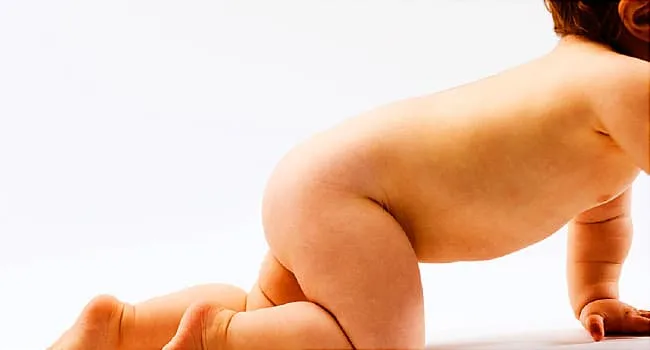
This is often the stage when the living room officially becomes a baby gym. Some babies crawl on hands and knees, while others scoot, roll, shuffle, or temporarily move backward. Crawling style and timing vary, and not every baby crawls before walking.
Common Milestones by About 9 Months
- Gets into a sitting position and sits without support.
- Transfers an object from one hand to the other.
- Uses the fingers to rake small pieces of food closer.
- Looks when their name is called.
- Makes repeated sounds such as “bababa” or “mamama.”
- Raises the arms to be picked up.
- Looks for a dropped or partly hidden object.
- Bangs two objects together.
- Enjoys peekaboo.
- May become shy or cautious around unfamiliar people.
Looking for a hidden or dropped item reflects developing object permanencethe growing understanding that something still exists when it cannot be seen. Separation reactions may increase for a similar reason: your baby understands that you have left but cannot yet understand exactly when you will return.
Play Ideas for 7 to 9 Months
Hide part of a toy beneath a cloth and encourage your baby to find it. Roll a soft ball back and forth, stack cups for the baby to knock over, and describe everyday actions. Keep small objects, coins, button batteries, magnets, and choking hazards completely out of reach, especially once the pincer grasp begins to develop.
10 to 12 Months: Cruising Toward the First Birthday

The final months of the first year often bring rapid gains in mobility, communication, and problem-solving. Babies become determined investigators. Containers must be emptied. Cabinets must be inspected. Every spoon dropped from the highchair must be tested again, apparently in the name of science.
Milestones Commonly Seen by 12 Months
- Pulls up to stand.
- Walks sideways while holding furniture, often called cruising.
- Picks up small pieces of food between the thumb and index finger.
- Places an object into a container.
- Looks for a toy hidden beneath a blanket.
- Waves “bye-bye.”
- Calls a caregiver “mama,” “dada,” or another special name.
- Briefly pauses or stops after hearing “no.”
- Plays interactive games such as pat-a-cake.
- Drinks from an open cup while an adult holds it.
Independent walking is not required by the first birthday. Many healthy 12-month-olds are still crawling, pulling to stand, or cruising. Walking may begin earlier or later, and it is more useful to look at the overall progression of strength, balance, symmetry, and mobility than to circle a single date on the calendar.
Encouraging One-Year Development
Create safe spaces where your baby can move freely. Use sturdy furniture for supported standing, play simple imitation games, and respond when your baby points or gestures. Expand early speech attempts: when your baby says “ba” while looking at a ball, answer, “Yes, that is a balla red ball.”
What About Premature Babies?
Babies born prematurely may reach milestones according to their corrected or adjusted age rather than their calendar age. Corrected age is calculated from the baby’s original due date. For example, a 6-month-old who arrived two months early may be developmentally compared with a 4-month-old.
Premature babies can follow the same general sequence of development while reaching individual stages at different times. Their pediatrician can explain how long corrected age should be used and whether additional monitoring is appropriate.
When Should You Talk to Your Pediatrician?
A single missed milestone does not automatically indicate a developmental disorder. Still, parents should raise concerns instead of waiting for the next dramatic milestone to appear. Contact your baby’s healthcare professional when:
- Your baby loses a skill they previously used.
- Movements appear unusually stiff, floppy, or consistently one-sided.
- Your baby rarely responds to voices, faces, or loud sounds.
- There is little progress in communication, movement, or social interaction.
- Feeding, hearing, vision, or muscle control concerns affect daily activities.
- Your instincts tell you that something is not developing as expected.
The American Academy of Pediatrics recommends formal developmental screening during the 9-month well-child visit, with additional screenings later in childhood or whenever a caregiver or clinician has concerns. Early evaluation can connect families with hearing services, physical therapy, speech-language support, occupational therapy, or other early-intervention resources when needed.
Real-Life Experiences From a Baby’s First Year
The Milestone You Missed Until You Saw a Photo
One common parenting experience is failing to notice a skill until a picture reveals it. You may take 47 photos because your baby has yogurt on one eyebrow, then realize the baby is sitting without using either hand for support. Development often arrives quietly. A skill may appear for two seconds, disappear for several days, and return when the baby has had enough rest, food, and encouragement.
Monthly photos can therefore be more than sentimental keepsakes. A picture of tummy time may show the head gradually lifting higher. A series of sitting photos may reveal that the baby first leaned forward on both hands, then used one hand, and eventually sat upright while holding a toy. The change can be easier to appreciate when the pictures are placed side by side.
Floor Time Usually Beats Fancy Gear
Many caregivers discover that the simplest activities produce the clearest progress. A blanket on the floor, a lightweight toy, a mirror, and an available adult can create dozens of learning opportunities. During floor play, babies practice shifting weight, turning the head, reaching across the body, rolling, sitting, and figuring out how to retrieve an object.
The adult’s role is not to conduct a miniature workout class. It is usually enough to offer an interesting target, provide encouragement, and allow the baby time to experiment. Babies can be surprisingly persistent when the prize is a crinkly toy, a wooden spoon, or something they are definitely not supposed to have.
Babbling Becomes a Family Conversation
Early communication can be easy to underestimate because it does not sound like recognizable speech. In real life, however, babies communicate constantly. They look away when overstimulated, raise their arms when they want to be held, squeal when excited, and repeat sounds when someone responds.
Families often develop entire conversations from this babbling. A baby says “ba-ba-ba,” an adult repeats it, and the baby responds with a delighted shriek. Although nobody has solved world peace during this exchange, the baby is practicing attention, turn-taking, listening, facial expression, and sound production.
Progress Is Rarely a Straight Line
Parents may also notice that development appears uneven. A baby who is concentrating on standing may babble less for several days. A new crawler may temporarily become frustrated at bedtime because there are suddenly more exciting things to practice. Illness, travel, disrupted sleep, or a major change in routine can make a familiar skill less visible.
This does not mean every regression should be ignored. Loss of an established skill deserves medical attention. More commonly, though, babies demonstrate abilities inconsistently while they are learning to use them in different situations.
The Comparison Trap Arrives Early
Baby groups and social media can make milestones feel competitive. One baby crawls at 7 months, another has two words before the first birthday, and someone online claims their 10-month-old has started preparing tax returns. These comparisons rarely account for temperament, corrected age, opportunities to practice, or the fact that children may focus on different abilities at different times.
A more useful comparison is your baby today versus your baby several weeks ago. Are movements becoming stronger and more purposeful? Is communication becoming richer? Is the baby increasingly curious about people and objects? Development is a collection of small changes, not a race toward the most impressive birthday video.
The First Birthday Is a Beginning, Not a Final Exam
By the end of the first year, your baby may be walking independentlyor may have no interest in letting go of the couch. There may be several meaningful words, one enthusiastic sound used for everything, or a sophisticated system of gestures. The first birthday does not close the milestone checklist. It marks the transition into another period of rapid language, movement, independence, and personality development.
The most valuable first-year habit is not obsessively checking boxes. It is observing your baby, creating safe opportunities to play, responding to communication, attending well-child visits, and speaking up when something concerns you.
Conclusion
Baby milestones provide a helpful map through the first year, but they are not a minute-by-minute itinerary. From the first social smile to sitting, babbling, cruising, and waving goodbye, each new ability grows from earlier experiences with movement, play, communication, and responsive care.
Celebrate the progress you see, take plenty of pictures, and resist turning development into a competition. Your baby does not need to be first. Your baby needs safe opportunities to explore, supportive people to interact with, and timely professional guidance whenever questions arise.

