
Skincare
A Canadian Mechanic Built a Terrifying Jay Leno Sculpture Out of Car Parts
Jul
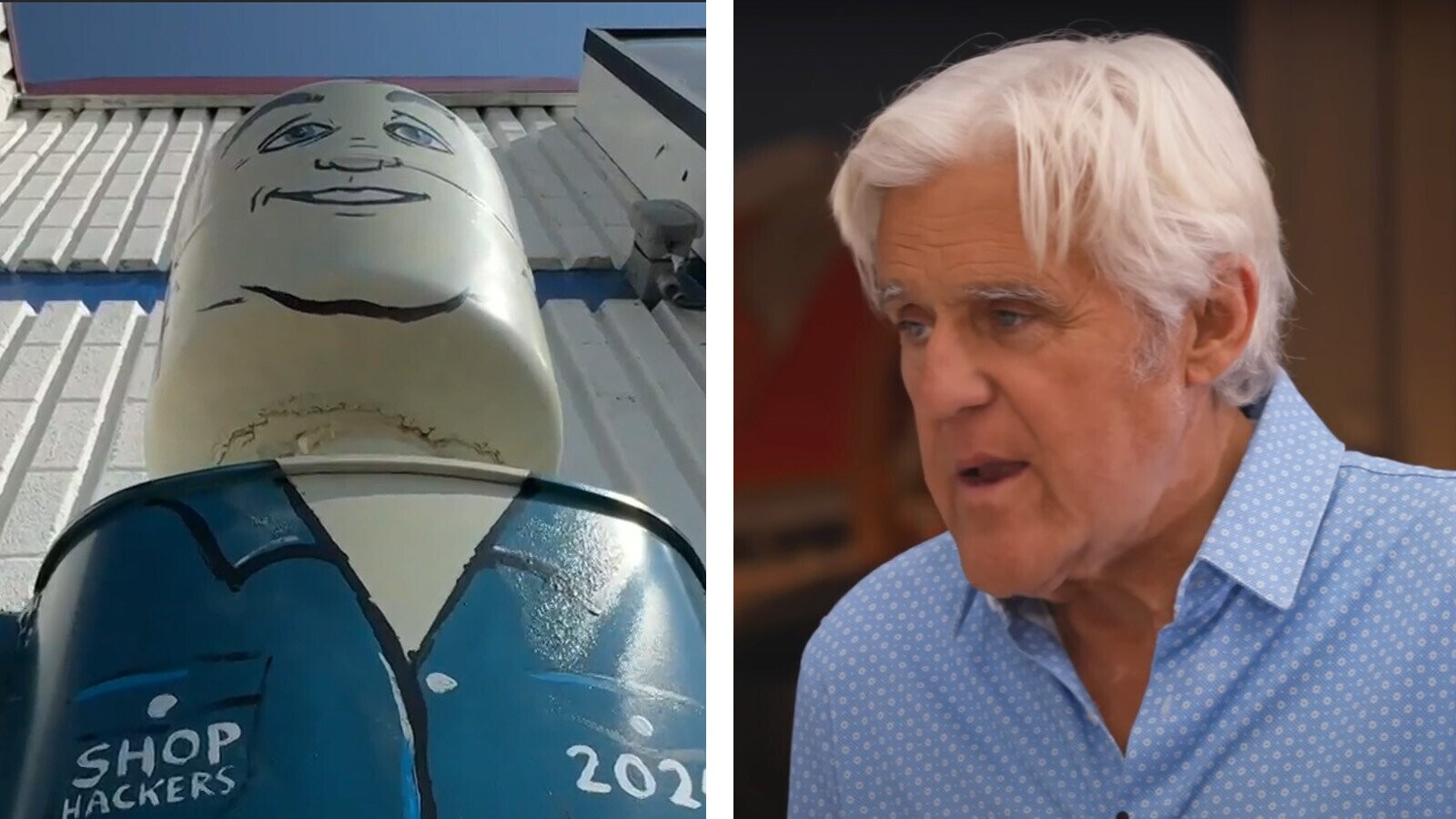
Some celebrity tributes are carved from marble. Others are cast in bronze. Peter Solly looked around his Windsor, Ontario, auto shop, saw a diesel muffler, a timing chain, several lengths of exhaust tubing and what appeared to be a perfectly usable metal canister, and thought: That is obviously Jay Leno.
The result was a towering Jay Leno sculpture built almost entirely from discarded automotive components. It was affectionate, ingenious and just unsettling enough to look as though it might start telling monologue jokes after everyone leaves the garage.
The unusual creation first attracted wider attention in 2024, when Solly was still trying to get the sculpture to Leno. The story later acquired a much happier ending. In May 2025, the Canadian mechanic personally presented his metal doppelgänger to the comedian before a performance at Caesars Windsor. Leno reportedly laughed, admired the workmanship and agreed that the oversized figure looked like himwhich was gracious, considering its torso had once helped silence a truck.
Meet Peter Solly, the Mechanic Behind the Metal
Peter Solly is an auto-shop owner, mechanic and self-taught sculptor based in Windsor. Instead of treating worn-out vehicle components as anonymous scrap, he studies their shapes and imagines what else they could become.
A curved pipe might form an elbow. A pair of circular housings can become eyes. A brake component may suddenly look less like something removed during a repair and more like the beginning of a celebrity’s belt buckle.
Solly has reportedly created hundreds of sculptures over the years, ranging from recognizable celebrities to cartoon characters and community tributes. His subjects have included the Blues Brothers, Freddie Mercury, Taylor Swift and SpongeBob SquarePants. He has also produced works honoring figures and landmarks connected to the Windsor region, including Terry Fox, hockey legend Gordie Howe, a rescue dog named Nell and the Gordie Howe International Bridge.
That variety explains why the Jay Leno sculpture feels more deliberate than a random pile of parts with eyebrows. Solly has developed a practical visual language. He understands how an industrial object can suggest a shoulder, chin, hand or facial expression once it is cleaned, repositioned and combined with other components.
How the Jay Leno Car-Parts Sculpture Was Built
The finished figure stands approximately 2.4 meters tall, or just under eight feet. It reportedly required about 40 hours of fabrication, fitting and assembly. That does not include the years of mechanical experience required to look at a giant muffler and see late-night television royalty.
A Diesel Muffler Became the Torso
The body was constructed from the muffler of a large diesel truck. It gives the sculpture a broad, cylindrical torso and provides enough visual weight to support the exaggerated proportions of the figure.
Using the muffler was also thematically perfect. Leno is one of the entertainment world’s most famous automobile enthusiasts, so building his chest from an exhaust-system component feels less like a materials decision and more like extremely specific casting.
A Metal Canister Formed the Head
The sculpture’s head was shaped from a canister resembling a helium-balloon tank. Its smooth, rounded surface gave Solly a foundation for Leno’s recognizable face, including the prominent jawline that caricaturists have appreciated for decades.
The finished head is not photorealistic. It does not attempt the microscopic detail of a wax museum figure. Instead, it operates like a three-dimensional caricature: identify a few memorable features, exaggerate them confidently and trust the viewer’s brain to complete the resemblance.
Timing Chain, Brake Pad and Exhaust Tubing Completed the Look
A heavy timing chain became the belt. A large brake pad was adapted into a buckle, while exhaust tubing formed much of the legs and feet. Square metal bars served as fingers. Each component retains enough of its original identity to reward anyone who examines the sculpture closely.
Artist Glen Hawkes, a frequent collaborator, handled the painting. The finished figure wears the denim-on-denim outfit long associated with Leno’s garage appearances. In a coincidence too neat for a screenwriter, the real Leno was dressed similarly when Solly finally presented the sculpture to him.
Why Jay Leno Was the Perfect Subject
A car-parts sculpture of almost any celebrity would be entertaining. A car-parts sculpture of Jay Leno feels inevitable.
Leno is known to generations of viewers as a stand-up comedian and former host of The Tonight Show. He was inducted into the Television Academy Hall of Fame in 2014 after a television career that included multiple Emmy nominations and wins. Yet his identity outside late-night television has become almost equally connected to automotive history.
Through Jay Leno’s Garage, Leno has reviewed rare vehicles, explored restoration projects, interviewed engineers and collectors, and introduced audiences to everything from steam cars to experimental machines. The program grew from a digital series into an Emmy-winning automotive show, while Leno’s official garage platform continues to feature classic cars, motorcycles, restomods and unusual mechanical creations.
He is not merely a wealthy collector who stores polished vehicles under soft lighting. Much of his appeal comes from his willingness to discuss how machines operate. He talks to mechanics, fabricators and restorers with genuine curiosity. He gets dirty. He appreciates a clever repair. He understands why an obscure component matters.
For that reason, Solly’s sculpture communicates something a traditional bronze statue might miss. It depicts Leno using the mechanical vocabulary associated with him. The material is part of the portrait.
Why People Called the Sculpture Terrifying
Let us address the eight-foot metal comedian in the room: the sculpture is a little scary.
Its height is imposing. Its industrial body looks nearly indestructible. Its rigid fingers appear capable of either waving hello or crushing a carburetor. The smiling face occupies the narrow territory between cheerful caricature and a robot that has recently learned what laughter is.
That does not make the work unsuccessful. In fact, the slightly uncanny appearance is part of its charm. Found-object portraits often create tension because viewers recognize both the subject and the original components simultaneously. You see Jay Leno, but you also see tubing, chains, welded seams and a former truck muffler.
The brain keeps switching between “friendly television personality” and “garage guardian assembled during a lightning storm.” That visual conflict makes the piece memorable.
The word “terrifying” also reflects the playful tone of the original viral coverage rather than Solly’s intention. The sculpture was created as an admiring tribute, not as the final boss in an automotive video game.
The Long Road From Windsor to Jay Leno
Building the sculpture was only half the challenge. Delivering an eight-foot metal version of a celebrity to that celebrity requires more than a shipping label and unreasonable confidence.
Solly initially hoped to present the piece during one of Leno’s appearances in the United States, but logistical restrictions prevented the delivery. He continued looking for another route and eventually connected with people associated with the Stahls Motor and Music Experience in Michigan.
That connection made sense. Stahls preserves and displays significant automobiles, including a running 1963 Chrysler Turbine Car. Another surviving example belongs to Leno, and the museum has documented connections to the restoration and history of his vehicle.
Photographs of Solly’s sculpture reached Leno, who contacted the mechanic. Arrangements were then made for a backstage meeting when Leno performed with Arsenio Hall at the Colosseum at Caesars Windsor on May 1, 2025.
Solly and Hawkes brought the sculpture to the venue and presented it before the show. According to Solly, Leno smiled, laughed and was touched by the creativity behind the gift. The sculpture was expected to spend time on display at Stahls before continuing to Leno’s garage in Burbank, California.
A Sculpture That Could Only Come From Windsor
Solly has described Windsor as a blue-collar automotive city, making it an especially meaningful place to present the work.
That description is supported by the city’s history. Windsor developed alongside the North American automobile industry, with Ford City growing around Ford’s Canadian operations. Municipal histories describe Windsor as a center of Canadian automotive production and identify the region’s manufacturing culture as a defining part of its economy and community identity.
In that context, the sculpture is more than celebrity fan art. It is a portrait built from the working materials of Solly’s hometown. The pipes, chains and muffler evoke the repair bays, factories, skilled trades and automotive knowledge that have shaped Windsor for generations.
It is also a cross-border story. Windsor sits across the Detroit River from Michigan, and the sculpture’s journey connected a Canadian mechanic, an American automotive museum and a California-based comedian. A pile of old components became a cultural ambassadoralthough admittedly one that would be difficult to fit in an embassy elevator.
Car-Parts Art Belongs to a Larger Creative Tradition
Solly’s method fits within the established traditions of assemblage and found-object sculpture. These forms invite artists to build new works from existing materials, allowing the history and original purpose of each object to remain visible.
Museums have exhibited assemblages containing everything from furniture and glass fragments to machine components and crumpled automotive metal. Smithsonian discussions of found-object art emphasize how ordinary or discarded materials can acquire new cultural meanings when artists reorganize them.
Car parts are especially expressive materials. They arrive with scratches, heat discoloration, grease stains and signs of mechanical stress. Unlike untouched sheets of new metal, used components already have biographies.
A timing chain once transferred motion through an engine. Exhaust tubing redirected hot gases. A brake pad helped stop thousands of pounds of moving machinery. Solly does not erase those identities. He turns them into visual jokes and anatomical features.
Reuse, Recycling and the Value of Supposed Junk
The Jay Leno sculpture also demonstrates the creative possibilities of direct reuse. Recycling generally involves collecting and processing discarded material so it can become a new product. Reuse extends an object’s life without first reducing it to raw material, which is exactly what happens when a muffler becomes a torso.
No single sculpture will solve the enormous problem of automotive waste. However, work like Solly’s can change how people perceive discarded materials. Scrap stops looking like an endpoint and begins to resemble an inventory of shapes, textures and structural possibilities.
The environmental message remains secondary to the humor and craftsmanship, but it is still present: usefulness depends partly on imagination.
What the Sculpture Says About Craftsmanship
The funniest aspect of the project may be its resemblance to Leno, but the most impressive aspect is its construction.
Large scrap-metal figures must support their own weight, survive transportation and remain stable while people stand nearby. Components designed for engines and exhaust systems do not naturally align into a human body. Every joint, angle and attachment point must be planned.
The artist also has to preserve recognizability. Too many details create visual clutter. Too few leave the viewer staring at an appliance with pants. Solly’s experience allows him to select parts whose shapes communicate quickly, especially when viewed from several feet away.
That combination of structural knowledge and visual intuition is why the sculpture works. A mechanic understands metal as a functional material. A sculptor understands it as shape, gesture and personality. Solly operates in both worlds.
Experiences and Lessons From Building Art With Car Parts
Anyone inspired by Solly’s Jay Leno sculpture should know that scrap-metal art is not simply a matter of welding interesting objects together until a face appears. The most successful projects tend to involve a surprisingly patient process of collecting, cleaning, arranging and revising.
The Hunt for Parts Changes How You See a Garage
One of the first experiences reported by scrap artists is a change in visual perception. A mechanic normally evaluates a component according to whether it still performs its intended job. An artist asks a different question: what does its shape resemble?
Coil springs become ribs. Gears become eyes. Wrenches become fingers. A dented hubcap can suggest a shoulder, shield or oversized ear. After enough time spent building with found materials, a scrap bin starts to feel less like waste storage and more like a casting department.
The challenge is resisting the temptation to use every interesting object. A sculpture benefits from a consistent visual vocabulary. Selecting five strong components is usually more effective than attaching 40 unrelated items simply because they were available.
Cleaning Is the Least Glamorous and Most Important Stage
Used automotive parts may carry oil, road grime, rust, coatings and sharp residue. Before fabrication begins, components need to be inspected and cleaned appropriately. Paint, plated surfaces and unknown contaminants require particular caution because heating them may produce hazardous fumes.
Professional metalworking practices matter. NIOSH notes that welding fumes can contain metals and other substances capable of affecting the respiratory system. Effective ventilation, suitable protective equipment, eye protection and an understanding of the materials being heated are essential. This is not a project category in which “I watched half a video” qualifies as safety training.
Temporary Assembly Prevents Permanent Regret
Experienced builders often arrange pieces on the floor, clamp them to a frame or create temporary tack welds before committing to final joints. A component that looks perfect from the front may project awkwardly from the side. A heavy head can also shift the center of gravity enough to turn a proud metal celebrity into a falling workplace incident.
Photographing the mock-up from several angles helps identify proportion problems. The artist can test silhouettes, adjust the pose and confirm that the subject remains recognizable at a distance.
Imperfection Creates Personality
Scrap art becomes less interesting when every surface is polished until the material’s history disappears. Scratches, seams and mechanical details remind viewers that the figure had a previous life as machinery.
The goal is not always anatomical perfection. Solly’s Leno succeeds because it exaggerates. The huge body, mechanical hands, denim paint and unmistakable face create a personality stronger than strict realism would provide.
Transportation Is Part of the Design
Large metal sculptures are heavy, awkward and exceptionally good at refusing to fit through doors. Builders must consider lifting points, removable sections, base dimensions and vehicle capacity before finishing the work.
Solly’s struggle to deliver the sculpture demonstrates that access and logistics can be as complicated as fabrication. A piece intended for a public presentation needs a route into the venue, a stable display position and a plan for what happens afterward.
The final lesson is persistence. Solly did not abandon the tribute when the first delivery attempt failed. He continued making connections until the sculpture reached its subject. The experience turned a humorous object into a memorable encounter among mechanics, artists, museum supporters and one famously car-obsessed comedian.
Conclusion: A Mechanical Doppelgänger With Heart
Peter Solly’s Jay Leno sculpture may look capable of patrolling a junkyard after midnight, but its story is warm rather than frightening.
It celebrates a television icon through the materials he loves. It reflects Windsor’s automotive heritage, demonstrates the expressive power of found objects and proves that mechanical knowledge can become artistic language.
Most importantly, the project reached the person who inspired it. Leno laughed, Solly fulfilled a long-held ambition, and a diesel muffler received the career change of a lifetime.
Editorial note: The original 2024 coverage focused on Solly’s unsuccessful attempts to contact and ship the sculpture to Leno. Subsequent reporting confirmed that Solly presented it to Leno in Windsor on May 1, 2025. This article incorporates that later development and draws on reporting and background material from Windsor Life, CBC-related coverage, Caesars Windsor, Cracked, Jay Leno’s Garage, NBC, the Television Academy, Stahls Motor and Music Experience, the City of Windsor, the Smithsonian, the U.S. Environmental Protection Agency and NIOSH.

