
Makeup
Two Step Equations: Easy Steps to Solve Any Algebra Problem
Jul
Two step equations may sound like algebra wearing tap shoes, but they are actually one of the friendliest skills in math. Once you learn the pattern, solving them becomes less like guessing a secret code and more like following a recipe: undo one operation, undo the next operation, check your answer, and enjoy the tiny victory parade in your notebook.
In algebra, a two step equation is an equation that takes two main moves to solve. Usually, the variable is being affected by two operations, such as multiplication and addition, or division and subtraction. Your job is to isolate the variable, which is math-speak for “get the letter by itself so it can stop hiding behind numbers.”
This guide explains how to solve two step equations clearly, using inverse operations, real examples, word problem strategies, common mistakes, and practical study tips. Whether you are preparing for a quiz, helping with homework, or trying to make peace with algebra after a dramatic breakup in seventh grade, you are in the right place.
What Is a Two Step Equation?
A two step equation is a linear equation that can be solved in two main algebraic steps. It usually looks like this:
ax + b = c
In this form, x is the variable, while a, b, and c are numbers. For example:
3x + 5 = 20
This equation has two operations happening to x. First, x is multiplied by 3. Then 5 is added. To solve it, you reverse those operations in the opposite order. That means you subtract 5 first, then divide by 3.
Think of it like putting on socks and shoes. If you put on socks first and shoes second, you must take off shoes first and socks second. Algebra follows the same “undo it backward” logic, but thankfully with fewer missing socks.
Why Two Step Equations Matter
Two step equations are not just random classroom exercises created to make pencils feel useful. They are the bridge between basic arithmetic and more advanced algebra. Once you understand them, you are better prepared for inequalities, word problems, graphing linear equations, systems of equations, and eventually more complex math courses.
They also appear in real life. Anytime you calculate a cost with a fixed fee plus a rate, solve for time, compare phone plans, figure out a discount, or work backward from a total, you may be using the same structure as a two step equation.
For example, suppose a gym charges a $20 sign-up fee and $15 per month. If your total bill is $95, how many months did you pay for?
15m + 20 = 95
That is a two step equation. Algebra just walked into the gym wearing sneakers.
The Golden Rule: Keep the Equation Balanced
The most important rule in solving equations is simple: whatever you do to one side, you must do to the other side. An equation is like a perfectly balanced seesaw. If you remove 5 from one side but not the other, the whole thing tips over, and algebra starts giving you the side-eye.
So, if you subtract 5 from the left side, subtract 5 from the right side. If you divide the left side by 3, divide the right side by 3. This keeps the equation equal and allows you to find the correct value of the variable.
Easy Steps to Solve Any Two Step Equation
Step 1: Identify the Operations Around the Variable
Look at the variable and ask, “What is happening to it?” Is it being multiplied? Divided? Added to? Subtracted from? In the equation 4x – 7 = 21, the variable is multiplied by 4 and then 7 is subtracted.
Before solving, notice the order of operations applied to the variable. Then prepare to undo them in reverse.
Step 2: Undo Addition or Subtraction First
In most two step equations, you begin by removing the constant that is added to or subtracted from the variable term. The constant is the number standing alone on the same side as the variable.
Example:
4x – 7 = 21
The constant is -7. To undo subtraction by 7, add 7 to both sides:
4x – 7 + 7 = 21 + 7
4x = 28
Step 3: Undo Multiplication or Division
Now the variable term is almost alone, but not quite. In 4x = 28, the variable is still multiplied by 4. To undo multiplication, divide both sides by 4:
4x ÷ 4 = 28 ÷ 4
x = 7
And there it is. The variable has been isolated. It can now relax, sip lemonade, and stop pretending to be mysterious.
Step 4: Check Your Answer
Checking is not optional if you want confidence. Substitute your answer back into the original equation:
4x – 7 = 21
Replace x with 7:
4(7) – 7 = 21
28 – 7 = 21
21 = 21
The statement is true, so x = 7 is correct.
Example 1: Solving a Basic Two Step Equation
Let’s solve:
5x + 3 = 28
First, subtract 3 from both sides:
5x + 3 – 3 = 28 – 3
5x = 25
Next, divide both sides by 5:
x = 5
Check:
5(5) + 3 = 28
25 + 3 = 28
28 = 28
Correct. No drama, no calculator meltdown.
Example 2: Solving with Subtraction
Solve:
2x – 9 = 17
Add 9 to both sides:
2x = 26
Divide by 2:
x = 13
Check:
2(13) – 9 = 17
26 – 9 = 17
17 = 17
The answer works.
Example 3: Solving with Division
Sometimes the variable is divided by a number:
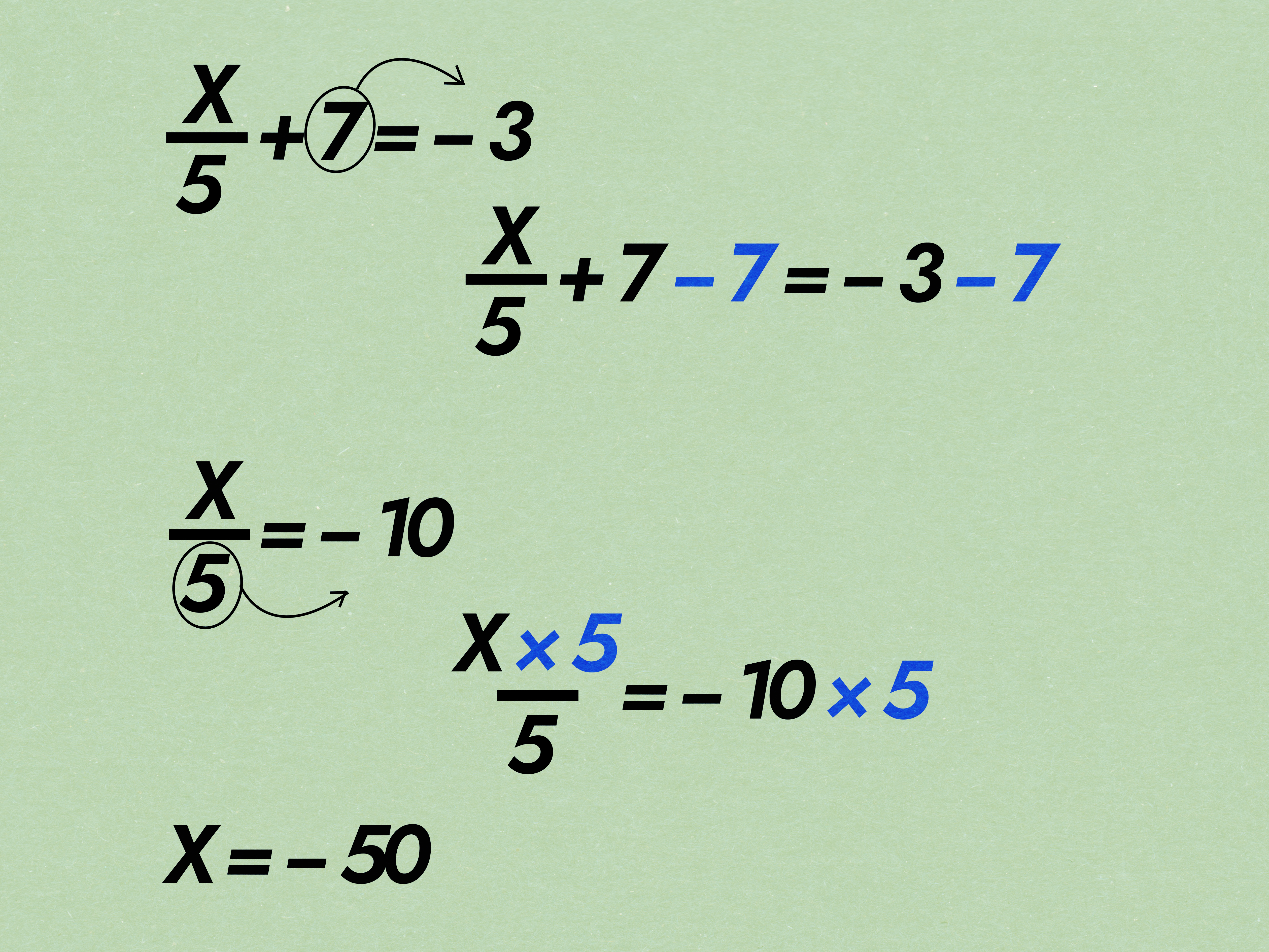
x / 4 + 6 = 11
First, subtract 6 from both sides:
x / 4 = 5
Now undo division by 4 by multiplying both sides by 4:
x = 20
Check:
20 / 4 + 6 = 11
5 + 6 = 11
11 = 11
Correct again. Algebra is beginning to look suspiciously manageable.
Example 4: Solving with Negative Numbers
Negative numbers can make two step equations look scarier than they are. The key is to move carefully and keep signs attached to their numbers.
Solve:
-3x + 4 = 19
Subtract 4 from both sides:
-3x = 15
Divide by -3:
x = -5
Check:
-3(-5) + 4 = 19
15 + 4 = 19
19 = 19
Negative signs are not villains. They are just tiny horizontal lines with strong opinions.
Example 5: Solving Equations with Fractions
Fractions are where some students start making emergency eye contact with the clock. But the process is still the same.
Solve:
x / 3 – 2 = 7
Add 2 to both sides:
x / 3 = 9
Multiply both sides by 3:
x = 27
Check:
27 / 3 – 2 = 7
9 – 2 = 7
7 = 7
Fractions tried to look intimidating. They failed.
How to Solve Two Step Word Problems
Word problems are two step equations wearing costumes. The trick is translating the words into math before trying to solve anything.
Step 1: Identify the Unknown
Ask: what are we trying to find? Let that unknown be a variable, usually x, m, or another letter that makes sense.
Step 2: Find the Fixed Amount and the Rate
Many two step word problems include a starting amount plus a repeated amount. Words like “each,” “per,” “for every,” and “monthly” often point to multiplication.
Step 3: Write the Equation
Example: A taxi charges a $4 starting fee plus $3 per mile. The total cost is $25. How many miles were driven?
Let m = miles.
3m + 4 = 25
Subtract 4:
3m = 21
Divide by 3:
m = 7
The taxi traveled 7 miles. That’s also about the distance your pencil feels like it has traveled during homework.
Common Mistakes When Solving Two Step Equations
Mistake 1: Forgetting to Do the Same Thing to Both Sides
This is the classic algebra oops. If you subtract from one side, subtract from the other. If you divide one side, divide the other. Balance is everything.
Mistake 2: Dividing Too Early
In an equation like 6x + 8 = 32, do not divide by 6 first. Remove the 8 first, then divide. Follow the reverse order of operations.
Mistake 3: Losing Negative Signs
Negative signs love to escape when nobody is watching. Write each step clearly so signs stay attached to their numbers.
Mistake 4: Not Checking the Answer
Checking your solution takes less than a minute and can save your grade from a tiny arithmetic disaster. Substitute the answer into the original equation, not the equation halfway through your work.
Two Step Equations vs. One Step Equations
A one step equation takes one operation to solve. For example:
x + 6 = 14
You subtract 6 and get x = 8.
A two step equation needs two operations:
2x + 6 = 14
You subtract 6, then divide by 2. The extra operation is what turns a one step equation into a two step equation.
Once you master one step equations, two step equations become a natural next move. It is like upgrading from a tricycle to a bicycle. Slightly more balance required, but much cooler once you get rolling.
Two Step Equations with Parentheses
Some equations look like two step equations but include parentheses:
3(x + 2) = 18
You have two good options. You can divide first:
x + 2 = 6
x = 4
Or you can distribute first:
3x + 6 = 18
3x = 12
x = 4
Both methods work. The best choice depends on what makes the equation cleaner. Algebra rewards neat thinking, not heroic suffering.
Practice Problems with Answers
Try solving these before looking at the answers. Yes, the answers are right below, but give your brain a chance to wear the cape first.
Problems
- 3x + 4 = 19
- 5x – 6 = 29
- x / 2 + 7 = 15
- -4x + 3 = 23
- 6x – 10 = 8
Answers
- x = 5
- x = 7
- x = 16
- x = -5
- x = 3
Tips to Get Better at Solving Two Step Equations
First, write every step. Mental math is useful, but when you are learning algebra, skipping steps can turn a simple equation into a mystery novel with a disappointing ending.
Second, use inverse operations as your main strategy. Addition and subtraction undo each other. Multiplication and division undo each other. Once you remember that, you have the key to solving most beginner algebra equations.
Third, keep the equal sign lined up as you work. This small habit makes your solution easier to read and helps prevent errors.
Fourth, practice with different types of numbers: positive numbers, negative numbers, fractions, and decimals. The structure stays the same, even when the numbers change outfits.
Finally, check your answer. It is the algebra version of proofreading. Nobody enjoys finding a mistake after submitting the assignment, especially when the mistake was just a missing minus sign acting like it owns the place.
Real-Life Uses of Two Step Equations
Two step equations are useful in everyday situations because they help you work backward from a total. For example, if a streaming service charges a one-time setup fee plus a monthly cost, you can use a two step equation to figure out how many months are included in a total bill.
They also help with budgeting. Suppose you saved $40 already and add the same amount each week. If you want $160 total, the equation might be:
20w + 40 = 160
Subtract 40:
20w = 120
Divide by 20:
w = 6
You need 6 weeks. Algebra just became your financial planning assistant, minus the suit and coffee breath.
How Teachers Often Explain Two Step Equations
Many teachers use the balance model. Imagine both sides of the equation sitting on a scale. If the scale is balanced, both sides have the same value. To keep it balanced, every move must happen equally on both sides.
Another popular explanation is the “undoing” method. Look at what happened to the variable, then undo the operations in reverse order. If the equation says 2x + 5 = 17, the variable was multiplied by 2 and then increased by 5. Undo the +5 first, then undo the multiplication by 2.
Visual tools like algebra tiles can also help. They show variables and numbers as objects, making it easier to see why removing the same amount from both sides keeps the equation balanced. Once students understand the idea visually, the symbolic steps usually make more sense.
Experience-Based Advice: What Solving Two Step Equations Feels Like in Real Learning
When students first meet two step equations, the biggest challenge is rarely the math itself. It is usually the feeling that there are too many things happening at once. A variable, a coefficient, a constant, an equal sign, and maybe a negative number all show up together like an algebra flash mob. The best approach is to slow down and name each part before solving.
In real practice, confidence grows fastest when students solve equations in neat, small steps. For example, instead of staring at 7x – 4 = 31 and trying to magically know the answer, write the first move: add 4 to both sides. That one action turns the equation into 7x = 35. Suddenly the problem looks much friendlier. Divide by 7, and the answer is x = 5. The mountain was actually two stairs wearing a dramatic hat.
A helpful habit is to talk through the equation in plain English. Say, “The variable is multiplied by 7, then 4 is subtracted. I will undo the subtraction first, then undo the multiplication.” This kind of self-explanation may feel silly at first, especially if your dog is the only one listening, but it trains your brain to recognize the pattern.
Another experience that helps is checking answers immediately. Many learners think checking is only for when they are unsure, but checking is also how you build trust in your process. When you plug your answer back into the original equation and both sides match, you get proof that your steps worked. That proof matters. It turns algebra from “I hope this is right” into “I know why this is right.”
It is also normal to make mistakes with negative numbers. Almost everyone does. The secret is not to become a perfect math robot. The secret is to write carefully enough that you can find the mistake. If -2x + 6 = 18, subtracting 6 gives -2x = 12. Dividing by -2 gives x = -6. The negative sign belongs to the 2, and ignoring it changes the answer completely. Treat negative signs like VIP guests: small, but important.
Practice works best when it is mixed. Do a few equations with addition, a few with subtraction, a few with fractions, and a few with negatives. This prevents your brain from memorizing only one pattern. You want to understand the method, not just repeat a trick.
For parents or tutors helping someone learn, avoid rushing to correct every tiny slip immediately. Instead, ask, “What operation is happening to the variable?” or “What would undo that?” These questions help the learner think, rather than just copy. Algebra becomes less scary when students feel like they are making decisions, not following mysterious commands from a textbook wizard.
For students, the best mindset is this: every two step equation is asking you to restore simplicity. The variable is trapped under two layers. Remove the outside layer first, then remove the inside layer. That is all. With enough practice, two step equations stop feeling like a test of intelligence and start feeling like a puzzle with reliable rules. And honestly, any puzzle that can be solved in two steps deserves a little respect.
Conclusion
Two step equations are one of the most important building blocks in algebra. They teach you how to isolate a variable, use inverse operations, keep equations balanced, and check your work. The process is simple: remove the added or subtracted number first, then undo multiplication or division. After that, substitute your solution back into the original equation to make sure it works.
Once you understand this pattern, algebra becomes much less intimidating. You can solve equations with positive numbers, negative numbers, fractions, decimals, and real-world situations. The numbers may change, but the method stays steady. In other words, two step equations are not here to ruin your day. They are here to teach your brain how to solve problems logically, one clean move at a time.

