
Body Care
A Work Of Art That Also Receives AM And SSB
Jun
Note: This article is written for educational and editorial use, synthesizing real information from amateur radio, electronics, maker, and homebrew receiver communities.
When a Radio Becomes More Than a Box of Parts
Most radio receivers are built to do one job: pull signals out of the air and turn them into sound. That alone is already a small miracle. But every so often, a builder creates something that does not merely receive AM and SSB signalsit looks like it escaped from a modern art gallery, took a detour through a ham shack, and decided to settle down on a workbench.
“A Work Of Art That Also Receives AM And SSB” is the perfect description for a homebrew radio receiver that combines practical engineering, digital control, analog radio craft, and sculptural enclosure design. At its heart, this kind of project is about more than tuning into shortwave broadcasts or amateur radio chatter. It is about the joy of building a machine that has personality.
In the world of homebrew radio, function matters. Sensitivity, selectivity, stability, audio clarity, shielding, and tuning accuracy all count. But form matters too. A receiver with visible design intention invites people to ask questions. Why are there two compartments? Why is one side digital and the other analog? Why does the handle look retro and futuristic at the same time? And most importantly: does it actually work?
Yes, it doesand that is what makes the project delightful. It is not a prop. It is not a decorative gadget pretending to be useful. It is a real AM and SSB receiver, built around proven radio ideas and enhanced with modern maker tools such as Arduino control, a Si5351 clock generator, an OLED display, an optical encoder, and a 3D-printed enclosure that proudly refuses to be boring.
What AM And SSB Reception Actually Mean
To appreciate the beauty of this receiver, it helps to understand what it is receiving. AM, or amplitude modulation, is one of the oldest and most familiar ways to transmit voice and music by radio. In a conventional AM signal, the transmitter varies the strength of a carrier wave according to the sound being sent. That creates two matching sidebands around the carrier. It is simple, robust, and historically important, but it uses more bandwidth than necessary.
SSB, or single sideband, is a leaner cousin of AM. Instead of transmitting the carrier and both sidebands, SSB suppresses the carrier and sends only one sideband. The result is a signal that occupies less spectrum and puts more usable energy into the information-carrying part of the transmission. That is why SSB is so popular in amateur radio, marine communications, aviation, and long-distance HF voice work.
For listeners, SSB has a small learning curve. Tune slightly off and voices sound like robots gargling through a kazoo. Tune correctly and the signal snaps into intelligible speech. A good SSB receiver needs a stable local oscillator, smooth tuning, and enough audio clarity to make weak voices understandable. That is where direct conversion receiver design becomes interesting.
The Direct Conversion Receiver: Simple, Elegant, And Slightly Magical
A direct conversion receiver is one of the most elegant architectures in radio. Instead of converting a radio signal to an intermediate frequency, filtering it, and then demodulating it, a direct conversion receiver mixes the incoming signal directly down to audio. In plain English, the receiver uses a local oscillator running near the frequency of the desired signal. When the oscillator and radio signal meet in the mixer, the difference between them becomes audible sound.
This approach is especially appealing for homebrew builders because it reduces complexity. Fewer stages mean fewer places for gremlins to hide. A direct conversion receiver can be simple enough for a determined hobbyist to build, yet capable enough to receive CW, AM, and SSB signals when properly designed.
The tradeoff is that direct conversion receivers demand care. Oscillator stability matters. Audio filtering matters. Shielding matters. Strong nearby stations can sneak in if the front end is not selective enough. Hum, grounding problems, and digital noise can also cause mischief. In radio building, mischief is measured in squeals, buzzes, whistles, and the occasional urge to stare into the middle distance while holding a soldering iron.
That is why the best homebrew receivers are not just circuits. They are systems. The antenna input, band-pass filtering, mixer, oscillator, audio amplifier, tuning controls, display, grounding, power supply, and enclosure all influence the final listening experience. A beautiful receiver that ignores RF layout is just a sculpture. A well-built one becomes a sculpture that talks.
The DC40 Influence And The Homebrew Tradition
Many modern homebrew direct conversion projects trace their inspiration to respected amateur radio designs such as the DC40 receiver. Designs like these became popular because they demonstrate an important lesson: radio does not have to be mysterious black-box technology. With a handful of components and careful construction, a builder can hear real signals from real people across impressive distances.
The receiver behind this article was inspired by the DC40 concept, with modifications from builders in the amateur radio community. This is how the homebrew world often works. One person designs a circuit, another improves a stage, another documents a fix, and someone else wraps the whole thing in an enclosure that looks like it belongs on the bridge of a tiny interplanetary tugboat.
That collaborative spirit is part of the charm. Amateur radio projects are rarely isolated inventions. They are conversations conducted through schematics, blog posts, build logs, GitHub repositories, forum comments, and coffee-stained notebooks. The final object may sit on one person’s bench, but it carries the fingerprints of a whole culture of experimenters.
Analog Soul, Digital Precision
One of the most compelling features of this receiver is the partnership between analog and digital design. The radio section is fundamentally analog: signals come from the antenna, pass through RF stages, mix with an oscillator, and emerge as audio. But the tuning system uses modern digital tools to improve usability.
An Arduino can control a Si5351 clock generator, which provides a tunable oscillator signal. A rotary encoder lets the operator change frequency smoothly, and a small OLED display shows the current tuning point. This combination gives the receiver a precise, modern feel without stripping away the charm of analog listening.
The Si5351 has become popular in homebrew radio because it is affordable, flexible, and capable of generating stable clock signals across useful frequency ranges. For builders, it can replace older variable frequency oscillator approaches that require more mechanical and analog finesse. That does not mean the old ways are obsolete. It simply means today’s hobbyist can combine classic RF ideas with digital control and get on the airor at least listen to itwith less frustration.
In this design, the digital system is not hidden. It is celebrated. The OLED, encoder, and control interface become part of the object’s visual identity. Instead of pretending to be a vintage receiver, the project says, “Yes, I contain microcontrollers and old-school RF magic. Please admire both.”
Why The Separate Enclosures Matter
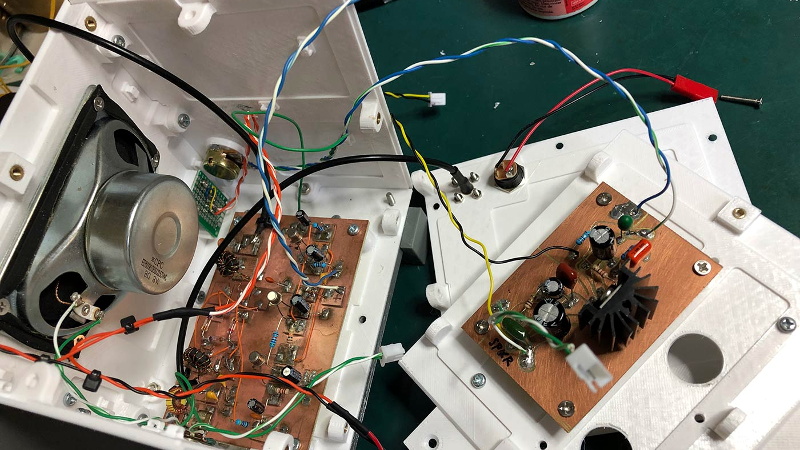
The receiver’s two-box design is not just aesthetic flair. Keeping digital and analog sections separated can reduce interference. Digital circuits are noisy little creatures. Microcontrollers, displays, clock generators, and fast switching signals can spray unwanted RF energy into sensitive receiver stages. Analog front ends, especially those designed to pull weak HF signals from the air, do not appreciate that kind of behavior.
By physically separating the tuner and receiver sections, the builder helps prevent digital noise from contaminating the analog signal path. This is practical engineering. But the enclosure turns that practical choice into visual drama. The two compartments sit at angles, with controls placed on opposite sides. The whole object looks slightly off-balance, yet intentionally composed.
That is where the “work of art” part earns its title. Many projects use 3D printing as a quick way to make a box. This one uses 3D printing as a design language. The case is not merely a container; it explains the machine. It tells you there are two worlds inside: the disciplined, number-crunching digital tuner and the sensitive, whisper-catching analog receiver.
The Role Of 3D Printing In Modern Radio Builds
Homebrew radio used to mean metal chassis, hand-drilled panels, surplus knobs, and whatever enclosure could be rescued from a retired power supply. Those builds have their own beauty. A scratched aluminum panel with hand-lettered labels can be as charming as an old jazz record. But 3D printing has expanded what a radio project can look like.
With 3D printing, builders can design custom shapes around their circuits instead of forcing circuits into generic boxes. They can create angled faces, integrated handles, recessed displays, custom encoder mounts, ventilation features, and internal supports. Brass heat-set inserts allow printed parts to be assembled and disassembled cleanly, giving plastic enclosures a more professional feel.
In a radio receiver, enclosure design is not only cosmetic. It affects usability. A good knob position makes tuning comfortable. A readable display reduces frustration. A stable base prevents the receiver from sliding around. A carry handle makes the object feel portable and intentional. When design supports operation, the radio becomes more inviting.
AM Listening: The Warm Side Of The Dial
AM reception gives a homebrew receiver immediate personality. Depending on the band and antenna, a listener might hear local broadcast stations, shortwave broadcasters, utility signals, or distant stations fading in and out as the ionosphere changes. AM has a familiar warmth because many people grew up with AM broadcast radio, even if they now stream music through devices that have never known the thrill of static.
On shortwave, AM can feel cinematic. Signals rise and fall. Voices arrive from far away. Music carries a texture that reminds you it traveled through the sky, not through a fiber-optic cable. A sensitive receiver makes that experience more vivid. Even when the audio is imperfect, the imperfections become part of the charm.
For a direct conversion receiver, AM reception can be a little tricky compared with standard envelope detection, but many designs can receive AM intelligibly. The key is careful tuning and proper oscillator behavior. When it works, the result is satisfying: a handmade object pulling broadcast energy out of the air like a net catching invisible butterflies.
SSB Listening: Where The Hobby Gets Addictive
SSB reception is where many listeners become hooked. Amateur radio operators use SSB across HF bands for casual conversations, contesting, emergency communications, portable operations, and long-distance contacts. Unlike broadcast AM, SSB often feels like eavesdropping on a living network of human voices.
Because SSB suppresses the carrier, the receiver must reinsert a reference signal locally. In practical terms, that means tuning matters. A tiny adjustment can change a voice from unintelligible duck-noise to perfectly clear speech. This gives SSB listening a tactile quality. You are not passively selecting a channel; you are actively resolving a signal.
A smooth encoder and stable digital oscillator make this process more enjoyable. The operator can move through the band with control, watching frequency on the OLED display while listening for voices to sharpen into focus. It is part science, part craft, and part treasure hunt.
Design Lessons From A Beautiful Receiver
This project offers several lessons for anyone interested in electronics, radio, or maker culture. First, aesthetics are not superficial. A good-looking project is more likely to be used, demonstrated, shared, and improved. Beauty keeps a build from becoming another unfinished board in a drawer labeled “Someday,” which every hobbyist owns and none will admit is actually a drawer of guilt.
Second, modular design helps. Separating digital control from analog reception makes troubleshooting easier and reduces interference risk. If something goes wrong, the builder can test sections independently. That is good engineering and good sanity management.
Third, old and new technologies can work beautifully together. Direct conversion receivers are classic. Arduino-controlled Si5351 tuning is modern. 3D printing is contemporary. The result does not feel confused; it feels complete.
Fourth, documentation matters. Projects like this inspire others because they are visible. Build logs, photos, code notes, enclosure designs, and circuit explanations help transform one person’s experiment into a learning resource for many.
Practical Tips For Building A Similar AM And SSB Receiver
Start With A Proven Circuit
New builders should resist the temptation to invent every stage from scratch. Start with a known direct conversion receiver design, then modify gradually. Proven circuits save time and reduce the number of mysterious failures that can make a beginner wonder whether radio waves have a personal grudge.
Pay Attention To The Front End
A receiver is only as good as what it lets in. Band-pass filtering helps reject strong out-of-band signals. Without proper filtering, powerful AM broadcast stations or local RF noise can overwhelm sensitive stages. Selectivity is not glamorous, but it is the difference between listening and suffering.
Keep Digital Noise Under Control
Microcontrollers, displays, and clock generators should be placed carefully. Use short signal paths, sensible grounding, shielding where appropriate, and physical separation between noisy digital sections and sensitive analog stages. The receiver’s two-compartment design is a smart example of this principle.
Invest In Good Controls
A quality rotary encoder or tuning knob can transform the user experience. SSB listening rewards fine adjustment. If the tuning control feels sloppy, the whole receiver feels less capable. The knob is where the operator’s hand meets the radio’s brain, so it should feel good.
Design The Enclosure Early
Do not treat the case as an afterthought. Think about airflow, access to screws, board mounting, control spacing, display visibility, cable routing, and how the receiver will sit on the desk. A beautiful enclosure begins as a practical enclosure that kept getting smarter.
Why Projects Like This Still Matter
In an age of inexpensive software-defined radios, it is reasonable to ask why anyone would build an AM and SSB receiver by hand. After all, a tiny USB dongle and a laptop can display huge chunks of spectrum in full color. That is impressive technology. But building a receiver teaches different lessons.
A homebrew receiver forces you to understand what happens between antenna and speaker. You learn why oscillators drift, why grounding matters, why filtering saves your ears, why strong signals overload weak designs, and why “just one more small change” can consume an entire Saturday.
More importantly, you develop a relationship with the object. A commercial receiver is a tool. A homemade receiver is a story. Every knob, screw, solder joint, printed bracket, and design compromise becomes part of that story. When it finally receives a voice from hundreds or thousands of miles away, the sound feels personal.
Experience: Living With A Receiver That Looks Like Art
Using a radio like this changes the mood of a room. A plain black receiver can be excellent, but it often disappears into the background of cables, monitors, and power supplies. An artful AM and SSB receiver does the opposite. It announces itself. Visitors notice it before they know what it is. Some assume it is a retro speaker. Others guess it is a science-fiction prop. A few ask whether it controls a submarine. These are all acceptable answers until the demonstration begins.
The first experience is tactile. You reach for the tuning control, and the receiver responds. The OLED gives a precise number, but the speaker gives the truth. Static rises, fades, and shifts. A carrier appears as a tone. A voice slides into focus. With AM, the sound may bloom slowly, like an old broadcast waking up from a nap. With SSB, the process is more interactive. You nudge the frequency, listen, nudge again, and suddenly the operator on the other end sounds human instead of like a tired robot trapped in a soup can.
There is also an emotional reward in knowing that the object is understandable. Modern devices often hide their intelligence behind sealed cases and software layers. A homebrew receiver invites curiosity. You can point to the antenna input, the mixer, the oscillator, the audio amplifier, the digital tuner, and the display. The radio becomes a teaching tool, not just a listening device.
The artistic enclosure adds another layer to the experience. Because the analog and digital sections are visually separated, the operator becomes aware of the receiver as a conversation between two disciplines. One side listens with analog sensitivity; the other side counts, controls, and displays. The handle, angled boxes, offset knobs, and printed structure make the receiver feel less like equipment and more like a character. It has posture. It has attitude. It looks ready to receive Radio Havana one minute and pilot a tiny moon rover the next.
In actual use, the receiver rewards patience. HF listening depends on time of day, band conditions, antenna quality, and local noise. Some sessions are quiet. Some are crowded. Some produce only atmospheric hiss and the humbling reminder that the ionosphere does not care about your schedule. But when a signal arrives clearly, the satisfaction is different from clicking a stream online. You did not request data from a server. You caught a wave.
That is the lasting appeal of a work-of-art radio receiver. It makes invisible forces feel intimate. It turns electronics into design, design into curiosity, and curiosity into sound. It proves that a handmade machine can be useful without being ugly, beautiful without being decorative fluff, and technically serious without losing its sense of fun.
Conclusion
A work of art that also receives AM and SSB is more than a clever headline. It is a reminder that engineering and aesthetics do not have to live in separate rooms. The best homebrew radio projects solve technical problems while also inviting people to look closer, ask questions, and maybe pick up a soldering iron themselves.
This kind of receiver combines the best parts of the maker movement: classic radio theory, modern digital control, practical 3D printing, careful enclosure design, and the deeply satisfying experience of hearing real signals through something you built. It may receive AM broadcasts and SSB conversations, but it also transmits a message of its own: useful objects can be beautiful, and beautiful objects can absolutely know their way around a band plan.

