
Makeup
Astier de Villatte + Commune de Paris
Jun
Astier de Villatte + Commune de Paris is the kind of collaboration that makes design lovers lean forward and say, “Wait, tell me everything.” It brings together Astier de Villatte’s handmade Parisian ceramics, poetic fragrances, and slightly mischievous old-world charm with Commune de Paris, a French label known for graphic identity, rebellious spirit, and modern design with historical bite. The result is not one single object, but a small universe: Tricolore tableware, a red-white-and-blue candle, and the unforgettable Commune de Paris 1871 cologne.
At first glance, this collaboration looks elegant, almost quiet. A cup. A plate. A candle. A bottle of cologne. Very civilized, yes? Then you notice the colors, the rough handmade edges, the historical reference to 1871, and the citrusy fragrance that behaves like it entered the room wearing a velvet jacket and carrying a protest sign. That is the beauty of the Astier de Villatte Commune de Paris partnership: it is refined, but never boring.
What Is Astier de Villatte + Commune de Paris?
The phrase Astier de Villatte + Commune de Paris usually refers to a creative collaboration between the Parisian ceramics and fragrance house Astier de Villatte and the fashion/design label Commune de Paris. The most visible pieces include the Tricolore line of tableware, the Commune de Paris candle, and Commune de Paris 1871, an eau de cologne designed with celebrated perfumer Françoise Caron and the Takasago perfume team.
These pieces share a common mood: French history reimagined through handmade luxury. Instead of shouting “patriotism” with a megaphone, the collection whispers it through red, white, and blue geometry, black terracotta clay, milky glaze, citrus notes, powdery woods, and a wink toward the Paris Commune of 1871. It is historical, but not dusty. It is luxurious, but not stiff. It is the design equivalent of a Parisian dinner guest who knows philosophy, wears excellent shoes, and somehow makes chipped ceramics look intentional.
The Two Creative Worlds Behind the Collaboration
Astier de Villatte: Handmade Imperfection as Luxury
Astier de Villatte was founded in Paris in 1996 and has become famous for ceramics that feel both antique and modern. The brand’s signature look often involves black terracotta clay finished with a luminous white glaze. Because pieces are handmade, small variations are part of the appeal. A plate may not be mathematically perfect; a cup may have a soft wobble; a rim may reveal the darker clay beneath the glaze. In mass production, that might be called a flaw. In Astier de Villatte’s world, it is the whole point.
The house is not limited to tableware. Astier de Villatte also works in candles, incense, colognes, stationery, books, and other objects that make a home feel curated rather than simply decorated. Its aesthetic sits somewhere between an 18th-century Parisian workshop, an artist’s apartment, and a cabinet of curiosities. It is romantic without becoming sugary, luxurious without becoming loud, and strange in exactly the right amount.
Commune de Paris: Graphic Design with a Revolutionary Pulse
Commune de Paris brings a different but complementary energy. The label is associated with fashion, product design, and a bold Parisian visual language. Its name references the Paris Commune of 1871, a short-lived but symbolically powerful revolutionary government. That historical connection gives the brand a sense of independence, audacity, and social memory.
When Commune de Paris meets Astier de Villatte, the collaboration does not feel like a simple logo swap. It feels like a conversation between craft and rebellion. Astier contributes material depth: clay, glaze, scent, handmade surfaces. Commune de Paris contributes graphic punch: tricolor motifs, historical reference, and a sharper visual rhythm. Together, they create objects that belong on a table, a mantel, or a shelf, but also in a story.
The Tricolore Tableware: French Color, Parisian Texture
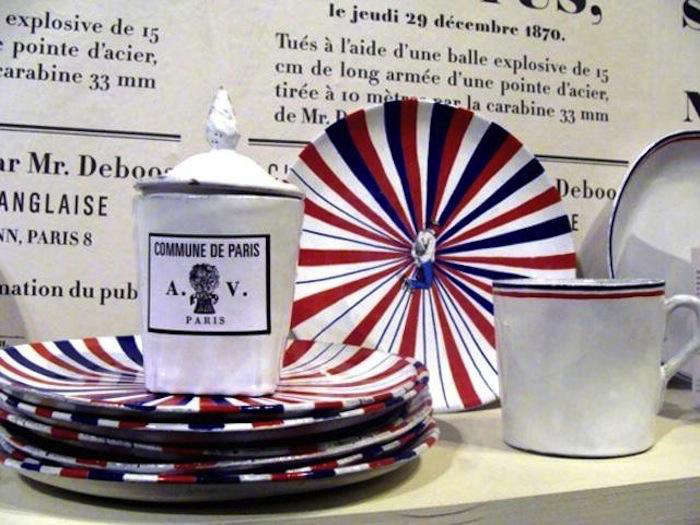
The Tricolore collection is one of the clearest expressions of the Astier de Villatte and Commune de Paris collaboration. The pieces have included tea cups, soup bowls, dessert plates, and other tabletop items decorated with red, white, and blue accents. The look nods to the French flag, but it avoids souvenir-shop clichés. No tiny Eiffel Tower winking at you from the saucer. No “bonjour” printed in a font that should be illegal. Instead, the design uses geometry and restraint.
What makes the Tricolore line work is the contrast between graphic clarity and handmade irregularity. The colors feel crisp, but the ceramic body remains soft, human, and slightly imperfect. That tension makes the pieces interesting. A Tricolore tea cup can look patriotic, playful, and antique all at once. A dessert plate can dress up a simple lemon tart so effectively that the tart may start believing it has a passport.
For collectors, Tricolore pieces also have appeal because they represent a specific creative moment. They are not just “white Astier ceramics,” although they carry the brand’s unmistakable DNA. They are Astier de Villatte seen through the visual lens of Commune de Paris. That makes them especially attractive to people who love French tableware, limited collaborations, and objects that can anchor a room without screaming for attention.
The Commune de Paris Candle: A Tricolor Object with Citrus Bite
The Astier de Villatte Commune de Paris candle takes the collaboration into fragrance and home atmosphere. Unlike Astier’s classic white ceramics, the candle’s porcelain vessel uses a red, white, and blue cube pattern. It breaks from the brand’s quieter ceramic palette while still feeling connected to its handmade world.
The scent profile has been described around a bright citrus structure, with warm and aromatic accents such as nutmeg, benzoin-like resin, green almond, and coumarin. In simpler terms, it does not smell like a generic “fresh candle” from a supermarket aisle. It smells more thoughtful: zesty at the top, softly nostalgic underneath, and just odd enough to be memorable.
As a design object, the candle is clever because it works before it is even lit. The patterned porcelain becomes a decorative piece, while the fragrance adds another layer once the flame is burning. It is the kind of candle that looks good on a marble mantel, a bookshelf, or a dining table set with mismatched white plates. It does not need a grand interior to shine. In fact, it may look best in a room that has books stacked horizontally, flowers in a chipped vase, and at least one chair that looks inherited from someone interesting.
Commune de Paris 1871 Cologne: The Rebellious Scent
Commune de Paris 1871 is perhaps the most wearable part of the collaboration. Created by Astier de Villatte with Commune de Paris and perfumer Françoise Caron, it is an eau de cologne that reinterprets a classic structure with a more unusual, historically charged personality.
The fragrance opens with a bright burst of Italian lemon, rosemary, and bergamot. Pink pepper adds sparkle, while lavender gives it an aromatic backbone. Then the scent moves into warmer, softer materials: labdanum, benzoin, patchouli, vetiver, and cedarwood. It also references two early synthetic perfume molecules: benzaldehyde, associated with an almond-like smell, and coumarin, known for a hay-like, freshly cut grass impression.
This is where the fragrance becomes more than “nice citrus.” Many colognes are designed to be brisk and clean, like a white shirt drying in the sun. Commune de Paris 1871 starts there, then wanders into a room filled with old books, polished wood, powder, herbs, and possibly a revolutionary pamphlet. It is fresh, but not shallow. It is powdery, but not old-fashioned in a sleepy way. It is unisex, elegant, and quietly eccentric.
Why the Collaboration Works
It Balances History and Modern Design
The best design collaborations do not simply place two names side by side. They create a third identity. Astier de Villatte + Commune de Paris works because both brands care about history, but neither treats the past like a museum rope you are forbidden to cross. Astier revives old ceramic methods and Parisian craft traditions. Commune de Paris uses the memory of 1871 as a creative spark. The result feels rooted, not retro.
It Makes Imperfection Desirable
Modern consumers are surrounded by perfect objects: identical mugs, identical plates, identical candles, identical everything. The Astier de Villatte approach offers a different pleasure. Handmade variation gives the object a pulse. A Tricolore cup may have tiny irregularities in shape or glaze. That is not a defect; that is the hand of the maker showing up for work.
It Has a Sense of Humor
There is something delightfully cheeky about turning revolutionary energy into elegant tableware and cologne. The collaboration knows that design can be serious without wearing a permanently furrowed brow. It can reference French political history and still look great beside a croissant. It can smell refined and still feel rebellious. That little contradiction is part of the charm.
How to Style Astier de Villatte + Commune de Paris at Home
If you own a piece from this collaboration, you do not need to redesign your entire home around it. These objects are strong, but they are not difficult. A Tricolore tea cup looks beautiful on open shelving with plain white ceramics, silver flatware, and linen napkins. A dessert plate can bring color to an otherwise neutral table. A soup bowl can make a weeknight meal feel like it deserves subtitles.
For a dining table, pair Tricolore pieces with simple linens, clear glassware, and matte metal accents. Avoid overloading the table with too many competing patterns. Let the red, white, and blue details do the talking. If you want a relaxed look, mix one or two Tricolore pieces with other Astier de Villatte white ceramics. If you want a bolder look, use the pattern repeatedly and keep the rest of the table minimal.
The candle works well in spaces where visual warmth matters: a reading corner, entry table, bedroom dresser, or living room mantel. Because the porcelain vessel has graphic presence, it can function as decor even when unlit. The cologne belongs wherever you prepare for the day: on a vanity, a bathroom shelf, or a desk tray with other personal objects. The bottle itself has that understated apothecary elegance that makes everyday grooming feel slightly more cinematic.
Buying Tips for Collectors and Design Lovers
Astier de Villatte pieces are often expensive, and collaboration items may be harder to find than standard collections. Before buying, check authenticity, condition, and seller reputation. Because handmade ceramics vary naturally, ask for photos of the exact piece when possible. Tiny irregularities are normal; cracks, major chips, or glaze problems should be clearly disclosed.
For fragrance, pay attention to bottle size and availability. Commune de Paris 1871 has appeared in 50 ml and 150 ml spray formats, with pricing varying by retailer and region. If buying online, confirm shipping restrictions, especially for perfume, because alcohol-based fragrances can have special delivery rules.
For ceramics, treat care instructions seriously. Many collectors prefer gentle hand-washing for artisanal pieces, even when a seller suggests durability. Avoid sudden temperature shocks, do not stack rare pieces carelessly, and remember that a handmade cup is not a gym sock. It does not appreciate rough treatment.
Who Will Love Astier de Villatte + Commune de Paris?
This collaboration is ideal for people who love French design, artisan ceramics, niche fragrance, and objects with stories. It is especially appealing if you enjoy interiors that feel collected over time rather than purchased in one afternoon from a showroom. These pieces are not for someone who wants everything symmetrical, shiny, and obedient. They are for someone who enjoys a little irregularity, a little history, and a little drama with their morning coffee.
It also suits gift buyers looking for something more meaningful than another predictable luxury item. A Tricolore cup, a scented candle, or Commune de Paris 1871 cologne can feel personal without being overly intimate. It says, “I noticed your taste,” rather than “I panicked and bought the first expensive thing I saw.” Honestly, that is a useful distinction.
Experience: Living with the Astier de Villatte + Commune de Paris Mood
The experience of Astier de Villatte + Commune de Paris is less about ownership and more about atmosphere. Imagine a small apartment on a gray morning. The table is not perfectly set, because real life rarely behaves like a catalog. There are crumbs near the cutting board, a stack of books on a chair, and flowers that are leaning dramatically, as if auditioning for French cinema. Then a Tricolore tea cup appears on the table. Suddenly the room feels considered. Not formal. Not precious. Just considered.
That is the quiet power of these pieces. They do not require perfection around them. In fact, they seem happier when the scene has texture. The handmade surface of an Astier de Villatte cup looks natural beside a linen napkin with wrinkles. The red, white, and blue pattern gives energy to a simple breakfast. Coffee tastes like coffee, of course, but the ritual feels upgraded. The cup gives your morning a costume change.
The same is true of the Commune de Paris candle. Lighting it in the evening changes the pace of a room. Citrus brings brightness, while warmer notes create softness. The fragrance does not flatten the space like an air freshener. It moves through the room in layers. One minute it feels crisp and lively; later it feels more resinous, powdery, and intimate. It is the sort of scent that makes a person look up from their phone and ask, “What is that?” That question is half the fun.
Commune de Paris 1871 cologne offers a different kind of experience because it travels with the wearer. At first spray, it feels energetic and clean, with lemon and herbs creating a fresh impression. After a while, the fragrance becomes warmer and more thoughtful. The almond-like and hay-like facets give it a vintage personality, but the composition never feels trapped in the past. It feels like an old idea rewritten with sharper punctuation.
What makes the entire collaboration memorable is that it turns daily gestures into small ceremonies. Drinking tea, lighting a candle, spraying cologne, setting dessert plates on the tablenone of these actions are complicated. But with the right object, they gain emotional weight. Astier de Villatte + Commune de Paris makes everyday routines feel connected to craft, history, and Parisian imagination.
And yes, there is a tiny danger. Once you begin noticing handmade edges, milky glaze, historical references, and niche scent structures, ordinary objects may start looking a little too ordinary. Your plain mug may seem nervous. Your generic candle may avoid eye contact. Your bathroom shelf may suddenly demand a French accent. That is the occupational hazard of good design: it teaches your eye to want better company.
Still, the appeal is not about showing off. The best way to enjoy Astier de Villatte + Commune de Paris is to use it, not worship it from across the room. Let the cup hold tea. Let the plate carry cake. Let the candle burn. Let the cologne settle into skin. These objects become more meaningful when they participate in life. Their beauty is not fragile in spirit. It is alive, imperfect, and ready for the table.
Conclusion
Astier de Villatte + Commune de Paris is a collaboration built on contrast: handmade ceramics and graphic rebellion, old-world craft and modern Parisian wit, fresh citrus and powdery historical depth. From the Tricolore tableware to the Commune de Paris candle and Cologne 1871, the partnership proves that luxury does not have to be cold or predictable. It can be irregular, fragrant, historical, funny, and deeply human.
For collectors, these pieces offer rarity and storytelling. For design lovers, they offer texture and visual charm. For fragrance fans, Commune de Paris 1871 offers a distinctive take on classic cologne. And for anyone who believes a cup, candle, or scent can make ordinary life feel more artful, this collaboration is a very persuasive argument.
Note: This article is based on publicly available brand, product, retailer, and editorial information about Astier de Villatte, Commune de Paris, the Tricolore collection, the Commune de Paris candle, and Commune de Paris 1871 cologne. It is written as original SEO content for web publishing.

