
Beauty Tools & Accessories
100+ Hours In 3 Minutes: A Time-lapse Video Of My Huge Marker Drawing
Jun
There is something wonderfully suspicious about a three-minute art video that begins with a blank surface and ends with a giant marker drawing full of characters, fruit, motion, and tiny details. Your brain knows the trick. It understands that more than 100 hours did not magically evaporate into a snack-sized clip. And yet, when the final image appears, the reaction is still the same: “Wait. How did we get here?”
That is the strange magic of a time-lapse drawing video. It compresses exhaustion, planning, caffeine, back pain, marker fumes, accidental ideas, and probably at least one dramatic stare into the distance into a few fast minutes. The project behind “100+ Hours In 3 Minutes: A Time-lapse Video Of My Huge Marker Drawing” captures exactly why process-based art content feels so addictive online. Viewers do not only want to see the finished piece. They want to watch the drawing wake up.
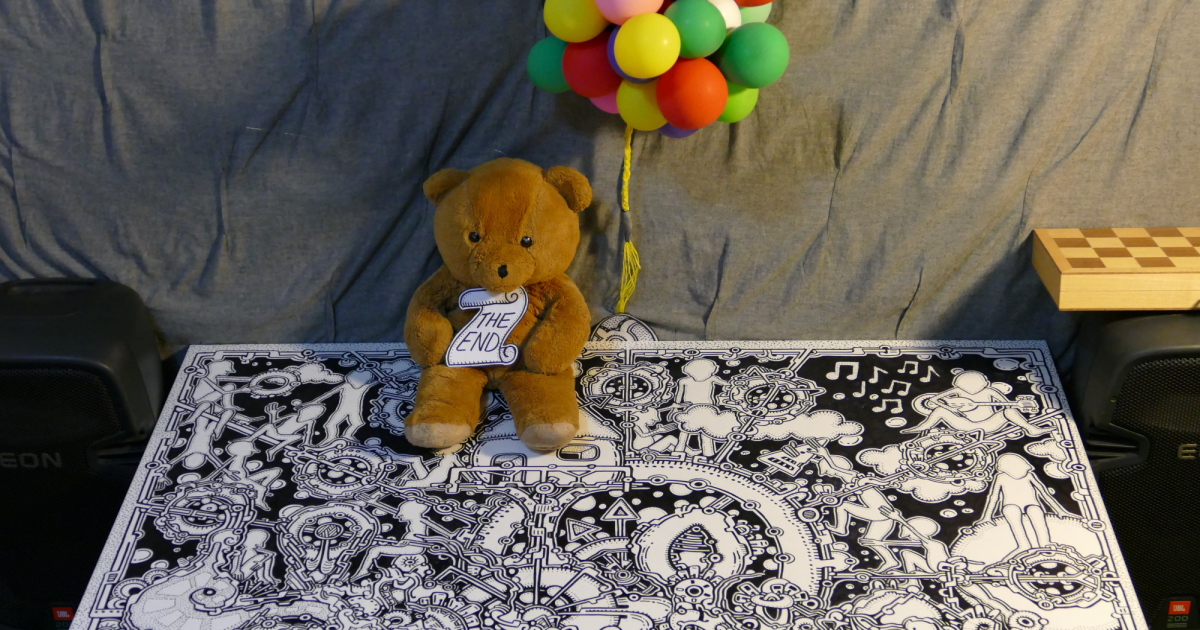
This huge marker drawing reportedly began with a simple idea: use a black marker on a wooden board and make a speed-drawing. That sounds easy in the same way “just build a house” sounds easy if you forget walls, plumbing, gravity, and your uncle’s opinions. Once the first frames were checked, a banana had appeared in the teddy bear’s hands, and from there the piece grew into something bigger, stranger, funnier, and far more time-consuming. The result is a dense visual story where fruits move, a teddy bear becomes part of the action, and the whole scene evolves like a doodle that drank an energy drink and got a master’s degree.
Why Time-lapse Art Videos Are So Satisfying
A time-lapse video works because it gives viewers the reward of progress without making them sit through every single hour of it. In real life, a 100-hour drawing includes long stretches where the artist is refining shadows, repeating patterns, correcting proportions, or leaning over the board wondering whether hands were invented by someone with a personal grudge against artists. In a time-lapse, those tiny decisions become visual momentum.
Instead of watching one line at a time, the viewer sees an idea transform. Blank space becomes structure. Structure becomes character. Character becomes chaos. Chaos becomes composition. This is why time-lapse videos of marker drawings, murals, paintings, ink illustrations, and sketchbook spreads perform well across visual platforms. They deliver a before-and-after transformation, but they also show the bridge between the two.
The Joy of Watching a Drawing “Come to Life”
The phrase “come to life” is used a lot in art writing, sometimes so often that it deserves a small vacation. But with a time-lapse drawing, it fits. The viewer watches objects appear, shift, and interact. The artist’s hand becomes a kind of narrator. Every new mark says, “Here is what I noticed next.”
In this marker drawing, the charm comes from the sense that the artwork is discovering itself. A teddy bear, a moon, fruit, and playful visual movement do not feel like cold design elements placed in a diagram. They feel like ideas that wandered into the room, made themselves comfortable, and refused to leave. That spontaneity is part of the appeal. Even highly planned drawings become more human when the viewer can sense the artist responding to happy accidents.
The Power of a Huge Marker Drawing
Marker art has a boldness that is hard to fake. A marker line is immediate. It does not politely ask permission. It arrives, sits down, and says, “Well, I live here now.” That confidence gives large marker drawings their graphic punch. Black marker on a wooden board is especially striking because the contrast is simple but intense. The surface has texture, the line has authority, and the composition has to carry the entire experience without hiding behind soft gradients or endless digital undo buttons.
Working large also changes the artist’s relationship with the piece. A small sketchbook drawing can be held, turned, and quietly judged under a desk lamp. A huge marker drawing has presence. It occupies space. It requires the artist to move around it, step back, lean in, and manage the composition like a tiny city planner with ink-stained fingers.
Why Black Marker Feels So Honest
Black marker has very little patience for hesitation. Unlike pencil, it does not easily disappear. Unlike digital drawing, it does not offer a friendly “Command-Z” after every questionable decision. That risk makes the process exciting. Every line matters because every line stays. Mistakes must be absorbed, disguised, turned into texture, or promoted to “intentional design choice,” which is the official survival phrase of many artists.
This is one reason viewers enjoy watching marker drawings in time-lapse format. They can feel the commitment. A long, confident stroke has tension. A repeating pattern has rhythm. A dense area of detail shows patience. The finished image may be whimsical, but the process requires discipline.
From Simple Speed Drawing to 100+ Hour Visual Adventure
The funniest part of many ambitious art projects is that they often begin with the words “I thought it would be simple.” That sentence has ruined weekends, destroyed clean desks, and created some excellent work. In this case, the original plan was modest: create a relatively simple speed-drawing using a black marker and wooden board. Then the drawing began to make suggestions.
That is a familiar experience for artists. You start with a plan. Then one shape asks for another shape. A character needs an object. The object needs a joke. The joke needs background detail. The background detail needs balance. Suddenly, what was supposed to be a quick drawing has become an ecosystem with fruit choreography.
The banana appearing in the teddy bear’s hands is a perfect example of creative escalation. It is small, funny, and visually specific. It turns the bear from a static figure into a participant. Once that happens, the image stops being only a drawing and becomes a scene. Scenes demand logic, movement, and personality. Before long, the artist is not merely filling space; the artist is directing a tiny black-and-white movie on wood.
What Makes a Good Art Time-lapse Video?
A successful art time-lapse is not only about pointing a camera at a desk and hoping for internet applause. The setup matters. The camera has to stay steady. Lighting should remain consistent. The frame needs to show enough of the process without blocking the artwork. If the artist’s hand covers everything, the audience sees less “creative genius” and more “mysterious wrist documentary.”
Good time-lapse storytelling also needs pacing. Viewers should see major stages: the blank beginning, early structure, expanding details, turning points, dense middle work, and final reveal. The best videos make the process feel inevitable, even when the artist privately knows that half the piece was held together by improvisation and stubbornness.
Camera, Lighting, and Patience
For a 100-hour drawing, the technical setup becomes part of the artwork. A tiny bump to the camera can ruin continuity. A sudden lighting change can make the video flicker. A shadow can cover important detail. Batteries, memory cards, tripods, and file backups become silent collaborators. They are not glamorous, but neither is losing eight hours of footage because a camera decided to nap.
The artist also needs patience with repetition. Large marker drawings often involve patterns, textures, and repeated shapes. In real time, that can be slow. In time-lapse, repetition becomes hypnotic. The viewer watches clusters grow, areas darken, and the composition tighten. What might feel tedious during production becomes one of the most satisfying parts of the final video.
Why Viewers Love Process More Than Perfection
Finished artwork is impressive, but process is relatable. Most people cannot create a huge marker drawing, but they understand effort. They understand starting with nothing. They understand a project getting out of hand. They understand the strange mix of excitement and regret that arrives around hour 47 of anything.
Time-lapse videos reveal the hidden labor behind art. They remind viewers that impressive work is not created in one dramatic burst while inspirational music plays in the background. It is built through decisions, corrections, experiments, and persistence. The three-minute version is fun, but its emotional power comes from knowing that those three minutes contain more than 100 hours of focus.
This is especially valuable in an online culture where finished images often appear without context. A time-lapse restores that context. It says, “Here is the making. Here is the mess. Here is the human behind the polished result.” That honesty builds trust with an audience.
SEO Lessons From a Marker Drawing Time-lapse
The title “100+ Hours In 3 Minutes: A Time-lapse Video Of My Huge Marker Drawing” works because it contains a clear promise. It tells readers the time investment, the compressed viewing experience, the format, and the subject. That is strong search-friendly storytelling. The title naturally includes important phrases such as “time-lapse video,” “marker drawing,” and “huge drawing,” while also giving the reader a reason to click.
For web publishing, this type of article benefits from clean headings, descriptive paragraphs, and related terms used naturally. Phrases like “marker art,” “speed drawing,” “drawing process,” “black marker illustration,” “large-scale artwork,” and “art time-lapse” help search engines understand the topic without making the article sound like it was written by a keyword blender.
Why the Human Angle Matters
The strongest part of this topic is not simply that a drawing took 100 hours. It is that a simple idea grew into something alive. That gives the article a story arc. Search engines can index keywords, but human readers stay for transformation. They want the tiny moment when the banana appeared. They want the shift from “simple drawing” to “time-consuming but fun experience.” They want the feeling that creativity is not a straight hallway but a weird little maze with snacks.
How to Preserve a Marker Drawing After the Video Ends
Once a large marker drawing is finished, preservation becomes important. Works on paper, wood, and other surfaces can be affected by light, humidity, heat, dust, and handling. Marker ink may also vary in permanence depending on the brand, pigment, dye, and surface. If the piece is meant to last, it should be photographed carefully, stored or displayed away from harsh sunlight, and protected from moisture and abrasion.
For artists, documentation is not optional. A high-resolution final photograph can preserve the work digitally, support prints, help with portfolio presentation, and provide a backup in case the physical piece changes over time. The time-lapse is part of that documentation, but the final still image matters too. Think of it as the artwork’s official yearbook photo, preferably taken before dust, fingerprints, or an enthusiastic pet gets involved.
What Artists Can Learn From This Project
The biggest lesson is that creative projects do not always need to begin with a perfect plan. Sometimes they begin with a surface, a tool, and a loose idea. The important part is staying alert when the artwork starts offering better suggestions than the original plan. That does not mean abandoning structure completely. It means leaving enough room for surprise.
Another lesson is that process can be content. Artists often underestimate how interesting their workflow is to others. The pauses, tests, sketches, close-ups, and gradual changes may feel ordinary to the maker, but to the audience they are proof of skill. A time-lapse video turns invisible effort into visible drama.
Practical Tips for Making Your Own Drawing Time-lapse
Start with a stable camera position and test the framing before beginning. Use consistent lighting and avoid placing the setup where daylight changes wildly unless that is part of the effect. Check storage space, battery life, and focus. Record more than you think you need. Back up files often. Most importantly, choose a project with visual stages so the viewer can see transformation clearly.
When editing, keep the rhythm tight but not frantic. A good time-lapse should feel fast, not confusing. Include a few slower moments if there is a satisfying detail or reveal. End with a clean shot of the finished artwork so the viewer can appreciate what all those flying marker lines were building toward.
Experience Notes: What 100+ Hours of Marker Drawing Really Teaches You
Spending more than 100 hours on a huge marker drawing teaches lessons that do not appear in a normal art tutorial. The first lesson is that enthusiasm is loud at the beginning and very quiet in the middle. At hour one, everything feels possible. The board is fresh, the marker is ready, and the idea seems charming. By hour 38, the drawing has become a roommate. By hour 72, it has opinions. By hour 100, you are no longer making the artwork; you are negotiating peace terms.
The second lesson is that comfort matters more than artists like to admit. A long drawing session can punish the neck, shoulders, wrist, and back. The romantic image of the tortured artist is much less romantic when the artist is trying to stretch like a confused flamingo beside a desk. Breaks are not laziness. They are maintenance. A tired hand makes sloppy marks, and a tired brain starts making decisions like “What if this corner needs 400 tiny grapes?” Sometimes it does not.
The third lesson is that mistakes are rarely the end. With marker, you cannot erase easily, so you learn to adapt. A line that goes too far can become a shadow. A strange shape can become texture. A misplaced object can become part of the story. This is not just a technical skill; it is a mindset. The artwork becomes less about controlling every inch and more about responding intelligently to what happens.
The fourth lesson is that filming the process changes the way you work. Knowing a camera is watching can make you more aware of hand placement, pacing, and the order of steps. It can also make you weirdly self-conscious, as if the tripod is judging your posture. But over time, the camera becomes part of the studio. It encourages consistency and gives you a record of decisions you might otherwise forget.
The fifth lesson is that viewers often notice the small things. You may think the grand composition is the main attraction, but someone will comment on a tiny fruit, a funny character, a background detail, or the moment a blank space suddenly becomes meaningful. That is a reminder that detail is not wasted. In a huge drawing, small discoveries reward close looking.
Finally, a 100-hour time-lapse teaches humility. The three-minute video looks effortless, but the artist knows what is hidden inside it: doubt, repetition, revisions, problem-solving, and persistence. That contrast is the beauty of the format. It gives the audience a quick burst of wonder while quietly honoring the long, stubborn process behind the image. It is proof that art can be playful and serious at the same time. It can include teddy bears and bananas and still represent discipline. Honestly, that may be the most accurate description of creativity ever: serious work wearing a ridiculous hat.
Conclusion: A Tiny Video With a Giant Amount of Work Inside
“100+ Hours In 3 Minutes: A Time-lapse Video Of My Huge Marker Drawing” is more than a catchy title. It is a perfect summary of what makes process art so compelling online. The finished marker drawing is impressive, but the compressed journey is what makes viewers lean closer. They get to see a simple idea expand, mutate, and become a lively visual world filled with humor, movement, and detail.
In a digital space crowded with instant images, a time-lapse like this reminds us that art still takes time. Sometimes it takes more than 100 hours. Sometimes it starts with a black marker and a wooden board. Sometimes a banana appears in a teddy bear’s hands and suddenly the whole project gets wonderfully out of control. And sometimes, after all that work, the best way to share it is to squeeze the madness into three minutes and let the internet say, “Again.”

