
Body Care
Neutrino Transmutation Observed For The First Time
Aug
For centuries, alchemists tried to turn one element into another with secret formulas, mysterious furnaces, and an admirable refusal to accept defeat. In 2025, physicists achieved a genuine form of elemental transmutation using something far stranger than a philosopher’s stone: solar neutrinos.
Scientists working with the SNO+ experiment detected evidence that an electron neutrino from the Sun struck a carbon-13 nucleus and transformed it into radioactive nitrogen-13. The event was not loud, dramatic, or accompanied by green lightning. It produced two tiny flashes of light separated by roughly ten minutesand identifying those paired flashes required a gigantic detector located about two kilometers underground.
The result represents the first evidence of solar neutrinos interacting with carbon-13 through this particular charged-current nuclear reaction. It also demonstrates how modern particle physics can extract meaningful measurements from a signal consisting of only a handful of events.
What Does Neutrino Transmutation Mean?
In ordinary language, transmutation means changing one chemical element into another. An element is defined by the number of protons in its nucleus, so turning carbon into nitrogen requires changing the nuclear proton count from six to seven.
That is exactly what happened inside SNO+.
The reaction can be written as:
νe + 13C → 13N + e−
An electron neutrino, represented by νe, interacts with a carbon-13 nucleus through the weak nuclear force. During the interaction, one neutron in the carbon nucleus becomes a proton. The nucleus therefore changes from carbon, which has six protons, into nitrogen, which has seven. An electron is also emitted.
This is real nuclear transmutation, but it is not a new industrial method for manufacturing nitrogen. Neutrinos interact so rarely that waiting for them to convert useful amounts of material would make watching paint dry seem like a high-speed competitive sport.
The Nitrogen-13 Does Not Stay Around
Nitrogen-13 is radioactive and has a half-life of approximately 9.96 minutes. It soon decays back into carbon-13 through positron emission:
13N → 13C + e+ + νe
The carbon nucleus therefore takes a short vacation as nitrogen before returning to its original identity. That temporary transformation, however, gives researchers a distinctive experimental signature.
How SNO+ Detected the Rare Reaction
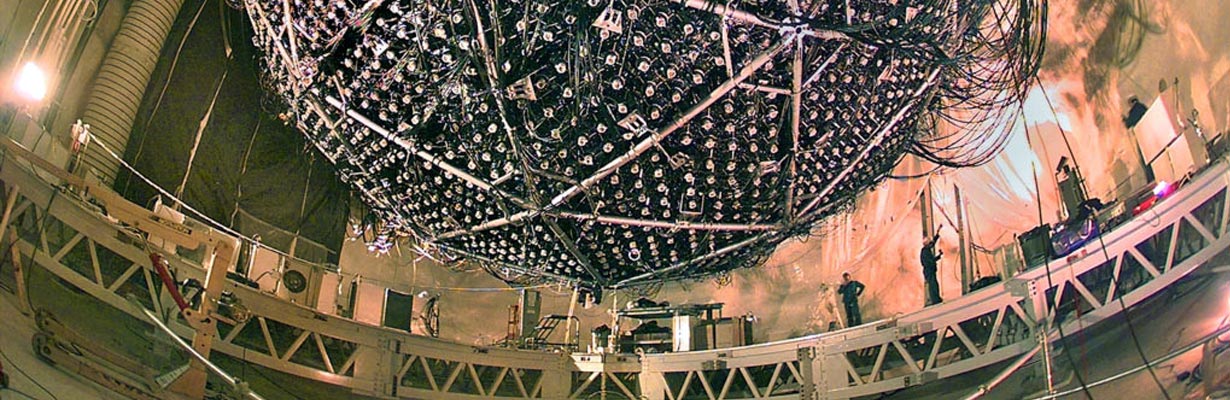
SNO+ is installed at SNOLAB in the Creighton Mine near Sudbury, Ontario. The detector sits beneath more than two kilometers of rock, where the overburden blocks most cosmic rays that could imitate or overwhelm rare particle signals.
At the center of the experiment is a spherical acrylic vessel approximately 12 meters in diameter. During the data-taking period used for this analysis, it contained about 780 metric tons of linear alkylbenzene-based liquid scintillator. Thousands of photomultiplier tubes surrounded the vessel, waiting to capture the faint light produced when charged particles traveled through the liquid.
That scale is necessary because neutrinos are famously antisocial. They carry no electric charge and interact primarily through the weak force. Enormous numbers pass through Earth, buildings, laboratory equipment, and human bodies without touching anything.
The First Flash: A Solar Neutrino Arrives
The detected reaction involved high-energy electron neutrinos produced by the decay of boron-8 in the Sun. When one of these neutrinos interacted with carbon-13, the emitted electron deposited energy in the liquid scintillator. The scintillator converted part of that energy into a prompt burst of light.
The first flash alone was not enough to prove that a carbon-13 transmutation had occurred. Radioactive impurities, other solar-neutrino interactions, atmospheric particles, detector noise, and unrelated decays can all produce light.
The Second Flash: Nitrogen-13 Decays
The crucial clue appeared several minutes later. The newly created nitrogen-13 nucleus underwent beta-plus decay and emitted a positron. That positron produced another burst of scintillation light near the location of the original event.
Researchers searched for pairs of signals that matched the expected energies, occurred close together in space, and were separated by a delay consistent with the nitrogen-13 half-life. This technique is known as delayed coincidence detection.
In effect, the nitrogen-13 nucleus left a delayed receipt confirming that the earlier neutrino interaction had taken place. Particle physics rarely provides receipts, so researchers tend to appreciate them.
Why Carbon-13 Made the Measurement So Difficult
Most naturally occurring carbon is carbon-12. Carbon-13 accounts for only about 1.07 percent of natural carbon, meaning that the vast majority of carbon nuclei in the scintillator could not participate in the reaction being studied.
Although SNO+ contained hundreds of tons of organic liquid, the analysis involved an effective carbon-13 target mass of only about 5.7 tons. That is still a great deal of carbon-13 by laboratory standards, but it is a tiny target when the incoming particle is a neutrino.
The reaction also has an energy threshold of approximately 2.2 mega-electronvolts. Only sufficiently energetic electron neutrinos can trigger it. In practice, the analysis focused on energetic boron-8 solar neutrinos and applied a prompt-energy selection beginning at 5 MeV to reject most radioactive backgrounds.
Scientists also had to contend with the long delay between the two signals. In some particle detectors, delayed coincidence means waiting microseconds. Here, the team had to connect events separated by minutes without accidentally pairing unrelated flashes. That is roughly the experimental equivalent of identifying two matching whispers in a noisy stadium after everyone has changed seats.
What the SNO+ Team Actually Found
The analysis used data recorded between May 4, 2022, and June 29, 2023. After accounting for detector quality requirements and veto periods, the usable exposure totaled approximately 231 days.
The researchers extracted a best-fit signal of 5.6 events. The theoretical expectation was about 4.7 events, so the measurement was consistent with established models of the solar-neutrino flux, neutrino oscillations, and the carbon-13 interaction cross section.
Five or six events may sound like a suspiciously small dataset. In rare-event physics, however, the number of observations is only part of the story. Researchers must also determine how often known backgrounds could imitate the signal and whether the candidates have the expected distributions in energy, position, and time.
The background-only hypothesis was rejected at a significance of 4.2 sigma. That corresponds to strong evidence that the observed pattern was not a random statistical fluctuation.
Evidence Versus Discovery
News headlines commonly describe the result as the first observation of neutrino transmutation on carbon-13. The scientific paper used the more cautious phrase first evidence.
Particle physicists traditionally reserve the word “discovery” for a significance of at least 5 sigma. The 4.2-sigma result is highly persuasive but remains below that conventional threshold. Additional data could increase the significance and sharpen the measurement.
This distinction does not make the result unimportant. It reflects the unusually strict statistical language used in fields where discoveries may depend on a few exceptionally rare events.
Why the Carbon-13 Result Matters
A New Solar-Neutrino Detection Channel
Solar neutrinos have previously been measured through several interactions, including scattering from electrons and reactions with chlorine, gallium, water, and heavy water. The SNO+ result adds carbon-13 charged-current interactions to the experimental toolkit.
Different target nuclei respond to different neutrino flavors and energies. Every newly measured channel gives physicists another way to test models of the Sun, nuclear structure, and neutrino behavior.
A Direct Measurement of the Reaction Cross Section
A cross section describes the probability that a particular interaction will occur. It is not a literal physical target area, although the terminology sometimes makes particles sound as though they are firing microscopic darts.
The SNO+ result provided the first direct measurement of the charged-current cross section leading specifically to the ground state of nitrogen-13 at solar-neutrino energies. Previous experimental information came from higher-energy neutrino sources and included multiple nuclear reaction channels.
Improved cross-section measurements reduce uncertainties in future neutrino experiments. They also help test nuclear models used to predict how neutrinos interact with complex nuclei.
Validation of Delayed-Coincidence Methods
The experiment proved that a delay of roughly ten minutes can still be used to identify an extremely rare neutrino-induced reaction when the detector has sufficiently low background levels and accurate position reconstruction.
That achievement could influence searches for other low-energy neutrino interactions that produce unstable daughter nuclei. The method may be especially useful in large scintillator experiments studying solar neutrinos, supernova neutrinos, or other weak nuclear processes.
From the Solar Neutrino Problem to SNO+
The new measurement belongs to a much longer scientific story. Beginning in the 1960s, experiments detected fewer electron neutrinos from the Sun than solar models predicted. This became known as the solar neutrino problem.
The original Sudbury Neutrino Observatory, or SNO, helped solve the mystery. Using heavy water, SNO could measure electron neutrinos separately while also measuring the combined flux of all active neutrino flavors. Its results showed that the total number agreed with solar predictions, but many electron neutrinos had transformed into muon or tau neutrinos during their journey to Earth.
This phenomenon, called neutrino oscillation, demonstrated that neutrinos have mass. Arthur B. McDonald of SNO and Takaaki Kajita of Super-Kamiokande shared the 2015 Nobel Prize in Physics for work establishing neutrino oscillations.
SNO+ reused much of the original underground infrastructure but replaced the heavy-water target with liquid scintillator. The new detection medium allows the experiment to study lower-energy events and pursue a broad scientific program that includes solar neutrinos, reactor antineutrinos, geoneutrinos, supernova signals, nucleon decay, and the search for neutrinoless double-beta decay.
What This Discovery Does Not Mean
The phrase “neutrino transmutation” is exciting enough to invite a few misconceptions. First, the experiment did not demonstrate that neutrinos can efficiently convert bulk materials into new elements. The probability of interaction is far too small for practical manufacturing.
Second, the result is not the same thing as neutrino oscillation. Oscillation changes a neutrino from one flavor into another. In the SNO+ carbon-13 reaction, a neutrino changes a nucleus by converting one of its neutrons into a proton.
Third, the finding does not overturn the Standard Model. The interaction was already predicted by established weak-interaction theory. The breakthrough was observing it directly at these energies and measuring its rate.
Sometimes science advances not because nature behaves unexpectedly, but because researchers finally become capable of seeing something that theory said should be there. Catching a predicted event after decades of technical preparation is less like finding a surprise guest and more like spotting an extremely punctual guest who arrived wearing an invisibility cloak.
What Comes Next for Neutrino Research?
More SNO+ data could raise the statistical significance of the carbon-13 signal and reduce the large statistical uncertainty in the measured interaction rate. A larger sample would also allow researchers to examine the energy distribution in greater detail.
Future liquid-scintillator detectors may collect far more carbon-13 interactions simply because they contain larger target masses and operate for longer periods. Measurements from several experiments could eventually provide precision tests of solar-neutrino survival probabilities and nuclear-response calculations.
The result also shows why underground laboratories remain essential. Shielding from cosmic radiation turns a nearly impossible measurement into a merely heroic one. As detectors become larger, cleaner, and more sensitive, neutrino interactions once considered inaccessible may become routine parts of experimental catalogs.
Experience: Understanding a Discovery Built From Only a Few Events
Following a result like the SNO+ neutrino transmutation measurement can feel very different from following a discovery based on millions of observations. The first reaction from many readers is disbelief: how can scientists make a serious claim after detecting only about five or six signal events?
The answer becomes clearer when the experience is approached as a problem of patterns rather than simple counting. Imagine standing in a dark room and seeing one flash. It could come from almost anything. Now imagine seeing another flash several minutes later, in nearly the same place, with exactly the range of energy expected from the decay of a particular radioactive isotope. Repeat that process several times, while observing that ordinary background events do not cluster in the same way. Each pair becomes much more informative than an isolated blink.
For students encountering rare-event physics for the first time, the most valuable lesson is that experimental work is often dominated by understanding what a signal is not. Researchers must model natural radioactivity, cosmic-ray products, atmospheric-neutrino reactions, accidental coincidences, electronic noise, and reconstruction errors. Finding a candidate event is exciting, but proving that mundane processes cannot easily explain it is where much of the real work begins.
There is also a useful lesson in patience. The data were collected over many months, yet the final signal remained countable on two hands. The detector needed hundreds of tons of scintillator, thousands of light sensors, extremely clean materials, sophisticated simulations, and two kilometers of rock overhead. All that infrastructure was required to watch a few carbon nuclei briefly become nitrogen.
For science communicators, the result offers another experience: balancing an irresistible headline with accurate statistical language. “Neutrino Transmutation Observed for the First Time” is vivid and understandable. “First Evidence for a Charged-Current Boron-8 Solar-Neutrino Interaction on Naturally Abundant Carbon-13” is more precise but has the conversational charm of an appliance warranty.
The best explanation preserves both excitement and caution. The reaction was physically observed through a statistically significant pattern, but the reported 4.2 sigma did not reach the conventional 5-sigma discovery threshold. Saying both things does not weaken the story. It reveals how carefully scientists handle extraordinary measurements.
Finally, the experiment changes the way a reader may think about apparently empty space. Solar neutrinos are passing through Earth continuously. Most leave no trace, but occasionally one encounters the right isotope with enough energy and the correct quantum interaction. A neutron becomes a proton, carbon becomes nitrogen, an electron flies away, and ten minutes later a positron completes the signature.
Nothing about that sequence is visible to human eyes. Yet a detector buried beneath a Canadian mine can reconstruct it from tiny bursts of light. That is perhaps the most memorable experience offered by the discovery: realizing that the quietest processes in nature can become observable when human beings build instruments large enough, clean enough, and patient enough to notice.
Conclusion
The first evidence of solar-neutrino transmutation on carbon-13 is not a new form of practical alchemy. It is something more scientifically useful: a direct view of a rare weak-force reaction that had previously existed mainly in theoretical calculations.
By linking an immediate electron signal to the delayed decay of nitrogen-13, SNO+ identified neutrino-induced nuclear transmutation from only a handful of events. The result expands the ways scientists can observe solar neutrinos, provides a direct cross-section measurement, and demonstrates the extraordinary potential of low-background liquid-scintillator detectors.
Neutrinos remain ghost particles, but one of them has now been caught changing carbon into nitrogenand even ghosts have trouble hiding when physicists surround 780 tons of scintillator with thousands of very attentive light sensors.

