
Hair Care
How to Write a Love Letter: Opening, Closing, & Formatting
Jun
In a world full of typing, swiping, and sending messages that disappear faster than your motivation on Monday morning, a love letter still has serious magic. It is personal, tangible, and wonderfully un-rushed. Unlike a text that says “miss u,” a real letter says, “I sat down, found a pen, used my actual feelings, and committed them to paper without deleting half of them.” That is romance with effort, and effort is attractive.
If you have ever wanted to write a love letter but froze at the blank page, you are not alone. Many people know exactly how they feel but have no clue how to begin, what to include, or how to wrap it up without sounding like a greeting card that became sentient. The good news is that writing a heartfelt note is less about being poetic and more about being sincere.
This guide will show you how to write a love letter from start to finish, including the best way to open it, how to close it, how to format it, and how to make it sound warm, personal, and memorable. You will also get examples, common mistakes to avoid, and practical tips for turning real feelings into words your person will want to keep forever.
Why a Love Letter Still Works
A love letter does something a fast message rarely can: it slows the moment down. It gives the reader your full attention. That matters. Whether you are writing to a spouse, partner, crush, or someone you have loved for years, a letter creates a keepsake. It can be tucked into a drawer, slipped into a book, reread on a hard day, or rediscovered years later and still land with the same emotional punch.
The best love letters are not always dramatic. In fact, the most effective ones often focus on specific, everyday details. Maybe it is the way your partner always remembers your coffee order, laughs at your terrible jokes, or makes ordinary Tuesdays feel less ordinary. Big feelings are great, but specific details make the letter believable. Romance lives in the little things.
Before You Start Writing
Know your purpose
Ask yourself what kind of letter you want to write. Is this a sweet anniversary note? A “just because” message? A letter of appreciation? A long-overdue confession? Your purpose shapes your tone. A playful note feels different from a deeply reflective one, and that is exactly how it should be.
Choose a tone that fits your relationship
You do not need to sound like a Victorian poet unless that is naturally your thing. Write in a voice that feels true to you and appropriate for the relationship. If the two of you are playful, let your humor show. If your connection is more tender and sentimental, lean into that. The goal is not to sound impressive. The goal is to sound real.
Jot down a few memories first
Before writing the full letter, make a short list of moments, traits, and feelings you want to mention. Think about:
- When you first realized they mattered to you
- A moment when they made you feel seen or supported
- Specific qualities you admire
- An inside joke, ritual, or shared memory
- What you hope for in the future
This quick brainstorming step makes the actual writing much easier. It also helps prevent the classic problem of starting strong and then wandering into a paragraph that reads like emotional mashed potatoes.
How to Open a Love Letter
The opening sets the emotional tone. You want it to feel natural, warm, and personal. A stiff opening can make the letter feel distant, while an overly dramatic one can sound like you swallowed a romance novel whole. Aim for heartfelt and specific.
Start with a greeting that fits
Your salutation should match your relationship. A few examples:
- Classic: Dear Emma,
- Romantic: My Love,
- Warm and simple: Hi, Jake,
- Playful: To the person who steals my fries and my heart,
- Personal: Hey, Sunshine,
Open with why you are writing
One of the easiest ways to begin is to explain what moved you to write the letter. That instantly makes the message feel grounded instead of random. For example:
“I was thinking about us this morning, and I realized there are so many things I never say out loud often enough.”
“I know life has been busy lately, but I wanted to slow down for a minute and tell you what you mean to me.”
“I keep thinking about the night we stayed up talking until 2 a.m., and it reminded me how lucky I am to have you.”
Hook the heart, not the ego
A strong opening is not about trying to sound clever. It is about making the other person feel something right away. A great first paragraph can be gentle, affectionate, grateful, or funny. It just needs to feel honest.
What to Include in the Body of a Love Letter
The middle of the letter is where you do the real work. Think of it as the heart of the message. This is where you explain what you love, why it matters, and how the relationship has affected you.
Be specific about what you love
Generic praise is nice, but specifics are unforgettable. Instead of writing, “You are amazing,” say what makes them amazing.
Weak: “You are so great.”
Better: “I love how you can make me laugh when I am stressed, and how you always notice when something is off even when I say I’m fine.”
Best: “I still think about the night you stayed on the phone with me when everything felt like too much. You did not try to fix me. You just stayed. That meant more than I can explain.”
Include shared memories
Memories are emotional anchors. They show that your feelings are tied to real moments, not just abstract ideas. Mention a first date, a road trip, a random grocery store laugh attack, or the way they squeezed your hand when you needed reassurance. Tiny moments often make the strongest lines.
Say how they changed your life
This does not have to be dramatic. Maybe they made you more confident, calmer, kinder, or more hopeful. Maybe they turned you into someone who now willingly shares dessert. That is growth.
Look toward the future
A beautiful love letter often includes hope. You can talk about what you want to keep building together, what kind of partner you want to be, or what moments you look forward to sharing. Future-facing lines add emotional depth without making the letter feel heavy.
Example:
“I love the life we are building, not because it is perfect, but because it is ours. I look forward to all the little things still ahead of us, from lazy Sundays to big milestones and every snack run in between.”
How to Close a Love Letter
If the opening starts the emotional journey, the closing is what lingers. A good ending should leave the reader feeling cherished, understood, and remembered. It does not need to be long. It just needs to land well.
Summarize the feeling
Your closing can gently pull together the main emotion of the letter. Gratitude, admiration, comfort, and hope all work beautifully.
Examples:
- “I just wanted you to know how deeply loved you are.”
- “No matter how busy life gets, I never want to stop telling you what you mean to me.”
- “You make my life better in ways both loud and quiet, and I am grateful for all of them.”
Choose a sign-off that matches the tone
Your sign-off should feel emotionally consistent with the rest of the letter. Good choices include:
- Love always,
- With all my love,
- Yours,
- Forever yours,
- All my heart,
- With love,
- Always,
If your relationship is lighthearted, you can personalize the closing too. Something like “Yours, even when you steal the blankets” can be charming when it fits your style.
Sign your name in a natural way
You can use your full name, first name, nickname, or even a private pet name. The point is to make the ending feel like it came from you, not from a template that escaped the internet.
Love Letter Formatting Tips
Handwritten vs. typed
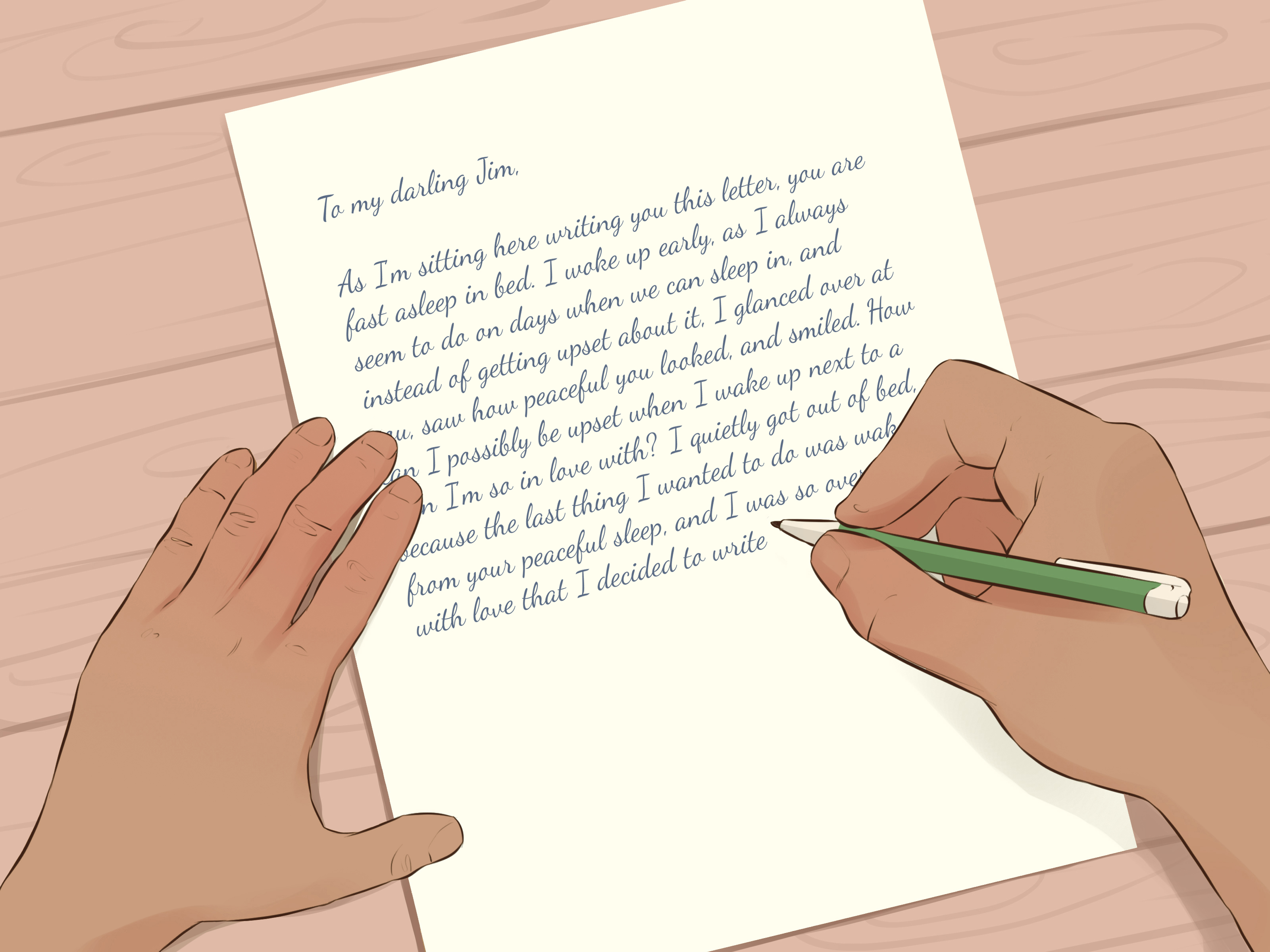
A handwritten love letter usually feels more intimate because your handwriting carries personality. It is imperfect in the best way. That said, a typed letter is perfectly fine if your handwriting looks like a spider slipped on ice. What matters most is the content.
Keep the format clean and readable
Use short paragraphs, clear spacing, and a structure that flows naturally:
- Greeting
- Opening reason for writing
- Specific qualities and memories
- What you hope for or appreciate
- Closing line and sign-off
If you are handwriting the note, choose good paper and write slowly enough that the recipient can actually read it without consulting a cryptographer.
Should you date it?
Yes, if you want the letter to feel extra keepsake-worthy. Adding the date gives it context years later. A letter that starts with “April 16, 2026” instantly becomes a tiny time capsule.
If you are mailing it
Use a neat envelope, write the delivery address clearly in the center area, and place your return address in the upper-left corner or another appropriate return-address position on the same side. Keep the outside simple and legible. The goal is romance, not a mystery challenge for the postal system.
A Simple Love Letter Template
If you need a starting point, this structure works almost every time:
Greeting: My Love,
Opening: I have been thinking about you a lot lately, and I realized there are so many things I feel that I do not say often enough.
Body: I love how you make ordinary days feel lighter. I love your patience, your humor, and the way you always know when I need support. One of my favorite memories is [insert memory], because that was one of the moments I felt closest to you. Being with you has taught me [insert insight].
Future note: I am so grateful for what we have, and I look forward to everything we still get to share.
Closing: I just wanted you to know how much you mean to me.
Sign-off: With all my love,
Your Name
Use this as scaffolding, not as a script. The more personal details you add, the more powerful the letter becomes.
Common Love Letter Mistakes to Avoid
- Being too vague: “You’re perfect” sounds nice, but details are what make the message believable.
- Trying too hard to sound poetic: If you never speak like a 19th-century novelist, do not suddenly become one.
- Making it all about you: Your feelings matter, but the letter should also make the other person feel seen.
- Overstuffing it: You do not need to include every emotion you have felt since the dawn of time.
- Forgetting warmth: Even a short letter can feel meaningful if the tone is affectionate and sincere.
Examples of Strong Love Letter Lines
If you want inspiration without copying anyone else, here are a few lines that show the right direction:
- “You make me feel more like myself, which is one of the greatest gifts anyone has ever given me.”
- “I love that with you, even the quiet moments feel full.”
- “You have this way of making life feel steadier, softer, and a lot more fun.”
- “I did not expect one person to become such an important part of my everyday happiness, but here you are.”
- “Thank you for being the person I can laugh with, lean on, and come home to emotionally, even on the messiest days.”
Final Thoughts on Writing a Love Letter
The perfect love letter is not perfect because it is polished. It is perfect because it is true. A heartfelt opening, a specific middle, and a warm closing will always matter more than fancy language. Whether your note is one page or three, handwritten or typed, playful or deeply sentimental, the real secret is honesty.
So say the thing. Write the memory. Mention the little habit, the private joke, the reason they matter, the future you hope for, the comfort they bring, the joy they create. Love letters are not about literary greatness. They are about emotional clarity. And honestly, that is a lot more romantic.
Experiences and Real-Life Moments That Make Love Letters Better
One reason people search for how to write a love letter is that the topic is not really about paper or formatting. It is about courage. A lot of people sit down to write because they have felt something meaningful in real life and do not want that feeling to pass without being noticed. Maybe it happens after a hard season in a relationship. Maybe it happens after a first trip together, a birthday, an anniversary, a reconciliation, or one tiny quiet moment that unexpectedly says, “This matters.”
For some, the experience begins with panic. They buy pretty stationery, open the notebook, write “Dear…” and then stare into the distance like a person waiting for divine intervention. That is normal. In real life, meaningful letters rarely arrive in one flawless burst. Most are built out of moments remembered one by one: the time your partner brought you soup when you were sick, the way they text before a big meeting to wish you luck, the look they gave you across a crowded room that somehow said everything without a word.
Many memorable love letters also come from ordinary experiences, not grand movie scenes. Someone writes after folding laundry together on a Sunday and realizing domestic life can feel deeply romantic. Someone writes after a stressful week because their partner made space for them without asking for applause. Someone writes after laughing so hard in the car that they had to pull over. These experiences matter because they are proof of connection. They give the letter texture.
Another common experience is writing what you could not say out loud. Some people speak easily in conversation. Others feel deeply but trip over their words in the moment. A letter helps because it removes the pressure of immediate reaction. It lets you explain, with care, what someone has meant to you over time. That can be especially powerful for long-term couples who assume the other person already knows. Maybe they do, but hearing it in writing still hits differently.
There is also something unforgettable about receiving a letter unexpectedly. Not on a holiday. Not because somebody forgot an anniversary and needed to recover heroically. Just because. Those are often the letters people keep. They get tucked into drawers, wallets, books, and memory boxes. Years later, they become evidence of a relationship not just felt, but expressed.
So when you write your own love letter, do not worry about sounding like everyone else. Write from experience. Write from the actual life you share. That is where the strongest lines come from, and that is what makes the letter worth keeping.
SEO Tags

