
Body Care
18 Technologies Straight Out of Sci-Fi That Became Real
Jun
For decades, science fiction gave us chatty computers, flying cameras, robot doctors, and maps that knew exactly where we were. We watched these ideas on screens while assuming they belonged in a future filled with silver jumpsuits and suspiciously clean hallways. Then reality got busy.
Today, many sci-fi technologies are hiding in plain sight: in our pockets, on our wrists, in hospitals, above our heads, and occasionally under the couch looking for dust bunnies. Some are fully ordinary now. Others are still early, expensive, or carefully regulated. But all of them prove that yesterday’s “that will never happen” can become tomorrow’s “why is my phone asking me to update again?”
Why Science Fiction Keeps Becoming Real
Science fiction does not always predict the future perfectly. It is much better at asking useful questions: What happens when machines understand speech? What if people can repair the human body with technology? What if distance becomes less important than bandwidth? Engineers, scientists, entrepreneurs, and researchers then spend years turning those questions into prototypes, products, and occasionally very confusing instruction manuals.
The following future technologies that exist today show how imagination, computing power, materials science, medicine, and a stubborn refusal to accept “impossible” have changed everyday life.
Everyday Sci-Fi Technology We Now Barely Notice
1. Pocket Supercomputers
Smartphones are perhaps the most successful science-fiction prop ever disguised as a rectangle. A single device combines a camera, music player, calculator, library, GPS receiver, game console, video studio, payment card, and internet-connected computer. Decades ago, a device with this much power would have needed a laboratory, a budget committee, and probably a cooling system the size of a refrigerator.
2. Video Calls and Digital Telepresence
Old sci-fi shows loved wall-sized video screens where captains called distant planets. We now make video calls while standing in grocery store parking lots. Remote meetings, virtual classrooms, family calls, and telehealth appointments have made face-to-face communication possible across oceans. The technology is less dramatic without starship uniforms, but the effect is still remarkable.
3. GPS Navigation
Satellite navigation turned “Where am I?” into a question that most phones answer before we have finished panicking. GPS uses signals from satellites and timing calculations to help devices estimate location, direction, and movement. It powers map apps, delivery services, emergency response, aviation, farming, fitness tracking, and the modern tradition of blaming a navigation app for missing an exit.
4. Real-Time Language Translation
Universal translators were once a favorite sci-fi shortcut because subtitles are hard work. Modern translation tools can interpret text, speech, and images across many languages in seconds. They are not perfect, especially with slang, humor, local expressions, or the ancient dialect known as “my uncle’s group chat.” Still, they make travel, education, and global communication far more accessible.
5. Conversational Artificial Intelligence
Talking to a computer used to mean entering rigid commands and hoping the machine did not respond with an error message that felt personally insulting. Today, AI assistants can summarize information, help draft documents, answer questions, translate language, analyze patterns, and support customer service. These systems can be useful, but they are tools, not infallible digital wizards. Important facts still deserve human verification.
6. Biometric Security
Unlocking a device with a fingerprint or face scan once sounded like something reserved for secret agents and poorly lit spy headquarters. Biometric authentication is now common in phones, banking, security systems, and travel documents. It can be convenient, but it also raises serious privacy questions. A password can be changed after a leak; replacing your face would be a much more complicated Tuesday.
Technologies That Let Us See, Build, and Move Differently
7. Augmented Reality
Augmented reality, or AR, layers digital information over the physical world. It can place navigation directions in a user’s field of view, help workers follow technical instructions, let shoppers preview furniture in a room, or turn a living room into a game board. AR is not a hologram-filled city street quite yet, but it already gives digital content a seat at the real-world table.
8. Virtual Reality
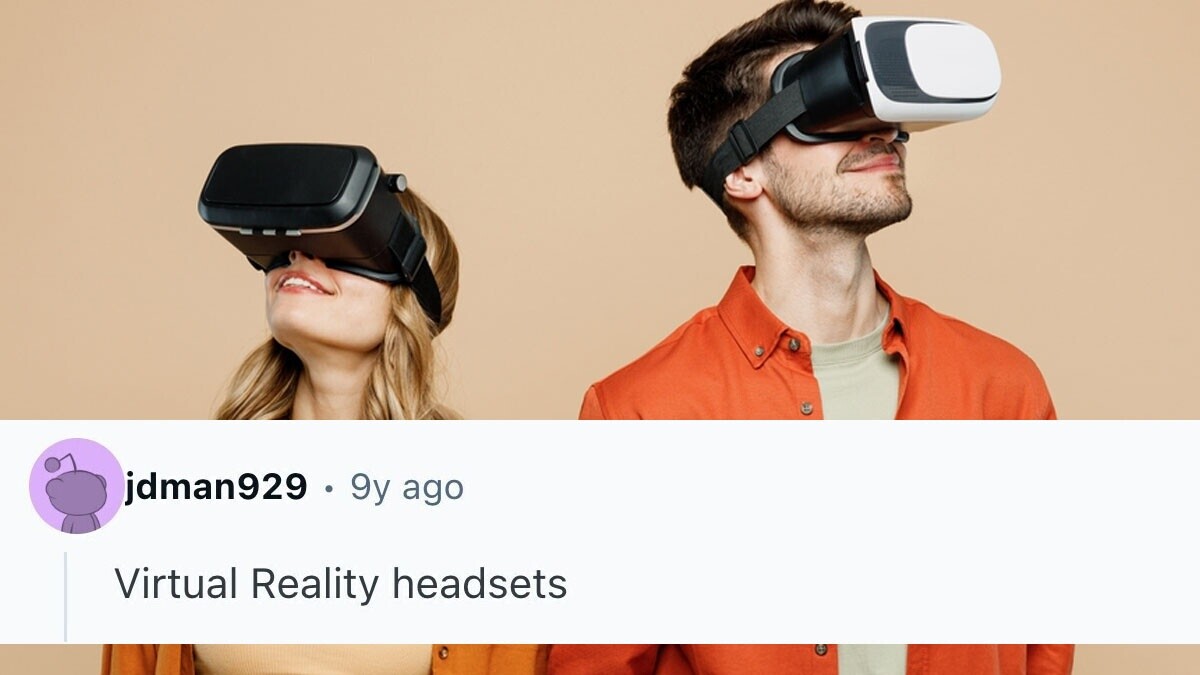
Virtual reality creates an immersive digital environment that can make a small room feel like a mountain trail, a concert venue, a flight simulator, or a galaxy far away. Beyond games, VR is used for training, design, education, therapy research, and safety simulations. The headset may leave your hair looking like it lost an argument with static electricity, but the experience can be surprisingly convincing.
9. 3D Printing
Replicators in science fiction could create almost anything from thin air. 3D printers are more humble, but they are still extraordinary. They build objects layer by layer from digital designs, producing prototypes, replacement parts, dental devices, custom prosthetics, engineering components, and even some construction materials. The technology has not solved dinner yet, but it has made manufacturing far more flexible.
10. Drones
Small flying robots once belonged mostly to military thrillers and futuristic police dramas. Drones now support photography, infrastructure inspections, environmental monitoring, agriculture, search operations, mapping, and scientific research. Their growth has also brought safety and privacy rules, which is sensible. A flying camera can be helpful; a flying camera outside someone’s bedroom window is simply a problem with propellers.
11. Driver-Assistance Systems and Early Autonomous Cars
Cars can now help with lane positioning, adaptive cruise control, parking, collision warnings, and emergency braking. Some vehicles can perform limited automated driving tasks in specific conditions. That does not mean every car is ready to become a chauffeur while its owner naps in the back seat. The safest description is that advanced driver-assistance technology is real, impressive, and still dependent on responsible human attention.
12. Lidar and Machine Vision
Lidar uses laser pulses to measure distance and create detailed three-dimensional models of spaces and surfaces. It helps map land, inspect infrastructure, guide robots, support some vehicle systems, and study forests or flood-prone areas. In sci-fi language, lidar gives machines a version of depth perception. In practical language, it helps them avoid mistaking a mailbox for an abstract sculpture.
Medical and Space Innovations That Changed the Rules
13. Wearable Health Monitoring
Smartwatches, rings, patches, and other wearable devices can track heart rate, sleep patterns, movement, activity, and other health-related signals. They have turned many people into amateur data analysts who know their resting heart rate better than their own postal code. These tools can support healthier habits and help users notice trends, but they are not a replacement for a clinician’s evaluation or professional diagnosis.
14. Telemedicine
Seeing a clinician through a phone or computer would have sounded futuristic not long ago. Telemedicine now helps many patients access routine consultations, follow-up care, mental health services, education, and chronic-condition support without traveling long distances. It cannot replace every in-person exam, test, or emergency service, but it has made health care more reachable for people facing mobility, transportation, or geographic barriers.
15. Cochlear Implants
Cochlear implants use electronic components to provide sound-related information to the auditory nerve for eligible people with certain types of hearing loss. They do not create identical natural hearing, and outcomes vary from person to person. Still, the basic idea is astonishing: a carefully engineered device can help translate sound into signals the brain can interpret. That is not magic. It is biomedical engineering doing its best magic impression.
16. Robot-Assisted Surgery
Robot-assisted surgery sounds like the opening scene of a movie where the robot eventually develops opinions. In reality, trained surgeons control sophisticated systems that can support precision, visualization, and minimally invasive techniques in certain procedures. The robot is not independently deciding what to do; the human surgical team remains in charge. That distinction matters greatly, especially when the situation involves actual organs and not movie popcorn.
17. Reusable Rockets and Autonomous Space Robotics
Rockets once seemed like one-time fireworks with a very expensive ending. Reusable launch systems have changed that assumption by demonstrating controlled returns and repeat flights in some cases. Meanwhile, robotic spacecraft and rovers explore places humans cannot easily reach. Mars, for example, has become a workplace for robots collecting images, analyzing terrain, and testing navigation methods from millions of miles away.
18. Programmable Biology: mRNA and Gene Editing
Medicine is increasingly able to work with biological instructions instead of only treating symptoms after the fact. mRNA technology can deliver temporary instructions that help cells make a specific protein, while gene-editing tools such as CRISPR allow researchers to study and potentially alter genetic material with remarkable precision. These developments are powerful, promising, and ethically complex. In other words, they are genuine sci-fi territory with real-world consequences.
The Big Lesson: Reality Is Usually Messier Than Movies
Real-world innovation rarely arrives with dramatic music. It arrives with patents, testing, regulations, software updates, safety reviews, user training, and a few years of people asking whether the battery lasts long enough. That is what makes these technologies more impressive, not less. They work because thousands of people solved boring, difficult, essential problems that science fiction usually skips.
The best science-fiction technologies are not the ones that make people feel like they are living inside a movie. They are the ones that make life safer, healthier, more connected, more creative, or more accessible. The future is not parked somewhere ahead of us. It is already here, quietly asking for permission to send notifications.
What It Feels Like to Live With Real Sci-Fi Technology
Living with real sci-fi technology does not usually feel dramatic. Most of the time, it feels suspiciously normal. You wake up, glance at a wearable device that tracked your sleep, unlock your phone with your face, and ask a digital assistant about the weather. Ten minutes later, you are following satellite navigation to a place you have never visited. If someone from 1985 saw this morning routine, they might assume you had borrowed equipment from a spaceship.
The strange part is how quickly people adapt. The first time a map app gives turn-by-turn directions, it feels miraculous. A year later, one delayed location update can trigger a full emotional monologue in the driver’s seat. The first video call with a family member across the world feels like a breakthrough. Soon after, people complain that the camera angle is unflattering. Human beings are wonderfully skilled at turning miracles into minor inconveniences.
At school or work, the experience becomes even more layered. AI tools can help organize notes, explain difficult concepts, draft a starting point for a project, or translate a message. Video platforms make it possible to collaborate with someone in another city or country. Augmented and virtual reality can turn training into an interactive simulation rather than a stack of slides that quietly puts everyone to sleep. These tools do not remove the need for judgment, curiosity, or creativity. They simply give people new ways to use them.
Health technology can feel especially personal. A wearable may encourage someone to walk more, notice changes in sleep, or keep track of a heart-rate trend. Telemedicine can make a follow-up appointment easier for a patient who lives far from a specialist. Medical implants and robot-assisted procedures may sound futuristic, but for patients and families, they are not science-fiction props. They are practical tools connected to hearing, mobility, recovery, independence, and hope.
There is also a quieter emotional shift. Technologies such as drones, reusable rockets, and robotic explorers make the world feel bigger while making information feel closer. You can watch a spacecraft image arrive from another planet, then use a tiny camera drone to see the roof of a building nearby. The gap between “outer space” and “my neighborhood” has become smaller in a way that would have delighted almost every sci-fi writer.
Of course, the experience is not perfect. Smart devices collect data. AI can be wrong. Automated systems can fail. Not everyone has equal access to high-speed internet, modern medical care, or advanced technology. The future is impressive, but it is not automatically fair. The most useful approach is to stay curious without becoming careless: enjoy the convenience, understand the limits, protect privacy, and remember that the person holding the device should remain smarter than the device whenever possible.
Note: The technologies in this article are real, but availability, safety standards, and appropriate use vary by product, country, medical situation, and regulation.
SEO Tags

