
Skincare
NASA Spacecraft Likely Flew Though a Europa Water Plume in 1997
Jun
In 1997, NASA’s Galileo spacecraft zipped past Europa, one of Jupiter’s strangest and most promising moons, at roughly 124 miles above the icy surface. At the time, the spacecraft’s instruments recorded a puzzling bend in the local magnetic field and a brief spike in charged particles. Scientists noticed the odd signal, filed it away, and moved on with the mission. Space science, after all, is a little like cleaning out a garage: sometimes the most valuable thing is sitting in a dusty box labeled “miscellaneous.”
More than two decades later, researchers returned to that old Galileo data with newer computer models and a sharper question: did NASA accidentally fly through a water vapor plume erupting from Europa? The answer, according to a major 2018 analysis, is probably yes. That possibility matters because Europa is not just another frozen rock doing laps around Jupiter. It is widely considered one of the best places in the solar system to search for environments that could support life.
The phrase “Europa water plume” sounds like something from a science-fiction trailer, but the idea is straightforward. Europa has a global ocean hidden beneath an icy crust. If cracks or vents allow water vapor to escape into space, a spacecraft could sample material from that ocean without drilling through miles of ice. In other words, Europa may occasionally hold up a cosmic spoonful of ocean and say, “Here, taste this.” Scientists are very interested in that spoon.
Why Europa Has Scientists Leaning Forward in Their Chairs
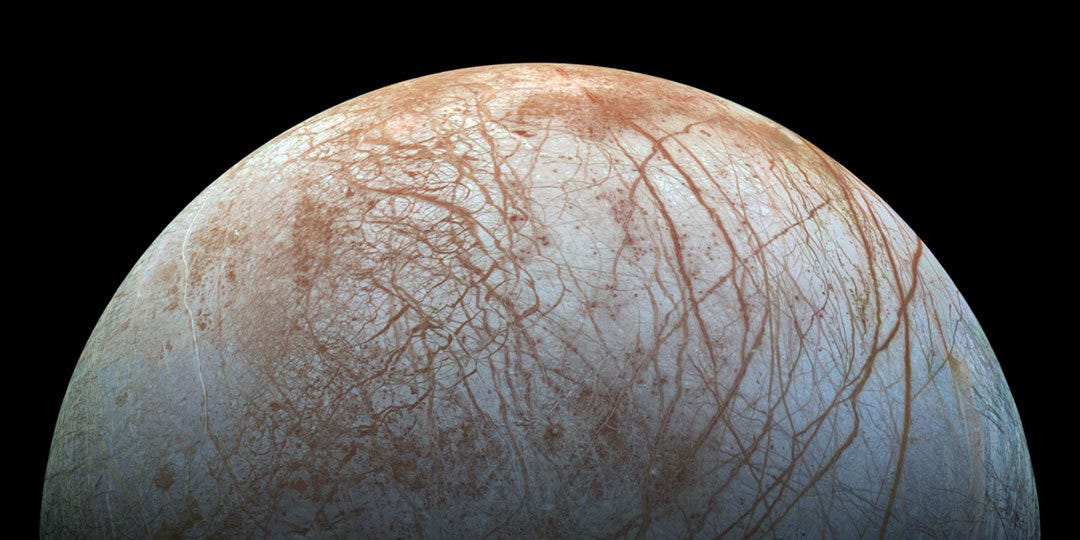
Europa is slightly smaller than Earth’s Moon, but it has a personality the size of Jupiter itself. Its surface is bright, icy, and crisscrossed by reddish-brown cracks, ridges, and chaotic terrain. These features suggest that Europa’s ice shell has been flexed, fractured, and resurfaced over time. The main engine behind that activity is Jupiter’s gravity, which squeezes and stretches Europa as it orbits the giant planet.
That squeezing, called tidal flexing, can generate heat inside the moon. Heat is important because Europa is far from the Sun, where surface temperatures are brutally cold. Yet beneath the ice, scientists believe Europa contains a salty global ocean with more water than all of Earth’s oceans combined. Add a rocky seafloor, possible chemical energy, and a steady supply of liquid water, and Europa starts to look less like a dead ice ball and more like a serious astrobiology target.
The Big Three: Water, Chemistry, and Energy
When scientists talk about habitability, they are not saying little green fish are definitely swimming under Europa’s crust. They are asking whether the basic conditions for life as we know it could exist there. The checklist includes liquid water, essential chemical ingredients, and an energy source. Europa may have all three. That is why NASA, planetary scientists, and anyone who has ever stared dramatically at a space poster keep coming back to this moon.
The challenge is access. Europa’s ocean is locked beneath ice. Depending on the region and model, that ice could be many miles thick. A future lander with a drill would face a wildly difficult engineering problem. A plume changes the game. If Europa vents vapor, ice grains, salts, or organic molecules into space, a flyby spacecraft could sniff the material directly. No drilling. No melting probe. No tiny robot submarine with a heroic soundtrack required.
The Galileo Mission: Old Data, New Surprise
NASA’s Galileo spacecraft launched in 1989, reached Jupiter in 1995, and spent years studying the giant planet and its major moons. Galileo transformed our understanding of Jupiter’s system. It gave scientists evidence for Europa’s subsurface ocean, mapped strange surface features, and measured the moon’s interaction with Jupiter’s powerful magnetic environment.
During a close Europa flyby in December 1997, Galileo passed over a region later associated with possible plume activity. The spacecraft carried instruments that could measure magnetic fields and plasma waves. As it swept past Europa, these instruments recorded unusual signatures: a localized magnetic disturbance and a short-lived increase in plasma density. At the time, the Galileo team did not conclude that the spacecraft had grazed a plume. The data were intriguing, but the right context had not yet arrived.
That context came years later from the Hubble Space Telescope. Hubble observations in the 2010s suggested possible water vapor plumes erupting from Europa, including activity near regions that overlapped with Galileo’s old flyby path. This motivated researchers led by Xianzhe Jia of the University of Michigan to revisit Galileo’s 1997 measurements. Using advanced models of how water vapor would interact with Jupiter’s magnetosphere, the team found that the old signals made sense if Galileo had flown through material from a plume.
What the Spacecraft May Have Detected
A water plume on Europa would not behave like a decorative fountain in a shopping mall. Europa sits inside Jupiter’s intense magnetic environment. When water vapor escapes from the surface, radiation and charged particles can ionize molecules, stripping electrons and creating plasma. That plasma interacts with magnetic fields. A spacecraft crossing the area could detect changes in magnetic direction, field strength, electron density, and wave activity.
That is exactly why the Galileo data became so interesting. The magnetometer showed a sudden, localized distortion. The plasma wave instrument detected a sharp density enhancement. Together, those signals were difficult to ignore once scientists modeled a plume scenario. The 2018 study argued that the spacecraft’s path, the timing of the signal, and the expected physics all lined up surprisingly well.
Why the 1997 Flyby Matters So Much
The Galileo plume interpretation is exciting because it suggests Europa’s ocean, or at least shallow reservoirs connected to it, may be able to communicate with the surface and space. That would make Europa more accessible to future missions. If material from inside the moon can rise through fractures and erupt outward, scientists may be able to analyze Europa’s chemistry from orbit or during repeated close flybys.
Think of it as the difference between studying a sealed soup can and studying steam coming out of the pot. A sealed can tells you something, but steam carries clues. It can reveal temperature, chemistry, and activity. A Europa plume could contain water vapor, salts, organics, or other compounds that help researchers understand whether the moon has ingredients needed for life.
The finding also connects Europa with another famous ocean world: Enceladus, a small moon of Saturn. NASA’s Cassini spacecraft directly observed and sampled Enceladus’s plumes, revealing water vapor, ice particles, salts, and organic molecules. Europa’s plumes, if they exist, appear less consistent and harder to detect. They may be smaller, more sporadic, and closer to the surface because Europa’s gravity is stronger than Enceladus’s. Still, even a shy plume is a scientific jackpot if a spacecraft catches it at the right moment.
The Evidence Is Strong, But Not a Slam Dunk
Good science does not throw confetti too early. The Galileo evidence is compelling, but Europa’s plumes remain a debated subject. Hubble’s observations were near the limits of detection, and some later analyses have questioned whether certain earlier plume signals were real or the result of noise, alignment issues, or statistical uncertainty. Recent research has also revisited parts of the Galileo interpretation, showing that Europa’s ionosphere and plasma environment may be more complicated than once assumed.
That does not make the 1997 plume story meaningless. It makes it scientific. The best version of the claim is careful: Galileo likely flew through a Europa water plume, based on a reanalysis of magnetic and plasma wave signatures, but the case is not closed. Europa is a difficult world to study from Earth and even from a passing spacecraft. Its environment is noisy, radiation-heavy, and full of magnetic weirdness. Jupiter does not make life easy for researchers. Apparently, being the largest planet comes with a dramatic personality.
Why Uncertainty Can Be Useful
Uncertainty is not a weakness in this story. It is the reason new missions exist. The plume debate helps scientists design better instruments, choose smarter flyby paths, and ask more precise questions. If Europa’s vapor eruptions are rare, spacecraft need broad coverage and sensitive detectors. If the plumes are tied to certain surface regions or orbital positions, mission planners can prioritize those areas. If some signals turn out to be caused by Europa’s atmosphere rather than erupting water, that still teaches scientists how the moon interacts with Jupiter’s magnetosphere.
In short, even the arguments are productive. They sharpen the mission.
Europa Clipper: NASA’s Follow-Up Act
NASA’s Europa Clipper mission launched in October 2024 and is scheduled to arrive at Jupiter in 2030. It is designed to make dozens of close flybys of Europa while orbiting Jupiter, studying the moon’s ice shell, ocean, geology, composition, and space environment. The spacecraft carries cameras, spectrometers, ice-penetrating radar, a magnetometer, plasma instruments, a thermal instrument, and dust and mass analyzers.
Europa Clipper is not a life-detection mission in the direct sense. It is not expected to scoop up a microbe and hold a press conference. Its goal is to determine whether Europa has conditions suitable for life. That includes measuring the thickness and structure of the ice shell, looking for subsurface water pockets, mapping surface composition, studying the ocean indirectly, and searching for signs of recent or ongoing activity.
If plumes are present during one of Clipper’s flybys, the spacecraft may be able to detect their material. Even if it does not fly straight through a plume, it can study Europa’s thin atmosphere and surrounding particles for clues. The mission’s repeated flybys are especially important because Europa may not be constantly venting. A single pass can miss a brief event. Dozens of passes improve the odds.
Why Not Orbit Europa Directly?
A natural question is: why does Europa Clipper orbit Jupiter instead of Europa? The answer is radiation. Europa travels through a harsh region of Jupiter’s magnetic field, where high-energy particles can damage spacecraft electronics. By orbiting Jupiter and dipping in for flybys, Clipper can collect data while limiting time spent in the most dangerous radiation zones. It is the space exploration version of entering a very smoky kitchen, grabbing the cookies, and getting out before your eyebrows object.
How a Water Plume Could Form on Europa
Scientists are still debating how Europa’s possible plumes might work. One possibility is that water from the deep ocean travels upward through fractures in the ice. Another is that shallow pockets of briny liquid form within the ice shell and occasionally erupt. Surface cracks, tidal stress, heating, and pressure changes could all play roles. Europa’s surface is not static; it is a fractured shell under constant gravitational kneading.
Some proposed plume sites correspond with warmer regions or disrupted terrain. That does not prove eruption, but it gives researchers places to look. If future missions can connect plume activity with specific surface features, scientists may learn how material moves between Europa’s ocean, ice shell, surface, and space.
This exchange matters because it may supply chemical energy. On Earth, life thrives in surprising places, including hydrothermal vent systems deep in the ocean where sunlight never reaches. If Europa’s rocky seafloor interacts with salty water, chemical reactions could create energy sources. If oxidants formed at the surface by radiation are transported downward, they could enrich the ocean chemistry. Europa’s habitability may depend on whether these materials mix effectively.
What Scientists Would Search for in a Plume
A Europa plume would be a floating sample of an alien ocean system, though scientists would interpret it carefully. They would look for water, salts, carbon-bearing molecules, sulfur compounds, hydrogen, oxygen, and other chemical clues. The exact mixture could reveal whether the material came from a shallow reservoir, the deeper ocean, or surface ice altered by radiation.
Organic molecules would be especially interesting, but “organic” does not automatically mean biological. Organic chemistry is common in space. The real question is whether Europa has the right chemical complexity, energy, and stability to support life. A plume sample could help answer that by showing what ingredients are available and how they are processed.
Plumes and Planetary Protection
Plumes also raise planetary protection questions. If Europa may be habitable, missions must avoid contaminating it with Earth microbes. NASA and international partners take this issue seriously. Spacecraft that study ocean worlds are designed, cleaned, and operated with strict contamination controls. Galileo itself was deliberately sent into Jupiter’s atmosphere at the end of its mission in 2003 to avoid any future crash into Europa.
That decision shows how seriously scientists treat the possibility of habitable environments beyond Earth. Europa is not just another scenic stop. It is a place where our curiosity must travel with caution.
The Human Side of a 21-Year-Old Discovery
One of the best parts of the Galileo plume story is that it proves old data can still surprise us. The spacecraft made its measurements in 1997, but the likely plume interpretation emerged decades later because scientists had new models, new context, and new questions. This is a powerful reminder that exploration does not end when a spacecraft stops transmitting. Data archives are scientific time capsules.
It also shows how different missions build on one another. Galileo measured Europa up close. Hubble watched from Earth orbit. Europa Clipper will return with instruments designed specifically for the questions that Galileo helped raise. Science is rarely a single “aha” moment. It is more often a relay race, except the baton is a spreadsheet full of magnetic field readings and everyone is wearing metaphorical lab goggles.
Experience Section: What This Story Feels Like From Earth
For anyone who follows space exploration, the idea that Galileo may have flown through a Europa water plume in 1997 has a special kind of magic. It feels like receiving a postcard decades late and realizing the message was important all along. Imagine standing in a museum, looking at an old spacecraft model, and learning that while it was doing its scheduled science work, it may have skimmed through material from an ocean hidden beneath an alien ice shell. That is not just a technical update. That is goosebumps with a mission patch.
The experience of reading about this discovery is also a lesson in patience. Modern culture loves instant answers: click, load, refresh, decide. Europa refuses to cooperate with that schedule. Its ocean is buried. Its plumes, if real, may appear only occasionally. Its signals are faint and tangled inside Jupiter’s magnetic storm. To understand it, scientists have to combine old measurements, telescope observations, computer simulations, and future mission planning. It is slow, careful work, which makes the story feel more believable, not less.
There is also something deeply relatable about the archive angle. Many people have found an old notebook, photo, email, or file that suddenly means more years later. The Galileo data worked like that. In 1997, the spacecraft recorded what it recorded. The instruments did their job. But the meaning of those measurements became clearer only after scientists had Hubble plume candidates, better models, and a reason to ask a more focused question. The past had not changed. Our ability to understand it had.
For students, space fans, and curious readers, this is one of the most encouraging parts of planetary science. You do not always need a brand-new discovery machine to learn something new. Sometimes you need a better question. Sometimes you need to revisit old evidence without assuming the first interpretation was the final one. In a world obsessed with the latest gadget, Europa quietly reminds us that yesterday’s data can still be tomorrow’s headline.
The story also changes how people imagine exploration. Many of us picture discovery as a spacecraft landing dramatically, drilling into the ice, and finding something unmistakable. That may happen one day, but the Galileo plume story is subtler. It is about a spacecraft flying through an invisible cloud, instruments twitching, scientists puzzling, and meaning emerging years later. It is not loud. It is elegant. It is the kind of discovery that whispers, then waits for humanity to catch up.
And perhaps that is why Europa is so captivating. It does not promise easy answers. It offers clues: cracks in ice, magnetic bends, faint vapor, possible eruptions, and an ocean sealed beneath a frozen shell. The 1997 Galileo flyby may have been a lucky accident, but it helped shape one of the most exciting scientific questions of our time: can an ocean world far from the Sun have the right conditions for life? Until Europa Clipper arrives and begins its close inspections, the best answer is honest and thrilling at the same time: maybe.
Conclusion
NASA’s Galileo spacecraft likely flew through a Europa water plume in 1997, although the evidence remains part of an active scientific debate. The reanalysis of Galileo’s magnetic and plasma wave data gave scientists a stronger reason to believe that Europa may vent water vapor into space. If true, those plumes could provide a natural sample of material from beneath the moon’s icy shell, making Europa even more important in the search for habitable environments beyond Earth.
Europa’s story is not just about one old flyby. It is about how science grows over time. Galileo, Hubble, laboratory models, computer simulations, and Europa Clipper all form one long investigation into a moon that may hide a vast ocean under its cracked ice. The plume question is still open, but it has already changed how scientists plan missions and imagine the search for life in the outer solar system. Sometimes the universe does not shout its secrets. Sometimes it leaves a strange signal in 1997 and waits for us to notice.
Note: This article synthesizes information from NASA/JPL mission materials, NASA Science Europa and Europa Clipper pages, NASA Hubble and Goddard releases, Nature Astronomy research summaries, University of Michigan and UCLA research coverage, Scientific American, CBS News, Space.com, Sky & Telescope, ESA Juice mission materials, and related peer-reviewed planetary science discussions.

